
When Ebony Explained Jim Crow to a Nation on Fire
How Lerone Bennett, Jr.'s August 1962 essay traced the architecture of segregation while America fought to dismantle it
The summer of 1962 moved fast. James Meredith stood at the gates of Ole Miss. Freedom Riders bled on Southern highways. Martin Luther King, Jr. spoke to crowds that stretched city blocks. And in August, between the tear gas and the television cameras, Ebony Magazine published something that didn't make headlines but should have: Lerone Bennett, Jr.'s "The Birth of Jim Crow."
It wasn't breaking news. It was something rarer—a reckoning.
While the nation debated what integration might look like, Bennett traced the architecture of the system being dismantled. He showed readers how segregation was built, who built it, and why it had lasted so long. For Ebony's audience, this wasn't abstract history. It was the story of their parents' lives, their own childhoods, the laws that had shaped every day they'd lived in America.
The August 1962 issue didn't just document the Civil Rights Movement. It explained why the movement had to exist at all.
The System Had a Name, and It Started as a Joke
Bennett began where most histories didn't—with Thomas "Daddy" Rice, a white minstrel performer in the 1830s who created a caricature called "Jim Crow." A stage act. A mockery. By the 1890s, that stage name had become shorthand for an entire legal regime.
The timeline Bennett laid out was brutal in its clarity:
1877: Reconstruction ends. Federal troops withdraw from the South, and with them goes any protection for Black political power.
1896: Plessy v. Ferguson enshrines "separate but equal" in constitutional law, giving legal cover to apartheid for the next six decades.
1901: George H. White, the last Black Congressman of the post-Reconstruction era, delivers his farewell speech and leaves Washington. It would be 28 years before another Black representative joined Congress.
Between those dates: literacy tests, poll taxes, grandfather clauses. Lynchings. Polling place terror. Laws written to sound neutral but designed to destroy. Bennett didn't flinch from any of it.
What made the essay powerful was its refusal to treat Jim Crow as inevitable. Bennett showed how each piece of the system required effort, legislation, violence, and Supreme Court approval. It was constructed. Which meant it could be dismantled.
Archive Details
Historical Figure: Lerone Bennett, Jr., Senior Editor and Historian
Issue Date: August 1962
Featured Essay: "The Birth of Jim Crow"
Archive Source: Original Ebony Magazine Collection
Historical Context: Published during the height of the Civil Rights Movement, months before the integration of Ole Miss
The Magazine That Refused to Choose Between Beauty and Truth
Ebony in 1962 was the most influential Black publication in America, and it had mastered an editorial high-wire act. The August issue's cover featured Mme. Félix Houphouët-Boigny of the Ivory Coast alongside Jacqueline Kennedy—a pairing that announced Ebony's mission without a word. Black elegance belonged next to American power. International sophistication and domestic politics occupied the same frame.
Inside, the magazine moved between jazz profiles and boxing features, college fashion spreads and Bennett's unflinching historical analysis. This wasn't contradiction. It was strategy. Ebony celebrated Black achievement while documenting the forces that tried to suppress it. It gave readers both joy and context, style and substance.
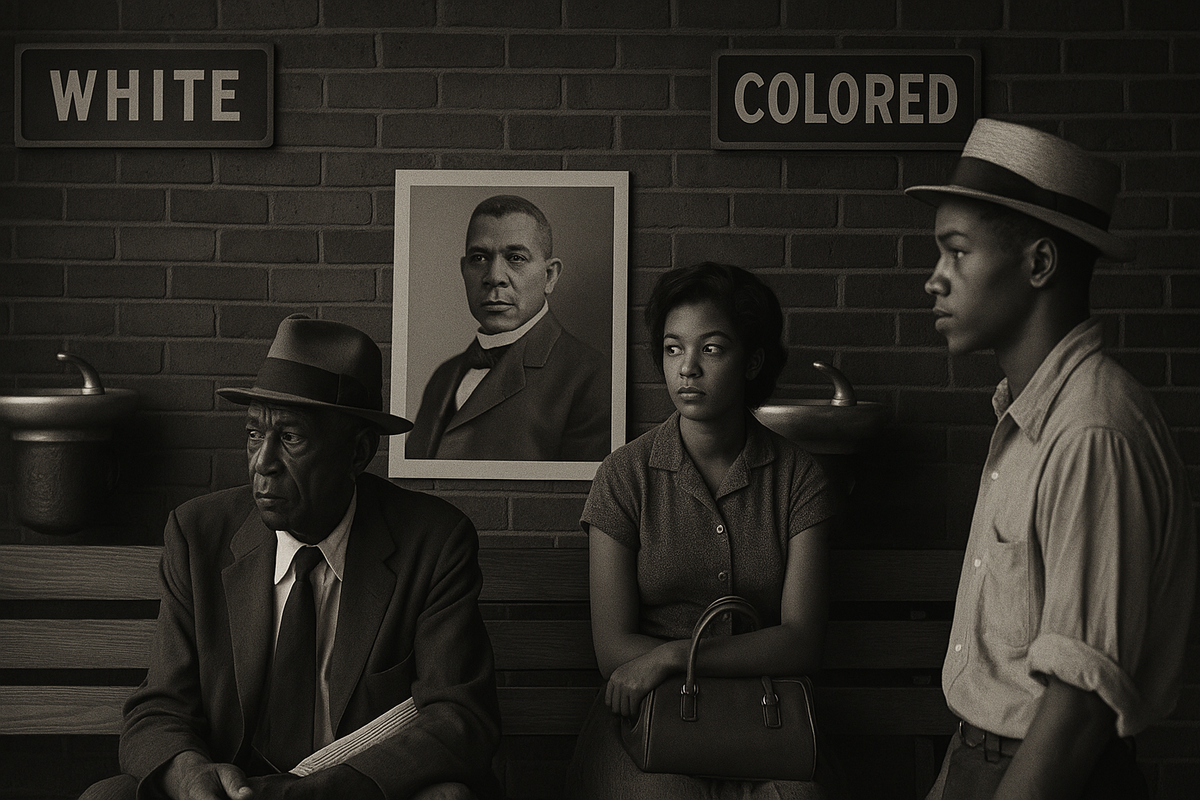
Bennett's essay came illustrated with the visual language of segregation: "WHITE" and "COLORED" signs over water fountains and waiting rooms, stark as a slap. Booker T. Washington at the 1895 Atlanta Exposition, proposing his controversial "compromise" with white power. W.C. Handy, Bessie Smith, Louis Armstrong—artists whose music rose from the same soil that produced Jim Crow's laws.
The photography didn't soften the history. It sharpened it.
What Bennett Understood About Resistance
The essay's most resonant sections connected cultural expression to political survival:
The Blues as Documentation
W.C. Handy's "Memphis Blues" and Bessie Smith's voice didn't just entertain—they testified. Bennett positioned Black music as both art and evidence, proof that creativity persisted under oppression.
The Debate Over Accommodation
Bennett examined Booker T. Washington's Atlanta philosophy—industrial education, economic progress, political patience—without dismissing it or endorsing it. He showed the internal debates within the Black community as serious intellectual work, not footnotes to white history.
George H. White's Prophecy
In 1901, leaving Congress, White predicted that Black Americans would return to political power. Bennett quoted him speaking to a future most white Americans couldn't imagine. Six decades later, that future was arriving.
Visual Documentation
The segregation-era photographs, from water fountain signs to portraits of cultural figures, served as primary historical sources—tangible evidence of a system designed to humiliate and exclude.
Bennett wrote for readers who understood that Jim Crow wasn't just laws—it was the daily calculus of where you could drink water, which door you could enter, whether you'd make it home alive. His essay gave that experience historical weight and narrative shape.
The Archive Endures
Searches for "Ebony magazine August 1962," "vintage Ebony Jim Crow," and "collectible Ebony Civil Rights" continue because these magazines function as more than collectibles. They're heirlooms. Educational resources. Tangible proof that African American experiences were documented on their own terms, in their own voice, even when the rest of American media looked away.
Holding this issue means holding a piece of the conversation that shaped a nation. Bennett's essay didn't predict the future—it explained the past so clearly that readers could understand what they were fighting for.
Why Collectors Hunt This Issue
Historical Timing
Published at the apex of the Civil Rights Movement, it bridges past oppression and present struggle. Readers could trace a direct line from the 1890s to the 1960s—and see that the fight wasn't new, just newly visible.
Bennett's Stature
As one of Ebony's most important editors and historians, Bennett transformed the magazine from entertainment into archive. "The Birth of Jim Crow" ranks among his essential works.
Visual Documentation
The segregation-era photographs, the portraits of cultural and political figures—these images are primary sources now. They're evidence.
Cultural Artifact Status
This isn't a magazine you read and discard. It's a document of African American life that mainstream media largely ignored. It's proof that the story was told, recorded, preserved.
Build Your Archive
From political analysis to cultural celebration, from protest coverage to fashion spreads, Ebony documented the full spectrum of Black American life. These issues aren't just history. They're the primary sources future historians will use to understand who we were.
Browse Ebony Magazine CollectionThe August 1962 issue of Ebony Magazine remains essential. Lerone Bennett, Jr.'s "The Birth of Jim Crow" traced segregation's rise with the precision of a prosecutor and the voice of a witness. For readers in 1962, it clarified the origins of the injustice they were dismantling. For us now, it stands as both historical resource and collectible artifact—a magazine that refused to let America forget how Jim Crow was born, or how hard it would be to kill.