
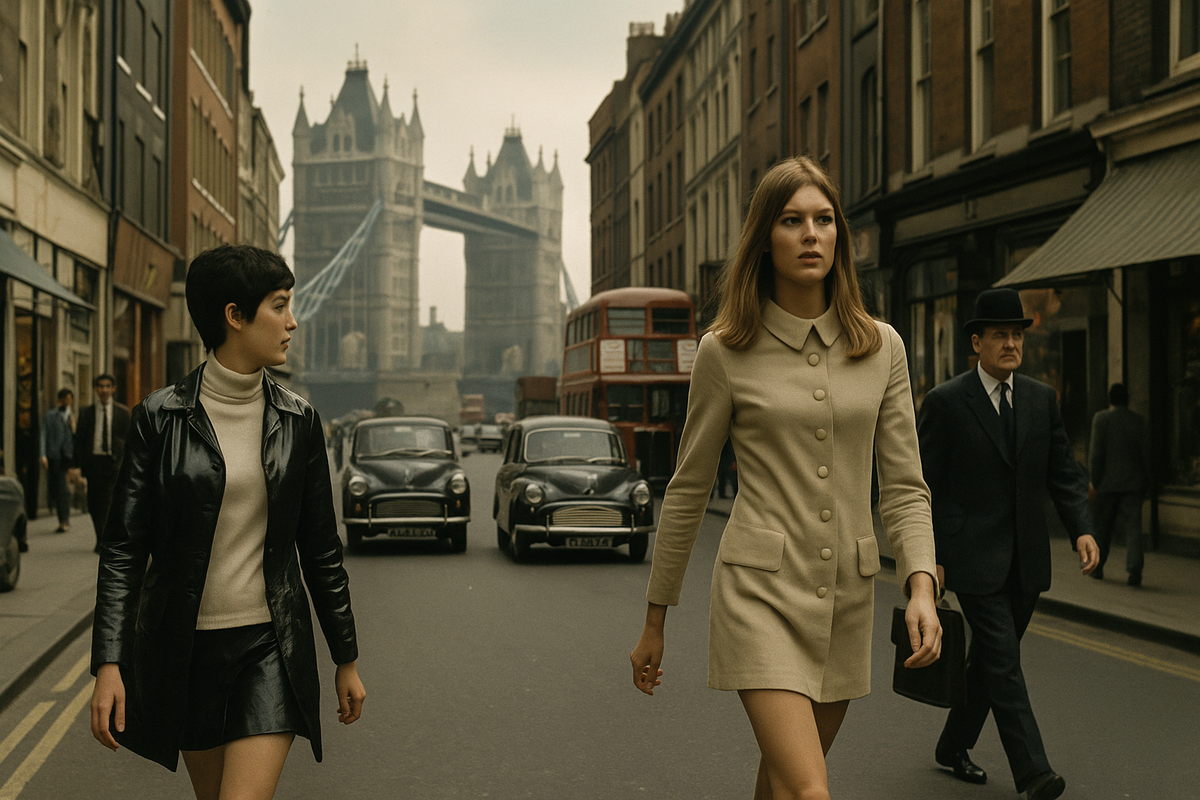
London in the 1960s: Swinging Style, Shifting Politics, and a City at the Center of the World
How Time Magazine captured a capital in transformation—where miniskirts met monarchy and youth culture rewrote the rules of global influence
On April 15, 1966, American newsstands delivered something extraordinary: not just another issue of Time Magazine, but a portal. Inside those pages, London burned with contradictions—a city where bowler hats crossed paths with miniskirts, where centuries-old monarchy collided with a youth revolt that was rewriting the rules of culture itself.
This wasn't foreign correspondence. This was the announcement that an old empire had found a new language.
Issue Archive
Publication: Time Magazine
Issue Date: April 15, 1966
Historical Context: Published immediately following Harold Wilson's landslide Labour victory in the March 1966 general election
Cultural Significance: Definitive documentation of "Swinging London" at its apex
Archive Classification: Political & Cultural Commentary
The Spring That Changed Everything
March 1966 had delivered Harold Wilson a landslide. His Labour Party secured a commanding majority in Parliament, a mandate to drag Britain out of postwar stagnation and into something resembling the future. Wilson promised modernization, economic reform, and relevance for a nation still measuring itself against faded imperial glory.
But Parliament was only half the story.
Beyond Westminster, London was convulsing with a different revolution entirely. The "Swinging Sixties" had arrived in full force—not as metaphor, but as tangible reality on King's Road and Carnaby Street. Chelsea boutiques pushed miniskirts and vinyl raincoats that scandalized traditionalists and electrified the young. Soho clubs pulsed with rock and R&B, their dance floors packed with a generation that had never known rationing, never accepted austerity as destiny.
Yet the old London persisted: swans gliding through St. James's Park, guards motionless outside Buckingham Palace, businessmen in bowler hats striding past Tower Bridge with the same purposeful gait their fathers had perfected. Time captured this unstable equilibrium with remarkable precision, giving American readers a front-row seat to Britain's identity crisis—and its unlikely triumph.
How Time Told the Story
By 1966, Time Magazine wielded singular influence in American journalism. When it turned its lens on a subject, the nation paid attention. This issue delivered London not as abstraction but as visceral experience, blending hard political analysis with the kind of cultural reportage that made readers feel the city's pulse.
The photography was forensic in its detail:
- St. James's Park at dawn, pelicans waiting for spring beside still water—the London of Wordsworth and empire.
- Carnaby Street at noon, shopfronts exploding with color, mannequins draped in bell-bottoms and geometric prints that would define the decade.
- Crockford's gambling club after midnight, chandeliers casting light on the elite at play, old money making peace with new habits.
- Trafalgar Square on election night, Labour supporters diving fully clothed into fountains, democracy as spectacle.
- A Soho discotheque at 2 a.m., bodies packed tight, miniskirts and mod suits blurring into motion under strobe lights.
- Tower Bridge at rush hour, the archetypal Briton—bowler hat, briefcase, impeccable posture—walking past a structure that had watched empires rise and fall.
Time understood what newspapers couldn't: that London in 1966 demanded immersion, not just reportage. These weren't illustrations of a story. They were the story—proof that journalism could function as cultural anthropology.
The Magazine as Mirror and Maker
The April 15, 1966 cover announced its ambition immediately. Inside, the editorial architecture was masterful: seamless movement from Wilson's economic challenges and Britain's uncertain role in Europe to the carnival of Carnaby Street, the avant-garde experiments of Chelsea galleries, the hedonism of Soho after dark.
Time excelled at this alchemy—transforming policy wonkery and nightclub dispatches into a unified argument about power, identity, and cultural export. Where competitors delivered speeches and statistics, Time delivered atmosphere. A curtain at the Sunset Strip club. The jostle of King's Road on a Saturday afternoon. The particular quality of light in a Chelsea boutique at closing time.
This was photojournalism as art form, and it's why issues like this one still command attention six decades later.
What Made This Moment Unstoppable
Wilson's Mandate
Labour's March victory gave the government real authority. Wilson could finally pursue the modernization agenda he'd promised: industrial reform, technological investment, a redefined Britain for the postwar world.
Fashion as Revolution
Carnaby Street and King's Road weren't just retail districts. They were laboratories of identity. The miniskirt, the mod suit, the vinyl raincoat—these weren't trends. They were declarations that youth culture now controlled the global aesthetic conversation.
Nightlife as Export
Soho's clubs and Chelsea's galleries became international destinations. Musicians, designers, and artists converged, transforming London into a cultural capital that rivaled—and in some ways surpassed—New York and Paris.
Tradition Under Siege
The bowler hat still existed, but it was now exotic, almost ironic. Tower Bridge remained magnificent, but the city it connected was unrecognizable from the London of 1946. Continuity and rupture occupied the same streets.
Democracy as Theater
Election night celebrations—candidates like the satirical Lord Sutch, supporters plunging into fountains—revealed a political culture unafraid of spectacle, where democratic participation carried genuine joy and absurdity in equal measure.
Time's implicit argument was impossible to ignore: London wasn't surviving its decline. It was transcending it, claiming a new kind of empire built on culture rather than colonies.
Why Vintage Magazines Still Matter
Time's 1960s coverage endures because it operated at the intersection of journalism and history-making. These weren't just reports. They were interpretations delivered with the confidence that comes from watching events unfold in real time.
In an era when news evaporates within hours, vintage magazines offer something increasingly rare: physical evidence of how the 20th century understood itself. They were read slowly, kept in homes, passed down through generations. They are witnesses with better memories than we have.
Why Collectors Covet This Issue
Historical Precision
Published immediately after the 1966 general election, it documents a political turning point with the urgency of real-time journalism.
Cultural Peak
Few publications captured Swinging London at its apex with this level of detail. From Carnaby Street's aesthetic revolution to Soho's underground energy, this is the era distilled.
Visual Archive
The photography alone justifies ownership. Election night fountains. Chelsea boutiques. Mod fashion as cultural insurgency. These images defined how the world understood London in the '60s.
Collector Demand
Vintage Time issues covering cultural revolutions—London in '66, Paris in '68, Woodstock—consistently attract serious buyers. This isn't nostalgia. It's primary source material.
To hold this issue is to hold a piece of London when it mattered most, when miniskirts carried political meaning and a magazine could make you feel a city you'd never visited.
Explore the Archive
Our collection preserves thousands of original Time issues spanning the 1930s through the 1970s. Each one captures politics, culture, war, and art as they happened—unfiltered by hindsight, undimmed by digital compression.
Browse Time Magazine CollectionWhether you're building a serious collection, researching cultural history, or honoring the memory of the decade that changed everything, these magazines offer direct access to the past. Not as memory. As artifact.
Final Word
The April 15, 1966 Time Magazine remains essential reading for anyone serious about understanding the 1960s. Its coverage of Harold Wilson's victory and Swinging London's cultural dominance delivered both hard analysis and sensory immersion—a combination that defined great journalism in the magazine's golden age.
To own this issue is to own the heartbeat of London at its most influential: the moment when miniskirts, democratic renewal, and musical revolution converged to redefine modern culture. Time's photographers and writers preserved that moment with a clarity that hasn't faded.
For collectors and historians alike, this isn't reading material. It's evidence. And the past it preserves still speaks—if you're willing to listen.