
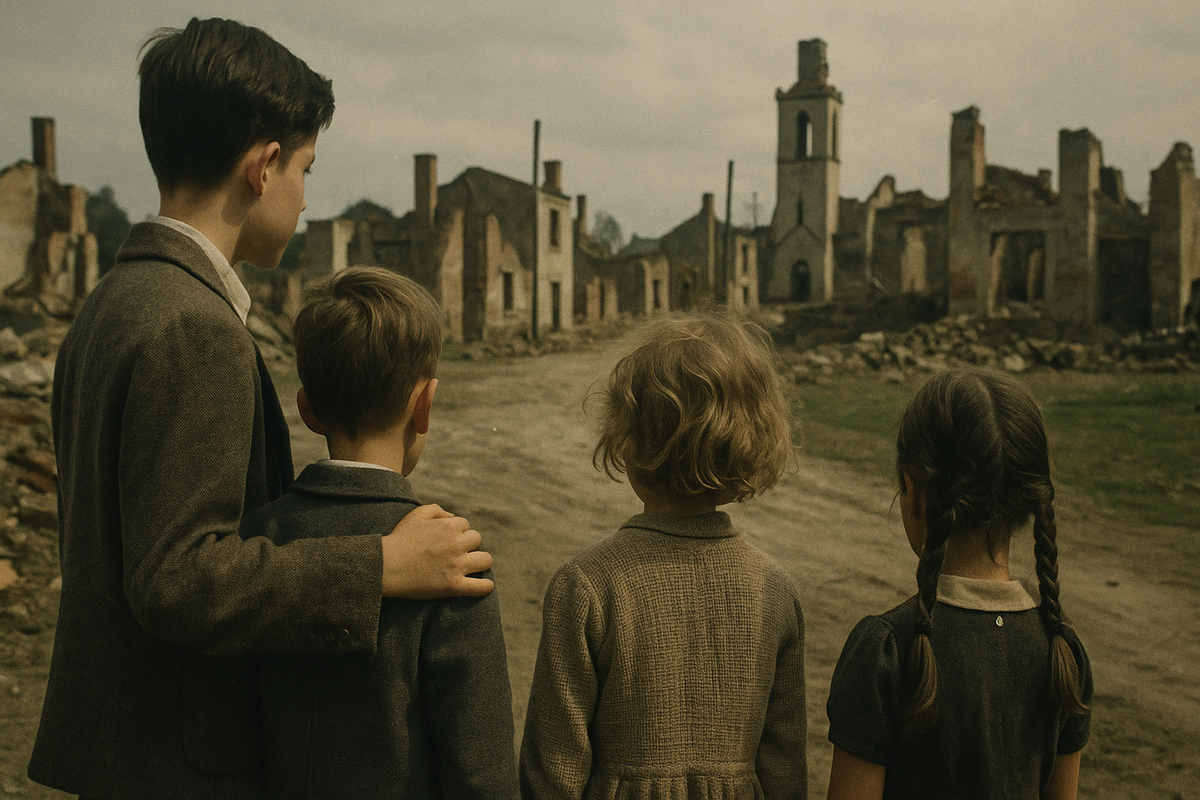
The Silence That Spoke: When The New Yorker Excavated Lidice
How a single 1948 magazine issue transformed atrocity into memory and journalism into witness
On May 1, 1948, Manhattan newsstands carried a magazine that refused to let its readers forget.
Tucked between cartoons and theater reviews, The New Yorker published "The Children of Lidice"—a dispatch so piercing it transformed a quiet spring morning into a reckoning. Six years after Nazi forces erased a Czech village from existence, America's most sophisticated magazine asked its audience a question they couldn't ignore: What does the world owe to the dead?
The timing was surgical. Czechoslovakia had just fallen to Communist control. The Marshall Plan was reshaping Europe's future while its past still smoldered. And here was The New Yorker, holding up a mirror to atrocity when most Americans wanted to look away.
This wasn't journalism. It was an act of witness.
June 10, 1942: The Day Lidice Died
The mechanics of annihilation are precise. After partisans assassinated Reinhard Heydrich—architect of the Final Solution—Nazi forces descended on Lidice with bureaucratic fury. Every man over fifteen was shot. Women were deported to Ravensbrück. Children were sorted: some murdered, others stripped of their names and handed to German families for "Germanization."
Then came the erasure. Houses dynamited. The church leveled. Fields plowed flat. Even the cemetery was destroyed. The Nazis didn't just kill Lidice—they tried to delete it from geography itself.
By 1948, only a handful of children had returned. The rest remained lost in the aftermath, scattered across a continent still counting its dead.
The Archive Record
Publication: The New Yorker
Issue Date: May 1, 1948
Feature: "The Children of Lidice" (Reporter at Large)
Cover Artist: Arthur Getz
Historical Context: Published six years after the Lidice massacre and two months after the Communist takeover of Czechoslovakia
Why This Story, Why Now
The New Yorker didn't traffic in atrocity tourism. Its Reporter at Large feature demanded something rarer: literary journalism that could hold both horror and humanity without collapsing into sentiment.
The article bypassed military statistics to center survivors—widows receiving monthly stipends from a government now under Communist control, children thrust into the role of witnesses before they understood what they were witnessing. Fourteen-year-old Václav Hanf became an unwilling ambassador, carrying Lidice's memory to international audiences while still trying to reconstruct his own childhood.
But the piece's genius lay in its refusal of easy resolution. Czech officials debated whether to rebuild Lidice as a national shrine or leave it unmarked. Survivors wrestled with whether remembering meant healing or reopening wounds. The New Yorker presented these tensions without flattening them, trusting readers to sit with the discomfort.
This was journalism as moral witness—a role the magazine would define for the rest of the century.
The Cover That Knew Too Much
Arthur Getz painted Manhattan in golden light for the May 1, 1948 cover. A quiet street. Ordinary calm. Postwar normalcy returning to American cities.
But place that image beside "The Children of Lidice" and the composition turns sinister. Here is an intact street in a city untouched by war. There is a village plowed into the earth. The juxtaposition wasn't accidental—it was The New Yorker's signature move, holding everyday American life against the century's darkest truths and letting the friction generate meaning.
Getz's cover didn't illustrate the Lidice story. It indicted the distance between those who could forget and those who couldn't.
Inside the Report
The Legacy of Looking Back
The New Yorker became culturally indispensable because it insisted that wit and witness could coexist. The same magazine that ran James Thurber cartoons also published John Hersey's "Hiroshima." It could hold contradiction without diluting either element.
"The Children of Lidice" exemplified this range. In 1948, it refused to let readers retreat into Cold War abstractions while the previous war's children were still searching for their names. Today, it stands as evidence that journalism's first obligation isn't to comfort—it's to remember accurately and report honestly, even when the story offers no resolution.
To read this issue now is to encounter a magazine that understood its responsibility: not just to document history, but to shape how its audience would carry that history forward.
What Collectors Recognize
For the Collector
The May 1, 1948 New Yorker represents a convergence of historical significance, literary achievement, and cultural documentation. Inside these pages: Arthur Getz's haunting cover, Reporter at Large journalism that set the standard for decades to follow, and a moment when one magazine refused to let its readers forget what forgetting would cost.
Browse The New Yorker Magazine CollectionFrom the Jazz Age through the Cold War, each issue preserves not just what was published, but how a generation understood itself.