
The Magazine That Brought the War Home
Life's July 10, 1950 Issue and the First Images of the Korean War
On a summer morning in 1950, Americans opened their mailboxes and found a war staring back at them.
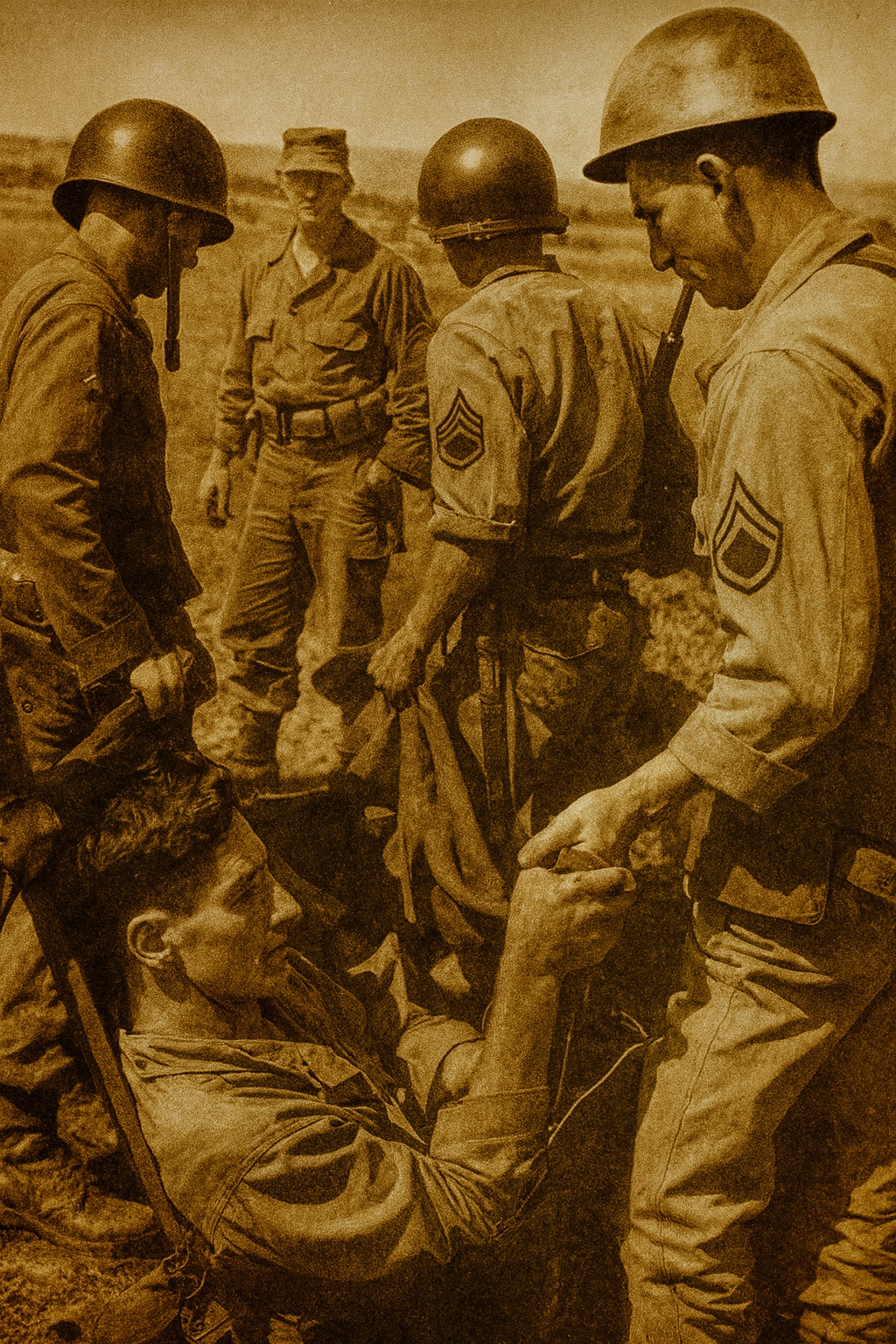
The cover of Life Magazine's July 10 issue showed no triumphant soldiers or waving flags. Instead, Private First Class Thomas Merante—bloodied, half-conscious—was being carried across a South Korean airfield by his fellow troops. Above him, the sky still smoked from the Soviet-built fighters that had just strafed the runway.
The Korean War was two weeks old. American boys were already dying.
For a nation barely five years removed from V-J Day parades and ticker-tape celebrations, the shock was visceral. The Cold War—until now a contest of speeches, espionage, and atomic posturing—had ignited into open combat. And Life, with its unmatched photojournalism infrastructure, had captured the eruption before most Americans even understood what Korea was.
This wasn't reportage. It was a reckoning.
When Peace Shattered Overnight
June 25, 1950. North Korean forces, armed with Soviet T-34 tanks and trained by Russian advisors, crashed across the 38th parallel. Within seventy-two hours, Seoul had fallen. South Korean units—underequipped and overwhelmed—collapsed in retreat.
President Truman didn't hesitate. By June 27, U.S. air and naval forces were committed. Days later, American ground troops landed. There was no congressional debate, no national mobilization, no time to prepare the public. It was an emergency intervention that felt less like strategy and more like reflex.
And then came the magazine.
Life's editors, sensing the magnitude of the moment, dispatched one of their most formidable assets: David Douglas Duncan, a photographer whose work from World War II had already redefined combat journalism. Duncan flew to Korea immediately, embedding with troops as the war unfolded in real time. What he sent back wasn't just documentation—it was witness.
Issue Details
Publication: Life Magazine
Issue Date: July 10, 1950
Cover Story: "U.S. Gets Into Fight for Korea"
Lead Photographer: David Douglas Duncan
Historical Context: Published two weeks after the outbreak of the Korean War on June 25, 1950
The First Five Days: Duncan's Unblinking Eye
Duncan's photo essay, "The First Five Days," occupies the emotional core of the July 10 issue. No captions softened the images. No editorial distance cushioned the impact.
A C-54 transport engulfed in flames, its fuselage crumpled after a strafing run.
South Korean soldiers retreating down cratered roads, their faces hollow with exhaustion.
Refugees flooding Suwon station, clinging to train cars, desperate to escape the advancing front.
American pilots—grim, unshaven—preparing to fly against an enemy that outnumbered them in the air.
These weren't posed military portraits. Duncan captured chaos: the smoke, the flight, the improvisation of a war being fought without plan or preparation. His photographs carried a truth that no wire service dispatch could match—they made the war felt.
And then there were the civilians. Families hauling bundles on their backs. Children perched on their parents' shoulders. An elderly couple being pulled on a cart by their son, fleeing south with nothing but what they could carry. Duncan's lens didn't flinch. War, he showed, was not a series of battles. It was dislocation on a human scale.
What Americans Saw
Inside the issue, Life constructed a narrative that balanced military action with human cost. The magazine's editorial voice—confident, clear, morally certain—guided readers through the opening week of combat without simplifying the stakes.
U.S. Casualties in the First Wave
The magazine made no attempt to shield readers from the reality that American soldiers were already wounded and killed within days of landing. For families whose sons had just shipped out, this was the first confirmation that Korea would not be a brief police action.
MacArthur and Rhee at the Front
Photographs of General Douglas MacArthur surveying the battlefield alongside South Korean President Syngman Rhee and senior commanders—Major General Edward Almond, Brigadier General John Church—conveyed both urgency and uncertainty.
Airfield Under Attack
Duncan's images of burning transport planes and scrambling ground crews illustrated how quickly air superiority had been contested. Soviet-trained pilots in Yak fighters were engaging American forces directly—a sobering escalation that brought Moscow's shadow into sharp focus.
The Refugee Crisis
Perhaps the most haunting spreads showed the human tide fleeing southward: endless columns of displaced families, clogging roads, overwhelming rail stations, carrying everything they owned. These images gave the war a face beyond soldiers and strategy.
Together, the photographs and reporting in this issue achieved something rare in journalism: they delivered not just information, but atmosphere. Readers didn't simply learn about the Korean War—they absorbed its texture, its panic, its stakes.
The Permanence of Print
In 1950, television was still a novelty. Network news was in its infancy. Radio delivered headlines, but it couldn't show you the war. Life Magazine, arriving in mailboxes every week, offered something irreplaceable: immediacy preserved.
Families could study Duncan's photographs at their kitchen tables, pass them between hands, return to them again and again. The images didn't vanish after the broadcast ended. They stayed—physical, permanent, undeniable.
That permanence is why vintage Life magazines endure as historical artifacts. They aren't disposable media. They're time capsules, locking in not just events but the way those events were first understood.
Why This Issue Matters to Collectors
Historical Timing
Published within two weeks of the outbreak, this issue represents the first major American illustrated account of Korea. It captured the war not as history, but as breaking news—raw, unprocessed, urgent.
Duncan's Legacy
David Douglas Duncan's Korean War photography set the standard for combat photojournalism in the second half of the 20th century. His images from this issue are studied in journalism schools, referenced in military histories, and exhibited in museums worldwide.
Cold War Milestone
Korea was the first armed confrontation of the Cold War—the moment when ideological rivalry became shooting war. This issue documents that pivot point with unmatched immediacy.
Cultural Memory
For families with relatives who served in Korea, this magazine is more than a collectible. It's a tangible link to the experiences of a generation that fought in what would later be called "The Forgotten War."
Market Demand
Like issues covering Pearl Harbor, D-Day, or V-J Day, the July 10, 1950 Life commands consistent interest from collectors, historians, and institutions. Its value lies not in rarity, but in relevance—it captured a turning point that still resonates.
To hold this issue is to hold the moment the Cold War turned hot.
Explore the Collection
If you're drawn to this era—whether as a collector, a historian, or someone honoring the memory of a family member who lived through Korea—vintage Life magazines offer an unmediated connection to the past.
These aren't reprints or digital archives. They're original issues, preserved across decades, carrying the ink and paper that Americans held in 1950. For serious collectors, they're irreplaceable. For history enthusiasts, they're essential. For families with Korea veterans, they're sacred.
Browse Life Magazine CollectionThe Magazine That Wouldn't Look Away
The July 10, 1950 issue of Life Magazine did what great journalism is supposed to do: it bore witness. It brought the war home before most Americans understood there was a war to come home from. It didn't editorialize or soften or wait for official narratives to solidify. It showed what was happening—immediately, unflinchingly, completely.
David Douglas Duncan's photographs gave the Korean War its first visual language. Life's editors gave that language context and weight. Together, they produced a document that remains, seventy-five years later, one of the defining artifacts of the early Cold War.
To read this issue today is to understand how quickly peace can collapse, how human suffering defines every conflict, and how photojournalism—at its best—doesn't just record history. It preserves its rawness, its urgency, its truth.
The Cold War turned hot in Korea. Life Magazine made sure America couldn't look away.