
The Dream Match, The Critics, and Wrestling's Battle for Supremacy
January 1992. Pro Wrestling Illustrated drops a grenade disguised as a magazine.
The headline alone was a declaration of war: "He'll Make Hulk Hogan Look Like an Amateur." For wrestling fans accustomed to WWF's carefully controlled narratives, this wasn't promotional copy—it was heresy. And it was exactly what the moment demanded.
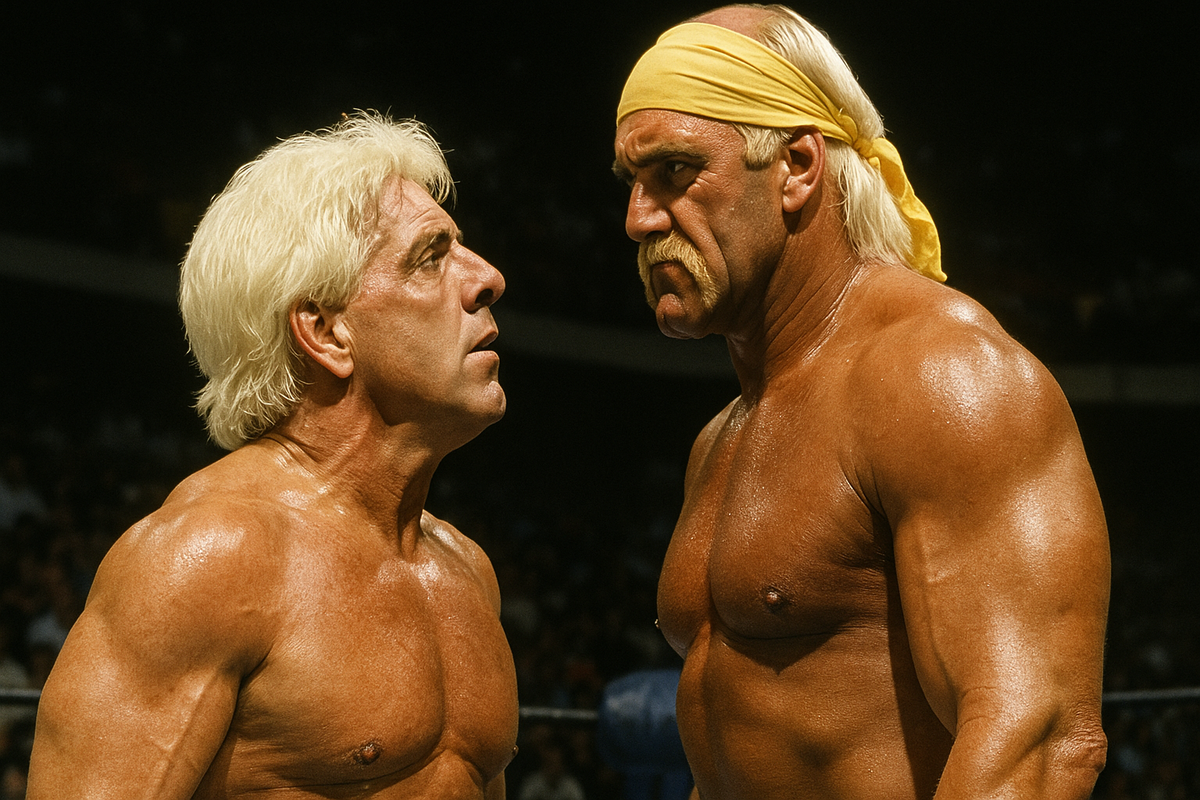
Ric Flair had just walked into Vince McMahon's empire carrying the "Big Gold Belt" and a résumé that read like a touring thesis on what wrestling could be. Hulk Hogan, meanwhile, stood as the most recognizable face in the industry's history—a man who had turned bodyslams into box office gold. The dream match wasn't just anticipated. It was necessary. And PWI understood that this collision would settle more than a championship. It would decide wrestling's identity.
This issue didn't just report the story. It became part of it.
When Two Philosophies Collide
The early 1990s marked the funeral of wrestling's territorial system. Vince McMahon's WWF had steamrolled regional promotions, transforming professional wrestling from a collection of traveling shows into a singular, global entertainment brand. But Flair represented something the WWF machine hadn't yet absorbed: the idea that wrestling could be both spectacle and sport, that a match could tell a story through technical mastery rather than just cartoon characters and one-liners.
By 1991, Flair's departure from WCW—disputed title belt in hand—created a crack in wrestling's narrative universe. When he appeared in the WWF as the "Real World's Champion," the kayfabe walls started to tremble. Two champions. Two philosophies. One ring.
PWI's feature captured this fracture with surgical precision. Writer Liz Hunter didn't just hype a fight—she framed a cultural referendum. Flair, the craftsman who had logged tens of thousands of miles across America and Japan, perfecting his art in front of crowds who demanded more than posing. Hogan, the phenomenon who had made wrestling mainstream but whose opponents increasingly looked like props rather than threats.
The question wasn't if they would fight. The question was whether wrestling fans cared about legitimacy anymore—or whether Hulkamania had permanently rewritten the rules.
Archive Profile
Publication: Pro Wrestling Illustrated
Issue Date: January 1992
Featured Article: "He'll Make Hulk Hogan Look Like an Amateur"
Writer: Liz Hunter
Historical Context: Published during Ric Flair's WWF debut with the "Big Gold Belt"
Why Pro Wrestling Illustrated Mattered
Pro Wrestling Illustrated earned its authority by refusing to be a house organ. While WWF Magazine existed to sell tickets and action figures, PWI operated in the space between insider knowledge and fan service. It maintained kayfabe where necessary but treated wrestling like a beat worth covering seriously—complete with rankings, critical analysis, and a willingness to compare promotions, eras, and styles.
The Flair vs. Hogan feature demonstrated this approach at its peak. Hunter assembled a jury of wrestling royalty: Buddy Rogers, Lou Thesz, Dory Funk Jr., Ron Garvin. These weren't celebrity endorsements. They were expert witnesses testifying to Flair's credibility in a way that couldn't be dismissed as promotional noise.
Rogers, the original "Nature Boy," predicted Hogan would be exposed. Thesz, the sport's purist philosopher, backed Flair's technical arsenal over Hogan's size and charisma. Funk emphasized Flair's adaptability—his ability to wrestle any style, anywhere, against anyone. Garvin, who had survived grueling wars with Flair in the mid-80s, vouched for a toughness that transcended ring psychology.
The photography reinforced the argument. Images of Flair grappling with Harley Race, battling Ronnie Garvin, clashing with Tatsumi Fujinami in Japan—these weren't just action shots. They were evidence. Compare them to Hogan's recent opponents: Earthquake, Sgt. Slaughter, The Warlord. Larger-than-life characters, certainly. But did any of them make Hogan work?
PWI transformed speculation into scholarship. It gave fans permission to think critically about wrestling without abandoning their love for it.
The Visual Case for Flair
The issue's design understood that this wasn't just another match preview—it was a reckoning. Bold typography framed Flair's challenge as something between a sporting event and a historical verdict. Full-page photographs captured the signature intensity of Flair's in-ring work: the desperation in a figure-four leglock, the precision of a knife-edge chop, the sweat-soaked theater of a sixty-minute draw.
The visual contrast told its own story. Flair's opponents looked like they'd been through a war. Hogan's opponents looked like they'd been through a movie.
Inside, PWI deployed its editorial strengths with precision:
Layered storytelling that respected kayfabe while acknowledging the smart fans who read between the lines. The article didn't break character, but it didn't insult anyone's intelligence either.
Global context through exclusive photography documenting Flair's career across territories and continents—proof that his legend wasn't regional mythology but international fact.
Authoritative voices that anchored the debate in wrestling's actual history, not just WWF's version of it.
Unlike television broadcasts, which existed to sell the next pay-per-view, PWI created space for fans to engage wrestling as a living tradition with credibility on the line.
The Jury Speaks
The article's power lay in its witnesses—legends who had no reason to lie and every reason to protect the business they'd helped build:
The Magazine That Understood Wrestling's Soul
Pro Wrestling Illustrated survived decades of industry upheaval because it treated wrestling as something worth taking seriously—not despite its predetermined outcomes, but because of how those outcomes connected to larger questions about performance, athleticism, and storytelling.
The January 1992 issue remains vital because it asks questions wrestling still hasn't fully answered: What happens when legitimacy confronts spectacle? When craft meets charisma? When the wrestler's wrestler finally faces the people's champion?
Flair and Hogan did eventually meet—at house shows, on pay-per-view, in rematches scattered across years. But the idea of their collision, the philosophical weight PWI gave it in this issue, still resonates. Because the magazine understood that the best dream matches aren't settled in the ring. They're settled in how fans remember them.
Why This Issue Endures
Vintage PWI issues tied to watershed moments command serious collector interest because they represent more than the stars on the cover. They document the fan culture that made those stars matter.
Explore Wrestling's Golden Age
Original Pro Wrestling Illustrated magazines from the 1970s through the 1990s documented wrestling's greatest rivalries, champions, and cultural turning points. From territorial legends to mainstream superstars, these issues preserve the debates that shaped the industry.
Browse PWI Magazine CollectionWhether you're a collector seeking specific eras, a historian researching wrestling's evolution, or a fan rediscovering the Flair-Hogan rivalry, these magazines remain the most authoritative primary sources for understanding wrestling's golden debates.
The Verdict That Never Came
The January 1992 issue of Pro Wrestling Illustrated stands as one of wrestling journalism's defining achievements. By positioning Ric Flair's technical mastery against Hulk Hogan's cultural dominance, PWI gave fans a framework for understanding wrestling's existential tension—the eternal war between what the sport was and what it had become.
Holding this issue means holding wrestling at its crossroads. The moment when the "Nature Boy" and Hulkamania were measured not just against each other, but against history itself.
For anyone who values wrestling's past, vintage PWI magazines aren't collectibles. They're testimony—evidence that once upon a time, the outcome actually mattered.