
When a Magazine Held the Weight of 700 Lives
Inside the February 25, 1950 Saturday Evening Post and the Naval Tragedy That Changed American Military Policy Forever
The reader who unfolded the February 25, 1950 issue of The Saturday Evening Post wasn't prepared for what waited inside.
Behind the cover—a Norman Rockwell-style illustration of a boy squirming in his Sunday suit—lay sixteen pages that would become one of the most searing pieces of naval journalism in American history. "The Terrible End of the U.S.S. Juneau" wasn't just an article. It was a reckoning.
Seven years after the light cruiser vanished beneath the South Pacific in twenty seconds, taking nearly 700 sailors with it, the Post gave America what it had been denied: the full story. Not the sanitized communiqué. Not the patriotic abstraction. The names. The faces. The oil-slicked water. The sharks. The five brothers from Waterloo, Iowa, who went down together because the Navy let them serve together.
This issue didn't just report history. It detonated it into the American living room.
The Battle That Couldn't Be Lost
Guadalcanal was where the Pacific War pivoted. After Pearl Harbor and the humiliating retreat across the Pacific, the August 1942 invasion of this malarial jungle island represented the first American counteroffensive against Imperial Japan. Control of Guadalcanal meant control of the sea lanes to Australia. Losing it was unthinkable.
By November 13, 1942, the naval campaign had devolved into savage night battles off the island's coast—what sailors grimly called "Ironbottom Sound" for the graveyard of warships accumulating below. The USS Juneau (CL-52), a brand-new Atlanta-class light cruiser, had already taken one torpedo during the chaotic engagement. Damaged but seaworthy, she limped into formation with the surviving American task force as they withdrew north at dawn.
Then the Japanese submarine I-26 found her.
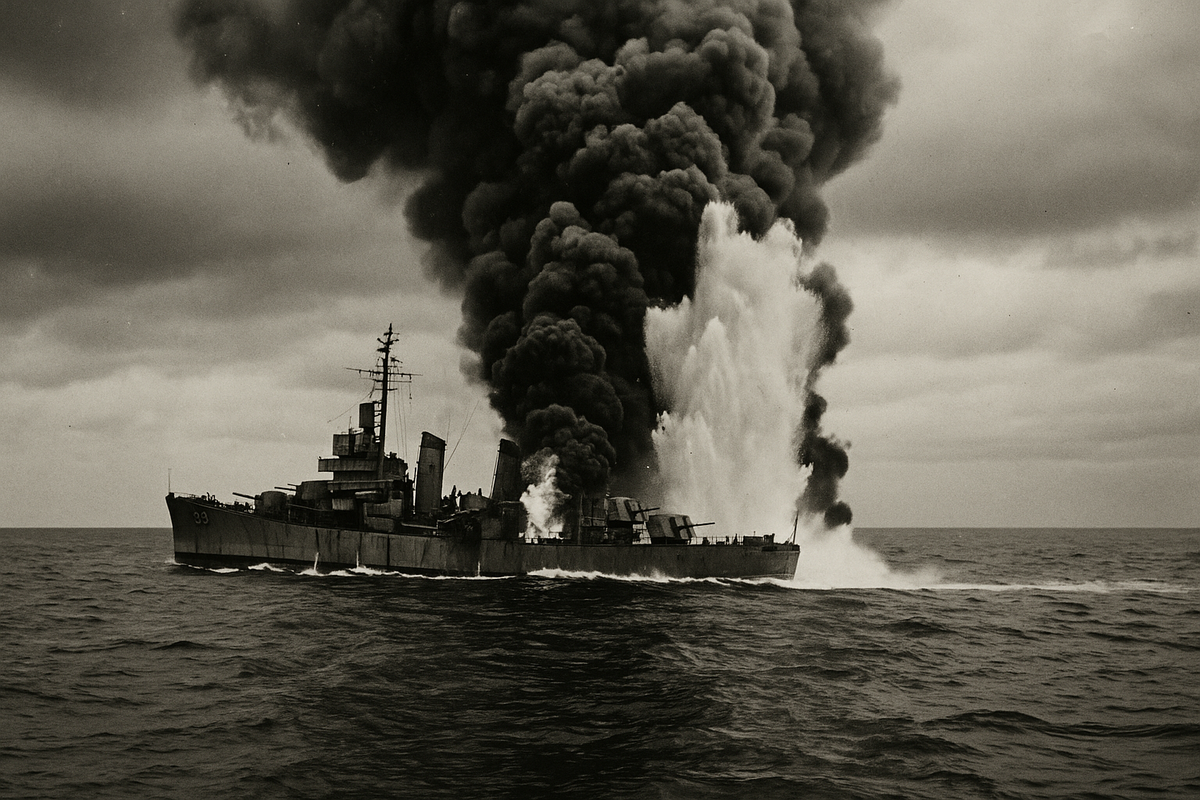
The second torpedo struck the Juneau's magazine. Witnesses on nearby ships described an explosion so massive it resembled a small atomic detonation—a fireball that consumed the entire vessel in an instant. When the smoke cleared, there was no wreckage. No debris field. No screaming survivors clinging to flotsam.
Just empty ocean where 700 men had been.
The Brothers Who Changed Everything
George Thomas Sullivan, 27. Francis Henry Sullivan, 26. Joseph Eugene Sullivan, 23. Madison Abel Sullivan, 22. Albert Leo Sullivan, 20.
Five sons of Thomas and Alleta Sullivan of Waterloo, Iowa. Five brothers who enlisted together the day after Pearl Harbor with one non-negotiable condition: they would serve on the same ship. The Navy, eager for the publicity of such patriotic unity, agreed. Regulations technically prohibited it, but regulations bent during wartime.
The Juneau became their collective assignment and their collective tomb.
When the ship exploded, George Sullivan—according to survivor testimony published in the Post—made a choice that would haunt the nation. Rather than attempt escape, he remained "among the oil-smeared dead," choosing to die with his brothers rather than live without them.
The Sullivan family received five telegrams. Five folded flags. Five gold stars for their window.
And the U.S. military received a policy overhaul. The Sole Survivor Policy, formalized in the wake of this catastrophe, was designed to prevent any American family from enduring such wholesale annihilation again. The Sullivans' tragedy didn't just break a family—it broke a system.
The Historical Record
Vessel: USS Juneau (CL-52), Atlanta-class light cruiser
Date of Loss: November 13, 1942
Location: South Pacific, off Guadalcanal
Casualties: Approximately 690 of 700 crew members
Magazine Issue: The Saturday Evening Post, February 25, 1950
Article: "The Terrible End of the U.S.S. Juneau" (double-length feature)
Policy Impact: Direct catalyst for the Sole Survivor Policy
Ten Against the Sea
Of approximately 700 men aboard the Juneau, only ten survived.
The Post gave those ten men a voice. Lt. Charles Wang. Frank Holmgren. Allen Heyn. Sailors who spent days adrift on rafts and wreckage, surrounded by sharks that circled with appalling patience. Men who watched shipmates dragged under or lose their minds to thirst, drinking seawater and babbling at hallucinations before slipping beneath the surface.
The most haunting detail: rescue was delayed. Other American ships, fearing additional Japanese submarine attacks, did not stop to search for survivors. A passing B-17 crew spotted the rafts and reported them, but confusion and miscommunication meant rescue aircraft didn't arrive for days. By then, most of the men who'd survived the initial blast had died of exposure, dehydration, or predation.
The article's photographs crystallized this horror with brutal intimacy. Images of the Sullivan brothers in their dress whites, grinning with the invincibility of young men. Battle shots of the Juneau maneuvering under fire just weeks before her destruction. And perhaps most poignant: Allen Heyn, one of the ten, photographed at home with his wife and infant child—a study in contrasts between the abyss he'd survived and the ordinary miracle of continued life.
Why The Saturday Evening Post Mattered
By 1950, the Post occupied a unique position in American media. It wasn't Life's photojournalism. It wasn't The New Yorker's literary sophistication. It was something more essential: the voice of mainstream America talking to itself about what it meant to be American.
Founded in 1821 and reimagined by editor George Horace Lorimer in the early 20th century, the Post had become the nation's storyteller-in-chief. Norman Rockwell painted its covers. F. Scott Fitzgerald and William Faulkner published in its pages. It serialized novels, investigated corruption, celebrated small-town values, and—crucially—served as the bridge between wartime sacrifice and postwar memory.
The February 25, 1950 issue exemplified this balancing act. The cover showed domestic comedy: a mortified boy dressed up like a miniature adult. Inside, readers confronted one of the war's darkest moments, rendered with unflinching detail. This wasn't tonal whiplash—it was editorial philosophy. The Post trusted its audience to hold both truths simultaneously: that life goes on, and that some losses never stop echoing.
The double-length Juneau article represented journalism as memorial. It gave the dead names and faces. It gave the survivors testimony. It gave the nation a way to process grief that the wartime censors had never permitted.
What the Article Revealed
The Instant Sinking
The Juneau vanished in twenty seconds after the second torpedo strike—an explosion so massive witnesses compared it to an atomic detonation.
George Sullivan's Final Choice
Rather than attempt escape, George chose to remain "among the oil-smeared dead" with his brothers.
Ten Against 700
Only ten men survived out of approximately 700, facing days adrift surrounded by sharks and dying shipmates.
The Delayed Rescue
Fear of additional submarine attacks prevented immediate rescue, condemning hundreds of survivors to death by exposure and predation.
Survivor Testimonies
Lt. Charles Wang, Frank Holmgren, and Allen Heyn recounted the ordeal in harrowing first-person detail.
Policy Transformation
The Sullivan tragedy directly inspired the Sole Survivor Policy, preventing future wholesale family losses.
What Endures
The Juneau tragedy persists in American memory because it compressed every horror of naval warfare into a single, comprehensible moment. Abstract casualty statistics became five brothers' names. Strategic necessity became men dying of thirst within sight of rescue. Policy failure became gold star mothers who lost their entire male lineage in twenty seconds.
The Saturday Evening Post understood its responsibility: to make sure those men didn't vanish twice—once into the Pacific, and again into historical amnesia.
Seventy-five years later, holding this issue means holding that responsibility. The paper has yellowed. The photographs have faded. But the names remain. George, Francis, Joseph, Madison, Albert. Lt. Wang. Frank Holmgren. Allen Heyn and his baby daughter.
They're still there, waiting between the pages, expecting to be remembered.
Collector Significance
Historical Timing
Published just seven years after the tragedy, this issue captured living memory before it calcified into myth—survivor testimonies still raw with trauma.
The Sullivan Connection
Issues tied to the Sullivan brothers' story command premium prices among collectors, historians, and military museums.
Editorial Range
The juxtaposition of a humorous cover with sixteen pages of unflinching wartime journalism exemplifies the Post at its cultural apex.
Primary Source Document
Not a retrospective or reinterpretation—this is the first major civilian publication to tell the full story, published when that story could still burn.
Explore the Archive
This issue represents just one thread in the Post's chronicle of 20th-century America. From the Roaring Twenties through the Cold War, these magazines documented not just events but the texture of American life.
Browse The Saturday Evening Post Magazine CollectionOriginal issues • Authenticated artifacts • Direct connection to history
The February 25, 1950 issue of The Saturday Evening Post accomplished what the best journalism always does: it made the unbearable bearable by refusing to look away. It gave 700 dead sailors their names back. It gave ten survivors their voices. It gave one Iowa family a place in the national memory that policy changes alone could never provide.
We're still carrying it. The magazine made sure of that.