
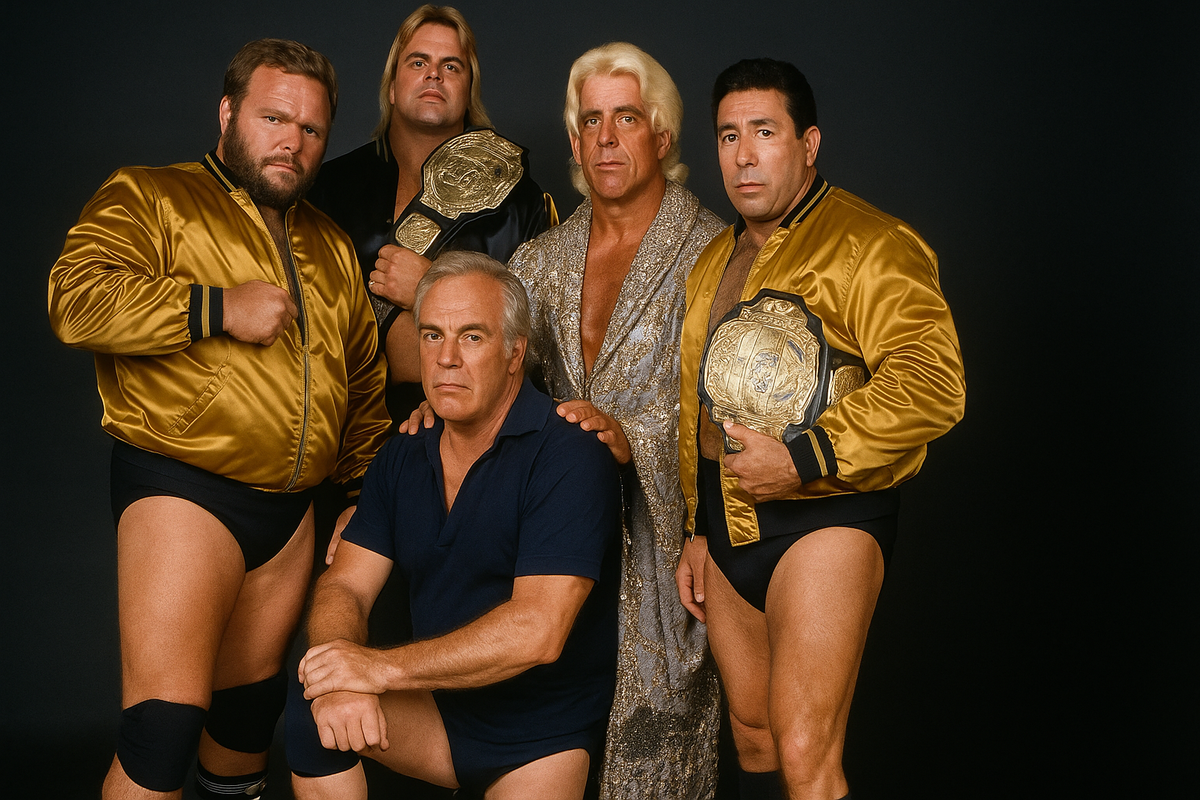
The Dynasty on the Brink
Inside Pro Wrestling Illustrated's Autopsy of The Four Horsemen's 1988 Implosion
December 1988. Pick up that month's Pro Wrestling Illustrated, and you weren't just holding a magazine—you were holding a smoking gun.
Right there on the glossy pages: "The Four Horsemen's Revolving Door — Who's the Next to Go?" It wasn't speculation. It was a death watch for wrestling's most lethal faction, published while they still held every major championship in the National Wrestling Alliance. Champions. Untouchable. And according to PWI's reporting, already tearing themselves apart from the inside.
This was wrestling journalism at its apex—the moment when kayfabe met investigative storytelling, and fans got a front-row seat to a power structure eating itself alive.
The Empire Cracks While Holding All the Gold
By late 1988, The Four Horsemen controlled everything. Ric Flair wore the NWA World Championship. Arn Anderson and Tully Blanchard held the World Tag Team titles. Barry Windham gripped the United States Championship. Manager J.J. Dillon orchestrated it all from ringside, a puppeteer in a three-piece suit.
On paper, this was dynasty at full strength. In reality—and PWI saw it first—it was a powder keg.
The magazine's feature dissected the fractures with surgical precision. Arn Anderson, tired of living in Flair's spotlight, reportedly questioned his place in the hierarchy. Tully Blanchard bristled at Flair's ego, frustrated that his own dominance played second fiddle to "The Nature Boy's" championship theatrics. Barry Windham, the group's newest and youngest weapon after his shocking April 1988 betrayal of Dusty Rhodes, cared more about establishing his U.S. Title reign than stable politics.
And Flair? The world champion was furious that his stablemates wouldn't rally to his defense during title matches—too busy protecting their own gold to safeguard his.
PWI didn't just report these tensions. It framed them as the natural consequence of putting four alpha predators in the same cage. This wasn't gossip. This was organizational psychology disguised as wrestling coverage.
The Issue in Focus
Publication: Pro Wrestling Illustrated
Issue Date: December 1988
Feature Article: "The Four Horsemen's Revolving Door — Who's the Next to Go?"
Historical Significance: Documented the internal collapse of wrestling's most powerful faction at the height of their championship dominance
Archive Source: Original 20th century magazine collection
The Revolving Door: A Faction Built on Betrayal
The Horsemen's instability wasn't new—it was structural. PWI understood this, and the December 1988 issue traced the pattern with forensic clarity.
Ole Anderson, one of the original Horsemen, had been forced out in 1987 due to family commitments. His replacement? Lex Luger, the sculpted "Total Package" who embodied the Horsemen's new-money arrogance. But Luger's tenure lasted mere months. After blaming Dillon for costing him a U.S. Title shot at Starrcade '87, Luger turned on the group and became one of their most dangerous enemies.
Enter Barry Windham. His arrival wasn't just a roster move—it was a narrative earthquake. Windham had been Dusty Rhodes' protégé, his tag team partner, his son in everything but blood. When he turned on Rhodes in April 1988 and joined Flair's faction, it wasn't just betrayal. It was patricide. PWI captured the aftermath: Windham's youth and athleticism gave the Horsemen fresh menace, but his priorities were solo glory, not collective dominance.
The magazine also highlighted an overlooked fracture point: Anderson's public comments about his friendship with Bobby Eaton of the Midnight Express had angered Dillon, exposing how even minor loyalty disputes threatened the group's cohesion.
PWI's conclusion? The Horsemen weren't just capable of self-destruction. They were designed for it.
Why PWI Mattered: The Authority That Made Wrestling Real
In 1988, Pro Wrestling Illustrated occupied a space no publication has held since. It wasn't a promotional tool like WWF's glossy programs. It wasn't an insider newsletter for hardcore tape traders. It was wrestling's newspaper of record—the publication that treated the sport as legitimate competition while providing the analysis fans craved.
PWI maintained kayfabe religiously, reporting on feuds and championships as if the outcomes weren't predetermined. But it also offered something deeper: context, rankings, investigative features that connected dots across territories. The annual PWI 500 rankings gave wrestlers from Memphis to Japan equal legitimacy. Star profiles and multi-page features like the Horsemen exposé provided narrative architecture that individual promotions couldn't—or wouldn't—deliver.
The magazine's photography reinforced this authority. No cartoon illustrations or campy graphics. Instead: black-and-white action shots that felt like wire service photos from a war zone. The December 1988 Horsemen feature included group shots documenting the faction's shifting lineup, images of Luger's betrayal mid-punch, double-team sequences from Anderson and Blanchard, and Dillon's ringside fury frozen in a grimace.
These weren't just pictures. They were evidence in PWI's case that the Horsemen were imploding.
A Time Capsule From Wrestling's Last Territorial War
The December 1988 issue arrived at a critical inflection point. Vince McMahon's WWF had already conquered national television, turned WrestleMania into a cultural phenomenon, and made Hulk Hogan a household name. The old territorial system—dozens of regional promotions operating as loose confederations—was collapsing under the weight of McMahon's expansion.
Jim Crockett Promotions and the NWA represented the last serious resistance. And at the center of that resistance stood The Four Horsemen—a faction that embodied regional wrestling's old-guard elitism and technical supremacy. They were the antithesis of Hogan's red-and-yellow heroism. They represented wrestling as sport, not cartoon.
PWI's feature on their internal chaos wasn't just wrestling journalism. It was war correspondence from a dying empire.
The Collector's Lens: Why This Issue Endures
The Horsemen are arguably wrestling's most influential faction. Any PWI issue dissecting their story becomes essential reading for historians studying how wrestling's power structures functioned—and failed.
The group photos and action shots preserve a roster in constant flux. Ole Anderson's departure. Luger's betrayal. Windham's shocking turn. These images document changes that happened so rapidly, some fans at the time couldn't track them without PWI's help.
This issue shows how fans consumed wrestling news before online spoilers and social media. PWI was the source. Owning this magazine means owning the lens through which 1988 audiences understood their sport.
PWI's reputation as wrestling's most credible publication elevates every issue beyond mere nostalgia. These aren't magazines—they're historical records, the equivalent of finding original broadsheets from a major political scandal.
For anyone building a collection focused on wrestling's golden age, NWA history, or the evolution of sports journalism, this issue is non-negotiable.
The Legacy: When Magazines Documented History as It Happened
Like High Times preserving counterculture or Life capturing wartime America, Pro Wrestling Illustrated documented wrestling's most dramatic eras with clarity and authority. Its pages remain relevant not because they're nostalgic, but because they're true—the most accurate snapshot of how wrestling's story unfolded before revisionist history, DVD documentaries, and Wikipedia rewrites.
The Horsemen would continue their cycle of betrayal and reformation for years. But in December 1988, PWI captured the exact moment when success stopped being enough, when holding every championship couldn't prevent the dynasty from cannibalizing itself.
That's the story worth preserving. That's the magazine worth owning.
Own a Piece of Wrestling's Documentary Record
If you collect wrestling history, cultural artifacts from the 1980s, or vintage sports journalism, Pro Wrestling Illustrated represents the gold standard. From Horsemen drama to Attitude Era chaos, PWI documented every era with authority that no modern publication has matched.
Browse Pro Wrestling Illustrated Magazine CollectionThese aren't reading materials. They're primary sources—the magazines that told wrestling's story when the story was still being written. Whether you're researching, collecting, or reliving the era when wrestling felt dangerous and real, PWI remains the essential text.
The Horsemen's revolving door keeps spinning in memory. But in December 1988, PWI stopped the frame and showed us exactly what betrayal looked like at the top.