
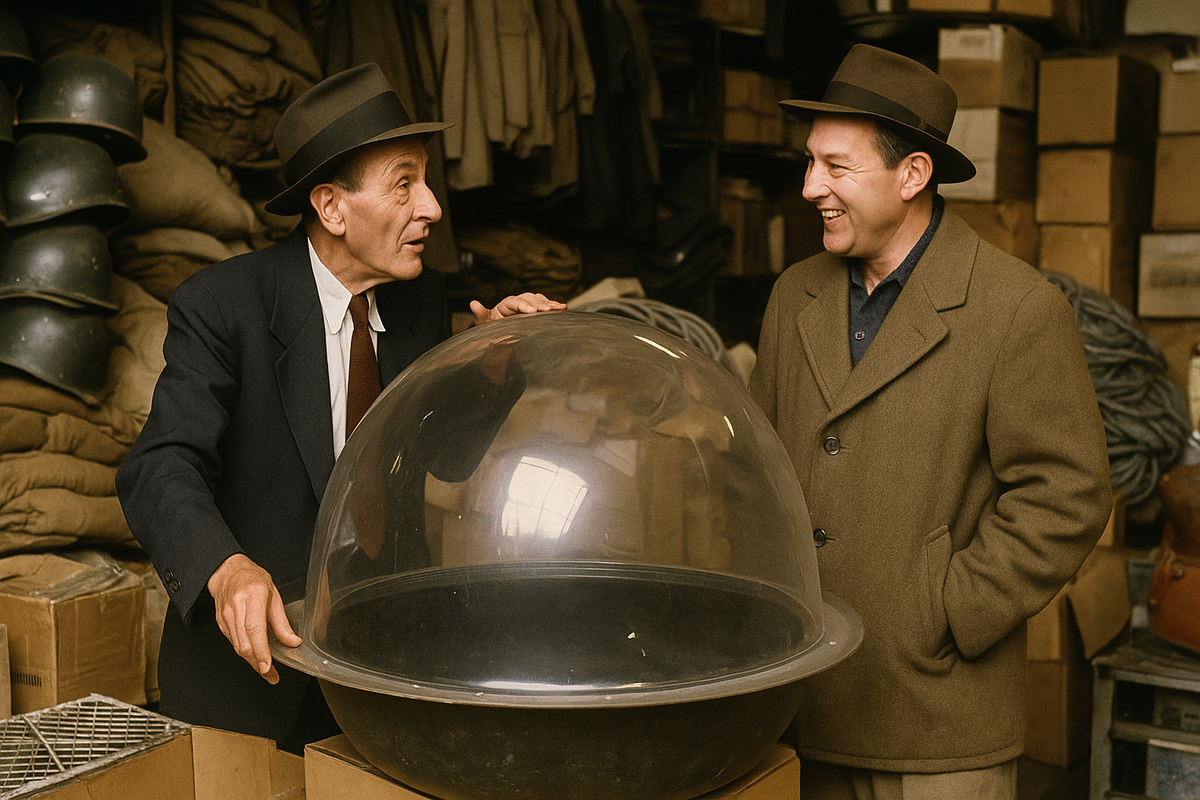
The Bomber Dome That Became a Fish Pond
Inside America's Postwar Junk Economy and the Hustlers Who Turned Military Surplus into Gold
Archive Details
On January 2, 1954, The Saturday Evening Post published a story that would have seemed absurd if it weren't so perfectly American. Morton M. Hunt's feature article, "There's Nothin' That Can't Be Sold," documented a booming underworld of surplus dealers who bought Army helmets by the truckload, fire-damaged radios by the crate, and—in one unforgettable case—sold a salvaged plastic bomber dome as the ideal addition to a backyard fish pond.
This wasn't journalism about captains of industry or Wall Street titans. Hunt had found something stranger and more revealing: a thriving marketplace built entirely on the detritus of World War II, where fortunes were made from spoiled meat, discolored face powder, and rubber toilet-tank balls. Less than a decade after V-J Day, America was still drowning in its own surplus, and a new breed of entrepreneur had emerged to turn that problem into profit.
The story captured postwar America at a crossroads—a nation simultaneously drunk on abundance and still instinctively thrifty, where anything could be sold because nothing, however damaged or obsolete, was truly worthless.
The Surplus Boom: When Warehouses Became Gold Mines
The early 1950s found the United States wrestling with an unprecedented problem: too much stuff. Warehouses from Brooklyn to San Francisco bulged with mountains of Army-Navy stock, airplane parts, uniforms, food supplies, and industrial equipment that had no peacetime purpose. Rather than let these goods rot, the federal government and private businesses began liquidating them in bulk auctions.
Into this opportunity stepped dealers like Ziegler & Son in New York, who built entire businesses around purchasing odd lots by the ton. These weren't retail operations in any conventional sense. Walk into a surplus warehouse on Canal Street—the undisputed epicenter of the trade—and you'd find sailors and bargain-hunters digging through chaotic mountains of merchandise, negotiating over items whose value had to be invented on the spot.
The business model was pure American hustle: buy cheap, sell cheaper than retail, move volume. Some items were straightforward—Army helmets, canteens, field jackets. But the real art lay in finding buyers for the absurd: truckloads of asbestos fire-fighting suits purchased by a toy manufacturer in Brooklyn, bomb-shaped alarm clocks, and that infamous plastic bomber dome.
A Window into Main Street, Not Wall Street
By 1954, The Saturday Evening Post had become America's living room magazine—a blend of Norman Rockwell covers, serialized fiction, and sharp cultural reporting that reached millions of households weekly. Its genius lay in finding the extraordinary in the ordinary, and Hunt's surplus story exemplified this perfectly.
The article balanced humor with documentation. Readers didn't just learn about the surplus trade; they saw it. Photographs showed sailors browsing Canal Street's chaos, a toy manufacturer examining piles of fire suits, and—most memorably—a customer grinning at that outrageous bomber dome while a salesman delivered his pitch with a straight face.
This was journalism that trusted its readers to appreciate absurdity without condescension. The Post didn't need to explain why a bomber dome as a fish pond was ridiculous. The image did that work. What Hunt captured was the spirit behind the transaction: the boundless creativity of finding new uses for obsolete things, the salesman's unshakable confidence that everything had a buyer, the customer's willingness to believe.
Thrift Meets Abundance: The Cultural Collision
What made the surplus economy so revealing was its contradiction. This was America in the first full decade of unprecedented consumer prosperity—buying homes, cars, and appliances at historic rates. The Depression and wartime rationing had ended. Abundance was the new normal.
Yet here were thousands of Americans combing through government castoffs, buying damaged goods, repurposing military equipment for civilian life. The impulse toward thrift hadn't disappeared; it had simply adapted. Surplus shopping wasn't born of necessity but of something deeper—the conviction that waste was morally wrong, that ingenuity could extract value from anything.
The article reflected both sides of this tension. The dealers themselves embodied American entrepreneurship at its most resourceful. They saw opportunity where others saw junk, created markets where none existed, and proved that in postwar America, nothing—not even spoiled cosmetics or fire-damaged electronics—was beyond redemption.
The Thornton Utz Cover: Chaos and Humanity
The January 2, 1954 issue opened with a Thornton Utz illustration that set the tone perfectly: a whimsical New Year's Eve train station packed with rushing passengers, luggage, and holiday chaos. This was The Saturday Evening Post's signature—not politicians or generals, but ordinary Americans navigating the comedy and stress of daily life.
Utz's covers have become collector's items in their own right, prized for their warmth and eye for character. This particular scene, with its bustling energy and human scale, served as the perfect gateway to Hunt's article inside. Both pieces celebrated the same thing: American life as it was actually lived, not as institutions or advertisements portrayed it.
The visual storytelling continued through Hunt's piece. Unlike magazines that relied solely on text, the Post understood that images completed the narrative. Those photographs of surplus dealers—arms crossed, surrounded by mountains of inexplicable merchandise—told the story as powerfully as Hunt's prose.
The Anatomy of American Hustle
The Dealers
Men like those at Ziegler & Son who bought surplus by the literal ton, warehoused it in chaotic lots, and somehow moved it all through sheer hustle and ingenuity.
Canal Street
New York's surplus district, where sailors on shore leave and veterans hunting bargains picked through piles of government castoffs in crowded shops that looked more like organized junkyards than stores.
The Absurd Inventory
Discolored face powder. Spoiled meat. Fire-damaged radios. Bomb-shaped alarm clocks. Each item represented the same question: Who would buy this, and what would they do with it?
The Bomber Dome Salesman
The article's emblematic figure—a man who could look at a salvaged piece of military equipment and pitch it, without irony, as essential to backyard fish ponds.
Government Auctions
The source of the whole economy. Military and industrial surplus liquidated in bulk lots, fueling a market that turned America's overproduction into a kind of second-chance retail sector.
American Ingenuity
The larger message: these dealers weren't just moving merchandise; they were solving a genuine postwar problem while proving that capitalism could find a market for literally anything.
Hunt presented all of this with affection and wit. The surplus trade was chaotic, sometimes ridiculous, occasionally questionable—but it was also pure American ingenuity. These dealers weren't just moving merchandise; they were solving a genuine postwar problem while proving that capitalism could find a market for literally anything.
The Long Echo: From Surplus Shops to eBay
Morton M. Hunt probably didn't know he was documenting the beginning of a tradition. But the surplus dealers of 1954 were direct ancestors of every thrift store, flea market, antique mall, and online reseller that followed.
The principle remains unchanged: one person's trash becomes another's treasure through effort, imagination, and the conviction that value is subjective. Whether it's a Canal Street dealer in 1954 convincing a customer that a bomber dome will revolutionize their backyard, or an eBay seller in 2026 flipping vintage electronics, the hustle is the same.
What's changed is the infrastructure. The dealers Hunt profiled operated in physical space—crowded warehouses, chaotic sidewalk displays, face-to-face negotiations. Today's resellers work from laptops, but they're still answering the same question: How do you create value from what others have discarded?
The surplus economy also revealed something permanent about American culture: the simultaneous embrace of abundance and the refusal to waste. We want new things, but we can't quite throw away the old. This tension—between consumer appetite and instinctive thrift—explains why every generation rediscovers the same basic idea that surplus dealers perfected seventy years ago.
Why This Issue Matters to Collectors
Historical Timing
Published at the threshold of the prosperous 1950s, it captures the moment when wartime scarcity finally gave way to consumer abundance—but hadn't yet erased the Depression-era instinct toward thrift and repurposing.
The Thornton Utz Cover
Covers by recognized illustrators like Utz carry value independent of the magazine's contents. His train station scene exemplifies the Post's visual identity: accessible, warm, focused on human-scale moments.
A Standout Feature
"There's Nothin' That Can't Be Sold" appeals to multiple collector niches: postwar historians, students of consumer culture, and anyone fascinated by American entrepreneurship at its most creative and chaotic.
Cultural Artifact
This isn't just a magazine—it's physical evidence of how Americans understood themselves in 1954. The Post's massive circulation meant this issue sat in millions of living rooms, shaping how readers saw their own country.
Own a Piece of American Hustle
The January 2, 1954 issue of The Saturday Evening Post documents a moment when American ingenuity expressed itself through the creative selling of bomber domes and fire-damaged radios. These aren't reproductions—these are original issues, the same magazines that sat on coffee tables in 1954.
Browse The Saturday Evening Post Magazine CollectionThe Bomber Dome's Last Word
What makes "There's Nothin' That Can't Be Sold" memorable isn't just its documentation of a quirky trade. It's the article's implicit argument: that American culture runs on the belief that nothing is truly useless, that every problem contains an opportunity, that the right salesman can convince you that a piece of military surplus will complete your backyard.
Hunt captured that moment when dealers on Canal Street looked at warehouses full of wartime leftovers and saw not junk but possibility. The surplus economy eventually faded—the military streamlined, the warehouses emptied, and Canal Street moved on to other trades.
But the spirit survived. Every garage sale, thrift store, and online marketplace operates on the principle those dealers proved: with enough creativity and hustle, there really is nothin' that can't be sold.
The January 2, 1954 Saturday Evening Post preserves that truth in 10¢ magazine form—the bomber dome and all.