
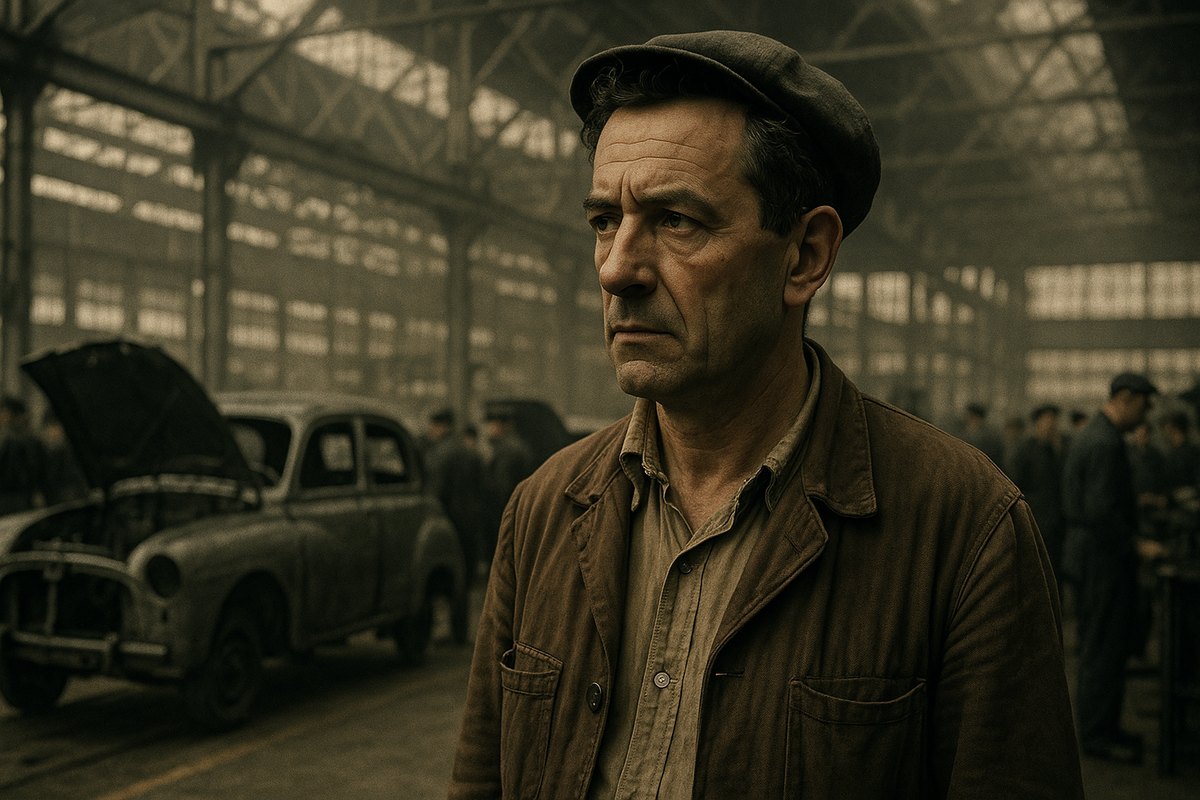
The French Communist Who Could Destroy America's Bet on Europe
How Edgar Snow's 1947 profile of a Renault union leader revealed the true battleground of the Cold War
When Edgar Snow walked into a cramped Paris apartment in 1947 to interview Fernand Dive, he wasn't chasing a celebrity. He was tracking power in its rawest form—the kind that didn't announce itself in marble halls or military parades, but on factory floors where thirty-five thousand men could stop working and bring a continent to its knees.
Snow's profile, "He Could Wreck Marshall's Plan," appeared in the October 4, 1947 issue of The Saturday Evening Post. For American readers still processing the shock of victory in World War II, the article delivered an unsettling message: the next war wouldn't be won by generals. It would be decided by union organizers at Renault.
Archive Details
Historical Figure: Fernand Dive, Communist union leader at Renault
Journalist: Edgar Snow (author of Red Star Over China)
Issue Date: The Saturday Evening Post, October 4, 1947
Cover Artist: John Atherton ("Sea of Grain" — Duluth grain elevators)
Photographer: Roger Coster (union meetings and factory scenes)
The Marshall Plan's Achilles Heel
By autumn 1947, Europe was a ruin struggling to stand. Factories sat idle. Food shortages persisted. Political instability spread like a contagion. Into this void, the United States committed billions through the Marshall Plan—a gamble that economic reconstruction could inoculate Western Europe against Soviet influence.
But there was a problem. In France, one of the largest aid recipients, the Communist Party controlled the labor unions. And those unions, led by men like Fernand Dive, weren't interested in cooperating with Washington's vision of recovery. They were orchestrating strikes, slowdowns, and disruptions designed to prove that American capitalism couldn't deliver.
Snow understood what many policymakers didn't: the Cold War would be won or lost not in treaty negotiations, but in the daily decisions of workers who wondered whether their next paycheck would come from a government aligned with Moscow or Washington.
A Magazine That Doubled as a Weapon
The Saturday Evening Post was more than entertainment. With a circulation in the millions, it shaped how middle America understood the world. Its October 4, 1947 cover—John Atherton's painting of towering grain elevators in Duluth, Minnesota—was no accident. Those silos represented American abundance, the agricultural muscle behind the Marshall Plan. While French workers lived on rations, the United States sat atop what Atherton depicted as a "sea of grain."
The visual argument was clear: America had the resources. The question was whether it had the will to deploy them before men like Fernand Dive made those resources irrelevant.
Inside, Snow's article stripped away abstractions. He didn't theorize about geopolitics. He showed Dive's modest apartment, described his devotion to Communist ideology, and explained how Renault—with its massive workforce—functioned as a barometer for France's political future. If Dive's union voted to strike, production stopped. If production stopped, the Marshall Plan's promise of rapid recovery became a lie.
Snow's reporting, accompanied by Roger Coster's photographs of union meetings and factory floors, gave American readers something rare: a human face on the Cold War. This wasn't about tanks rolling across borders. It was about whether a French metalworker believed capitalism or communism would put food on his table.
Fernand Dive: The Man Who Held the Cards
Snow portrayed Dive not as a villain but as a product of his circumstances—a skilled worker living in cramped quarters, raising a family on inadequate wages, and finding community in the Communist Party. For Dive and thousands like him, Soviet ideology wasn't an abstraction. It was a language that explained their poverty and promised a solution.
Renault wasn't just a car company. It was France's largest industrial employer, a nationalized symbol of postwar recovery, and a proving ground for Communist influence. When Dive organized a strike, he wasn't merely bargaining for better pay. He was demonstrating that the workers, not the Americans, controlled the means of production.
This was the leverage Snow wanted American readers to grasp. Billions in aid meant nothing if the factories stayed silent. And the factories would stay silent as long as men like Dive believed Moscow offered a better future than Washington.
What Snow Captured—and What It Reveals Today
The genius of Snow's article wasn't its alarmism. It was its specificity. He didn't write about "the Communist threat" in vague terms. He profiled one man, in one factory, in one city—and showed how that man's decisions could unravel an entire foreign policy.
For collectors and historians, the October 4, 1947 issue remains a primary source of extraordinary value. Published just months after Secretary of State George Marshall announced his plan, it captures American anxiety at the moment of maximum uncertainty. Would Europe tilt toward the Soviets? Could American aid compete with Communist organizing? Snow didn't have answers. He had Fernand Dive—and that was enough to show how precarious the whole enterprise was.
The issue also represents The Saturday Evening Post at the height of its cultural power. This was a magazine that could move seamlessly from fiction to geopolitical analysis, that could pair John Atherton's grain elevators with Edgar Snow's factory-floor reporting, and make both feel essential to understanding America's place in the world.
Key Themes in Snow's Reporting
Why This Issue Still Matters
Cold War history often focuses on Berlin, Korea, or Cuba. But the real battle was fought in places like Renault, where the outcome depended less on military strategy than on whether workers believed their lives would improve under capitalism.
Snow's profile of Fernand Dive is a reminder that history pivots on ordinary people making ordinary decisions—whether to strike, whether to trust a government's promises, whether to believe in a political system that hasn't yet delivered. The Marshall Plan succeeded, but in 1947, its success was anything but guaranteed.
For anyone interested in how America projected power during the Cold War—not through coercion, but through aid, persuasion, and the hope that prosperity could win hearts—this issue is essential reading.
Collector Significance
Explore the Archive
If this issue resonates, it's one of thousands that chronicle American culture from the Great Depression through the Cold War. The Saturday Evening Post didn't just report history—it shaped how Americans understood their world.
Browse The Saturday Evening Post Magazines CollectionWhether you're a collector, historian, or someone preserving a slice of the past, these magazines are more than paper. They're witnesses.