
When Black Leadership Met the New Frontier
The Jet Magazine cover that redefined American diplomacy in the shadow of segregation
On May 18, 1961, a photograph appeared that shouldn't have been possible.
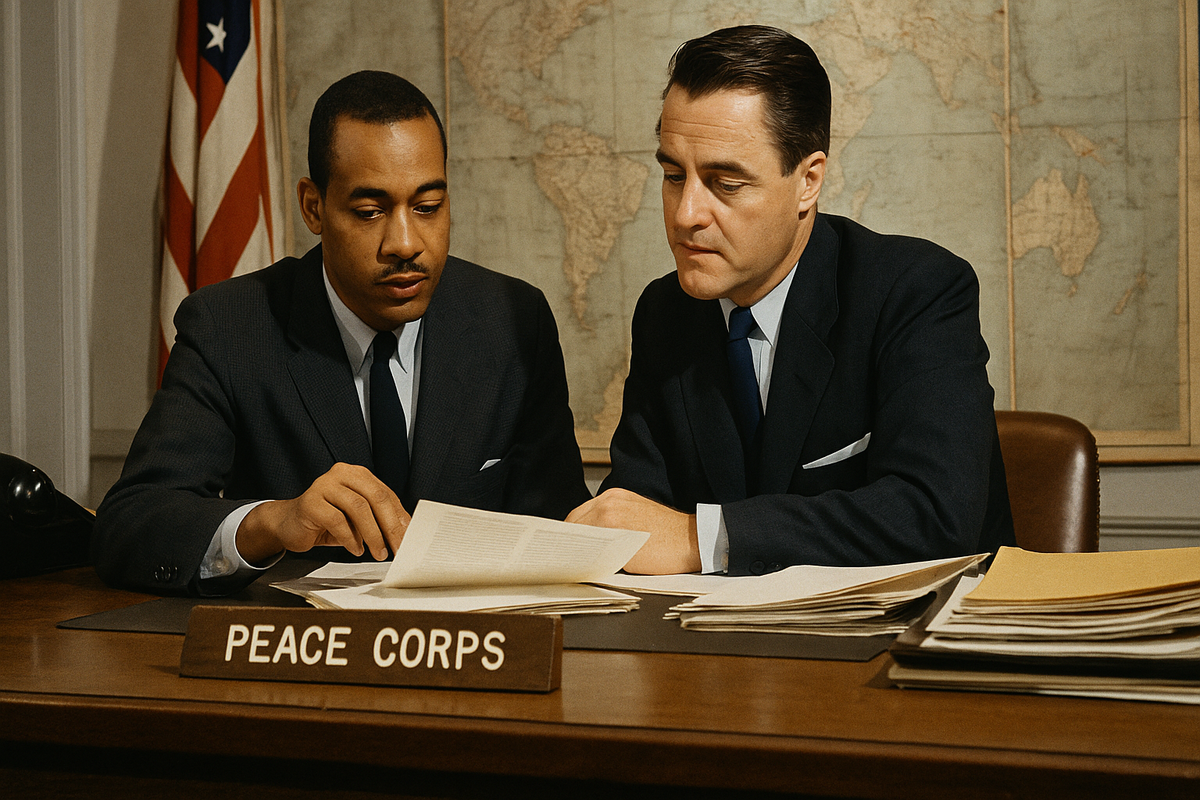
Two men—one Black, one white—leaning over a desk marked "Peace Corps." Not a staged publicity shot. Not a token gesture. Franklin Williams, the NAACP attorney who'd spent years dismantling Jim Crow in courtrooms, now sat as right-hand man to R. Sargent Shriver, architect of Kennedy's most ambitious global initiative.
For Jet Magazine's readers, the image landed like a challenge: Your country needs you abroad while it still denies you at home. What will you do?
This wasn't just another Kennedy administration photo op. It was the visible crack in America's Cold War contradiction—and Jet knew it.
The Impossible Task: Selling Democracy While Practicing Segregation
Kennedy faced a problem that military spending couldn't solve. Across Africa, Asia, and Latin America, newly independent nations were choosing sides. The Soviet Union pointed to Little Rock, to lunch counter violence, to bombed churches. How can America lecture us about freedom?
The Peace Corps was Kennedy's answer—but only if it looked different than everything that came before. That meant Franklin Williams couldn't be window dressing. He had to be indispensable.
Williams brought credentials that mattered: Fordham Law School, years battling school segregation for the NAACP, a mind sharp enough to translate Kennedy's soaring rhetoric into operational reality. When Shriver announced plans to send 100 volunteers to Tanganyika by summer's end—with additional deployments to Ghana, Nigeria, Sierra Leone, India, Pakistan, and beyond—it was Williams who helped determine how those volunteers would avoid replicating the colonial dynamics they were meant to replace.
Jet understood what the mainstream press missed: this wasn't a story about foreign policy. It was a story about who gets to represent America when the world is watching.
Issue Archive
Publication: Jet Magazine
Issue Date: May 18, 1961
Historical Figure: Franklin Williams, NAACP Attorney & Special Assistant to Peace Corps Director
Co-Featured: R. Sargent Shriver, First Director of the Peace Corps
Historical Context: Published four months into Kennedy's presidency, during the height of Freedom Rider activism
Why Jet's Coverage Mattered More Than Time or Newsweek
While mainstream magazines covered the Peace Corps as Kennedy's latest innovation, Jet asked a different question: What does it mean when the same country that needs federal marshals to integrate schools asks Black citizens to export democracy?
The May 18, 1961 issue didn't flinch from that tension. On the cover: Williams and Shriver, evidence of interracial partnership at the highest levels. Inside: "The Lonely Hero of Virginia School Fight," a reminder that the battle for dignity continued in both hemispheres.
Jet's editorial genius lay in refusing to separate these narratives. A reader could move from Virginia's desegregation struggles to profiles of young Black Americans preparing to serve in Africa without encountering a single jarring transition. Because for Jet's audience, there was no separation. The Freedom Riders testing segregation laws in Mississippi and the volunteers headed to Tanganyika were fighting the same war on different fronts.
The magazine quoted Ohio State student Henry Jackson describing the Peace Corps as a chance to channel youthful energy into international goodwill. But Jet knew what Henry Jackson was really saying: We're tired of begging for rights at home. Let's show the world what we can do when someone actually asks.
The Visual Argument: What That Cover Photograph Declared
Strip away the context, and the Williams-Shriver photograph is almost boring: two men at a desk, papers spread between them, both focused on work.
But context is everything.
In 1961, photographs of Black and white professionals collaborating as equals were rare enough to be radical. Most images of interracial cooperation showed white officials "helping" Black communities—the power dynamic unmistakable, the hierarchy preserved.
This photograph declared something else: We built this together.
For Jet's readers—many of them working-class, most of them shut out of elite government service—the image was evidence. Not of what might someday be possible, but of what one Black attorney had already achieved. If Franklin Williams could help shape America's global mission, what did that say about the manufactured limits constraining everyone else?
Jet's pocket-sized format, designed for affordability and portability, ensured that image reached newsstands from Harlem to Houston. The magazine understood its role: not just reporting history, but arming readers with proof that their exclusion from power was a choice, not an inevitability.
What Williams' Role Revealed About Kennedy's Calculation
Kennedy needed the Peace Corps to succeed for strategic reasons—the Cold War demanded it. But he also needed it to succeed symbolically. Sending volunteers abroad while Bull Connor turned fire hoses on children would be a propaganda gift to Moscow.
Williams' appointment was strategic brilliance. It signaled that the Peace Corps would be different from the colonial projects it superficially resembled. It demonstrated that Kennedy understood—or at least recognized—that America's credibility abroad depended on addressing its credibility gap at home.
But more than that, Williams brought something Kennedy's other advisors couldn't: lived experience with institutions that promised equality while practicing exclusion. The Peace Corps couldn't just avoid replicating colonial dynamics in theory. It had to avoid them in practice—in recruitment, in training, in deployment. Williams knew how to spot the gap between policy and implementation because he'd spent his career exploiting those gaps in court.
Jet's coverage emphasized the "brilliant interracial staff" not as praise, but as proof. Here was the New Frontier's promise made tangible: talent recognized regardless of race, leadership distributed based on capability.
It was aspirational. It was also insufficient. But in May 1961, it was further than America had gone before.
Key Themes in This Issue
Interracial Leadership
The Peace Corps was staffed by leaders of many races, with Franklin Williams serving as Shriver's right-hand man—a landmark moment for African American representation in elite government service.
Global Reach
Plans to send volunteers to Tanganyika, Ghana, Nigeria, Sierra Leone, India, Pakistan, and beyond signaled Kennedy's belief that America could win hearts through service, not just military might.
Youth Engagement
By quoting student leaders like Ohio State's Henry Jackson, Jet underscored how the Peace Corps tapped into the activism of a generation already mobilized by the Civil Rights Movement.
Symbolic Power
For readers in 1961, the Peace Corps represented a chance to challenge America's image of race and democracy before an international audience—serving abroad while fighting for dignity at home.
Why Collectors Covet This Issue
The Kennedy Mythology
Published months into an administration later defined by assassination and "what if" speculation, it captures the New Frontier at its most optimistic—before Dallas, before disillusionment.
Civil Rights in Foreign Policy
Williams' presence documented a largely erased history: Black professionals shaping American diplomacy during the movement's most volatile years.
Cold War Strategy
The Peace Corps was humanitarian theater with geopolitical stakes. This issue captures that duality without sanitizing either element.
Visual Rarity
Photographs of genuine interracial collaboration in elite government service were uncommon enough in 1961 to be historically significant.
Holding History
Digital archives preserve text. Original magazines preserve context.
When you hold the May 18, 1961 issue of Jet, you're holding the urgency its first readers felt. The Civil Rights Movement was accelerating. The Cold War was intensifying. And somewhere in that collision, there was Franklin Williams at a desk marked "Peace Corps," proving that Black leadership belonged everywhere America claimed to stand for something.
Jet documented that moment not with detachment, but with purpose. It told its readers: You are part of this story. Your leaders are shaping the world.
Sixty years later, that message still resonates—not as nostalgia, but as evidence of what's been fought for, what's been won, and how much further there is to go.
Explore the Archive
Discover decades of African American history, culture, and politics through original Jet magazines from the 1950s through the 1980s—from civil rights protests to jazz milestones, from sports triumphs to global diplomacy. These aren't reproductions. They're original artifacts of African American resilience, leadership, and vision.
Browse Jet Magazines Collection