
The Miracle That Learned to Fail
When America Discovered Penicillin's Dark Secret in The Saturday Evening Post, August 3, 1946
August 3, 1946. A nation still drunk on victory opened its weekly ritual—The Saturday Evening Post—and found something unsettling beneath Norman Rockwell's cheerful cover. Between the fiction serials and the advertisements for automobiles America was finally building again, Steven M. Spencer delivered news that bordered on heresy: the miracle drug was dying.
Penicillin, the pharmaceutical savior that had rewritten the rules of war and medicine, was failing. Not everywhere. Not all at once. But in hospitals from Detroit to Baltimore, doctors were watching infections laugh off doses that should have annihilated them. Bacteria—lowly, mindless bacteria—were learning.
For a country that had just harnessed the atom and reshaped the world through sheer scientific will, the message was unmistakable: progress had limits. Victory was temporary. And the future Americans thought they'd secured might already be slipping away.
Historical Record
Publication: The Saturday Evening Post
Issue Date: August 3, 1946
Feature Article: "The Great Penicillin Mystery" by Steven M. Spencer
Cover Artist: Norman Rockwell
Archive Significance: First mass-circulation account of antibiotic resistance
The Weight of 1946
To understand why "The Great Penicillin Mystery" landed like a gut punch, you have to understand the year itself.
Twelve months earlier, atomic bombs had vaporized two Japanese cities, delivering both victory and existential dread in a single stroke. The United Nations had assembled in San Francisco, a monument to hope built on the rubble of 60 million dead. The Cold War hadn't yet declared itself, but Americans could feel the chill—Stalin's suspicions, the Iron Curtain's first shadows, the slow realization that the alliance of necessity was curdling into the rivalry of ideology.
Science occupied sacred ground in this landscape. It had given America radar, the proximity fuse, the Manhattan Project. And penicillin. Especially penicillin.
Mass-produced for the first time in 1943, the drug had saved thousands of Allied soldiers from the infections that killed as efficiently as shrapnel. Pneumonia, scarlet fever, syphilis, infected wounds—all suddenly treatable. Death sentences became footnotes. When a soldier in the Pacific took a bullet and didn't die screaming from gangrene three days later, penicillin got the credit. When a sailor contracted syphilis in a port bar and returned home cured rather than insane, penicillin was the reason.
The drug wasn't just medicine. It was proof of concept. Proof that American ingenuity could rewrite the rules of nature itself.
So when Spencer reported that bacteria were adapting—that streptococcus was clinging "tenaciously" to heart valves despite massive doses, that entire strains identified at the Navy's Streptococcus Typing Center in Bethesda, Maryland showed complete indifference to penicillin—it felt like betrayal.
The miracle was mortal after all.
Rockwell's Roadside, Spencer's Laboratory
The August 3 cover showed Norman Rockwell in his element: two young women stranded roadside with a flat tire, one sprawled beneath the car with a wrench, the other wrestling the spare into position while a rustic cabin loomed above. Humorous, warm, quintessentially American. Resourcefulness as comedy.
Turn the page, and the temperature drops.
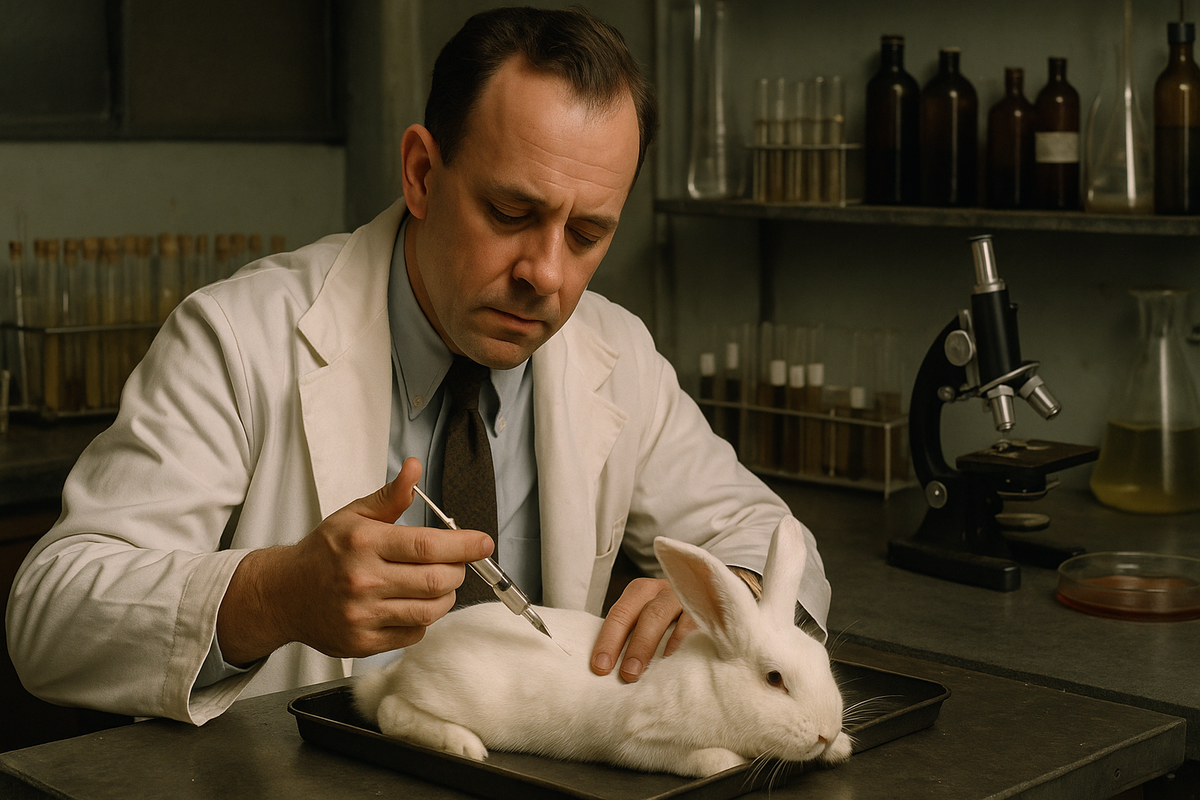
Spencer's article came illustrated with stark black-and-white photographs from Johns Hopkins University—laboratory rabbits injected with syphilis bacteria, test subjects in the unglamorous work of pharmaceutical research. For most readers, this was their first glimpse behind the curtain of modern medicine. No propaganda. No triumphalism. Just the raw, uncertain process of science confronting its own failures.
The juxtaposition was The Saturday Evening Post at its finest. Rockwell's cheerful Americana on the outside, the hard truths of a complicated world within. The magazine gave its readers permission to laugh and permission to worry, often in the same sitting.
This is what made the Post essential. It didn't just entertain. It narrated the nation to itself.
The Anatomy of a Mystery
Spencer structured his piece like a detective story because, in many ways, that's what it was.
Doctors in Detroit and Baltimore reported cases first. Pneumonia patients who should have recovered didn't. Scarlet fever lingered. Syphilis required doses that would have been unthinkable a year earlier. At Johns Hopkins, researchers injected rabbits with the disease and photographed the results—some animals responded, others didn't, and nobody could explain the pattern.
Meanwhile, at Navy research centers and university labs, scientists raced to engineer solutions. New mold strains with names like Q-176 and X-1612 promised triple the yields and greater potency. Researchers debated dosing protocols. Was the problem overuse? Were doctors prescribing penicillin for minor infections, inadvertently training bacteria to resist it?
What Spencer captured—and what made the article extraordinary—was the provisional nature of knowledge itself. This wasn't a story of failure. It was a story of science in real time, stumbling forward, revising assumptions, discovering that miracles required maintenance.
For a readership raised on certainty, on the idea that problems had solutions and solutions were permanent, it was a bracing education. The war had been won with decisive force. But the war against disease would be iterative, ongoing, and maddeningly uncertain.
What the Post Revealed
Each revelation built toward a larger truth: penicillin was powerful, but power required stewardship. The age of antibiotics would be an arms race, not a final victory.
Why Collectors Prize This Issue
Historical Pivot Point
Captures America in transition, suspended between wartime certainty and peacetime complexity, between atomic triumph and atomic terror.
Medical Foresight
Spencer's article is among the first mass-circulation accounts of antibiotic resistance, a phenomenon that now kills over a million people annually worldwide. Reading it today feels like discovering a warning the world didn't heed.
Rockwell's Cover
Any issue illustrated by Norman Rockwell carries value, but this one—with its roadside comedy juxtaposed against the scientific crisis inside—offers layers of irony and insight that deepen with time.
Cultural Snapshot
Beyond the penicillin piece, the issue includes fiction, serials, advertisements for cars and appliances, the full texture of American life in late 1946. It's a time capsule.
To own this issue is to hold a turning point. The moment when America learned that science could deliver miracles, but miracles came with expiration dates.
The Post's Enduring Compact
The Saturday Evening Post worked because it never condescended. It assumed its readers could handle complexity, could hold optimism and anxiety in the same hand, could laugh at a flat tire and absorb news of bacteria outsmarting the best minds in medicine.
In wartime, it rallied morale. In peace, it asked harder questions. "The Great Penicillin Mystery" sits alongside the magazine's greatest journalism—not because it solved the problem, but because it trusted Americans to understand it.
Today, as antibiotic resistance accelerates and researchers scramble to develop alternatives, Spencer's 1946 article reads like prophecy. The Post gave its readers the first clear language to describe a crisis that would outlive them. That's why these mid-century issues remain vital—not as nostalgia, but as evidence that the past saw us coming.
Explore the Archive
We maintain one of the largest collections of original Saturday Evening Post magazines, spanning the 1920s through the 1970s. These aren't reproductions or digital scans—they're the actual issues that sat on American coffee tables, that sparked dinner table debates, that shaped the national conversation week by week.
Whether you're a collector hunting specific Rockwell covers, a medical historian tracking the evolution of public health discourse, or simply someone fascinated by mid-century America, these magazines offer something digital archives can't: the weight, the smell, the tangible presence of history.
Browse Saturday Evening Post CollectionHolding Paradox
The August 3, 1946 issue endures because it refused easy answers. It celebrated science's power while documenting its limits. It honored penicillin's miracle while reporting its mortality. It gave Americans Norman Rockwell's optimism on the cover and Steven M. Spencer's caution inside, trusting readers to navigate the contradiction.
That tension—between triumph and uncertainty, between what we've accomplished and what we've yet to understand—is the heartbeat of the postwar era. And it's all there, preserved in ink and paper, waiting to be held again.