
The Magazine That Made Thanksgiving a Wrestling Holiday
Inside the December 1989 WWF Preview That Captured an Empire at Its Peak
When subscribers tore open their mailboxes in late November 1989, they found something more valuable than they realized: a 64-page blueprint for how the World Wrestling Federation planned to own an American holiday.
The December 1989 issue of WWF Magazine wasn't just promoting Survivor Series. It was documenting a cultural shift—the moment Thanksgiving stopped being just about turkey and became synonymous with elimination matches, neon spandex, and Hulk Hogan body-slamming a movie villain on pay-per-view. Thirty-five years later, this issue stands as one of the most significant wrestling publications ever printed, a snapshot of the WWF at the absolute zenith of its golden era.
Archive Details
Publication: WWF Magazine, December 1989
Featured Event: Survivor Series 1989 (Thanksgiving Night)
Historical Significance: Documents WWF's four-PPV annual structure and peak golden era roster
Archive Source: Original 20th Century Magazine Collection
1989: The Year WWF Became Inevitable
By the time this magazine hit newsstands, the WWF had moved beyond wrestling promotion into something closer to cultural infrastructure. Hulk Hogan remained the company's gravitational center—his championship belt, his pythons, his red-and-yellow certainty that good would triumph. But the roster around him had evolved into a carnival of personalities so vivid they didn't need last names: Warrior. Savage. Piper. Andre.
The business model had evolved too. WrestleMania had proven that wrestling could command pay-per-view dollars. Now the WWF had systematized spectacle: four annual PPVs—WrestleMania, SummerSlam, Survivor Series, and the Royal Rumble—each anchoring a season of storytelling. Survivor Series, launched just two years earlier in 1987, had claimed Thanksgiving as its territory through sheer audacity: team elimination matches that turned the entire roster into chess pieces, where alliances meant something and betrayals hit harder.
The December 1989 magazine understood its assignment: make readers who couldn't afford the $19.95 PPV price feel like they had to find a way.
Nine Teams, One Night, Zero Mercy
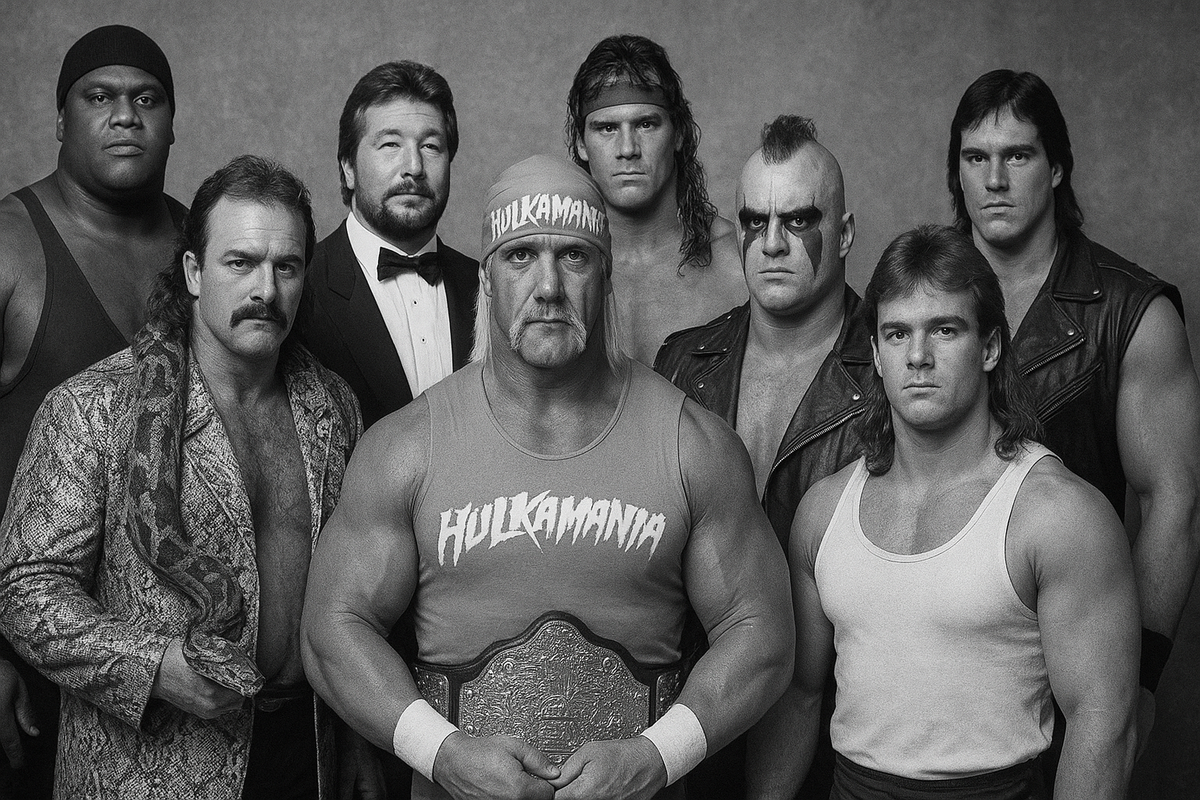
The magazine's centerpiece was a photo essay that doubled as psychological warfare. Each team received a full-page spread—studio photography that turned wrestlers into archetypes:
The Hulkamaniacs (Hulk Hogan, Jake "The Snake" Roberts, Demolition) posed with Hogan's championship belt catching the light like Excalibur. Roberts' python coiled ominously. Ax and Smash flanked them in studded leather, facial paint suggesting they'd walked off a battlefield.
The Million $ Team (Ted DiBiase, Zeus, Warlord, Barbarian) radiated menace in layers. DiBiase smirked in his tuxedo, the embodiment of wealth as villainy. Behind him loomed Zeus—actor Tiny Lister in full No Holds Barred character, his WWF storyline a literal Hollywood crossover where movie feuds became real grudges.
The Ultimate Warriors (Ultimate Warrior, Rockers, Jim Neidhart) exploded in neon chaos. Warrior's face paint streaked like war crimes against good taste. Shawn Michaels and Marty Jannetty struck poses in bandanas and fringe. This was 1989 distilled to a single frame.
Heenan's Family (Andre the Giant, Haku, Arn Anderson, Tully Blanchard) anchored themselves around Andre's 7'4" frame. At 43, ravaged by acromegaly, Andre still commanded the photo through sheer mass. Bobby Heenan's managerial genius had assembled enforcers around him—Haku's Tongan fury, the Brain Busters' technical cruelty.
Roddy's Rowdies (Roddy Piper, Jimmy Snuka, Bushwhackers) promised controlled chaos. Piper in his kilt, Snuka shirtless and ageless, Luke and Butch licking their chops. This team had one strategy: make the match unwatchable for everyone who wasn't them.
The Rude Brood (Rick Rude, Mr. Perfect, Rougeau Brothers) preened with the confidence of men who knew they were better than you. Rude's airbrushed tights, Perfect's spit-slicked hair, the Rougeaus' smug Canadian charm—athleticism weaponized into arrogance.
The Dream Team (Dusty Rhodes, Brutus Beefcake, Tito Santana, Red Rooster) represented blue-collar heroics. Rhodes in his infamous polka dots, the "American Dream" gimmick in full effect—a plumber's son from Austin, Texas, playing the everyman against corporate heels.
The Enforcers (Big Boss Man, Rick Martel, Akeem, Honky Tonk Man) brought props: Boss Man's nightstick, Martel's cologne atomizer, Honky's guitar. Villainy as performance art.
The 4x4s vs. The King's Court pitted Jim "Hacksaw" Duggan's lumber-swinging patriotism against "Macho King" Randy Savage's royal pageantry, Sensational Sherri at his side in full regal menace.
These weren't just team rosters. They were narrative ecosystems, each photo telling readers exactly what emotional territory the match would occupy.
The Feuds That Fueled the Fire
The magazine didn't just present matches—it weaponized backstory:
Hogan vs. Zeus blurred reality and kayfabe to the point of collapse. Zeus had "attacked" Hogan on the set of No Holds Barred. Now the movie villain wanted revenge in a real ring. The magazine sold this with zero winking, treating a Hollywood actor's WWF debut as an existential threat to Hulkamania.
Ultimate Warrior vs. Andre the Giant replayed Warrior's shocking 1989 victory over Andre, positioning Heenan's Family as a revenge squad. Warrior's unstoppable momentum met Andre's fading invincibility—a torch-passing disguised as a grudge match.
Roddy Piper vs. Rick Rude weaponized pride. Piper's Scottish fire against Rude's narcissistic swagger. The magazine framed it as a battle for dignity itself.
Dusty Rhodes vs. Big Boss Man leaned into class warfare. The Dream Team's working-man ethos versus The Enforcers' authoritarian cruelty. Boss Man's nightstick against Rhodes' elbows.
Hacksaw Duggan vs. Macho King Randy Savage played with WWF's royal gimmick obsession—Duggan's 2x4 and "USA" chants versus Savage's crown and scepter, Sherri's shrieks echoing through every camera shot.
The writing treated every storyline with operatic seriousness, giving fans permission to care deeply about outcomes that were, on some level, predetermined. That was the magazine's genius: it understood that knowing the genre doesn't diminish the experience.
Why This Issue Became a Grail
Roster Density
This single issue features Hulk Hogan, Ultimate Warrior, Randy Savage, Ted DiBiase, Dusty Rhodes, Andre the Giant, Roddy Piper, Bret Hart, and Shawn Michaels—all future Hall of Famers, many at their absolute peak.
Visual Time Capsule
The team photos preserve the costumes, color palettes, and physical presence of late-'80s WWF. These aren't candid shots—they're official iconography, WWF presenting its own mythology with studio precision.
Event Anchoring
Unlike general issues, this magazine ties directly to a specific PPV, making it a primary source document for Survivor Series 1989—a show that delivered on every promise the magazine made.
Cultural Artifact Status
It represents the moment WWF Magazine functioned as essential infrastructure, not optional merchandise. In an era before internet spoilers, this was the authoritative preview.
For collectors of 20th-century pop culture ephemera, original wrestling magazines occupy the same archival space as vintage Mad, Rolling Stone, or Life—they're journalism and myth-making simultaneously, capturing moments before historical revision set in.
The Magazine as Memory Device
What separates vintage WWF Magazine issues from disposable promotional content is their function as locked-in memory. Digital media updates, disappears, gets overwritten. A physical magazine from 1989 still says what it said in 1989. The hyperbole remains frozen. The promises are permanent.
Opening this issue today means encountering Survivor Series exactly as the WWF wanted fans to anticipate it: Zeus as a legitimate threat, not a punchline. Andre as terrifying, not tragic. Warrior as unstoppable, not self-destructive. The magazine preserves the kayfabe in amber.
For anyone who watched WWF on Saturday mornings, rented No Holds Barred from Blockbuster, or begged parents to order Survivor Series, this magazine is a neurological trigger. The smell of the paper, the particular grain of the photos, the bold sans-serif fonts—these aren't just design choices. They're sensory passwords to childhood.
Collector Significance
Historical Timing
Tied directly to Survivor Series 1989, capturing a PPV that showcased nearly every major WWF star of the era in one landmark event.
Star Power
Features multiple future Hall of Famers at their peak, making it a cornerstone piece for any golden era collection.
Archival Quality
Official WWF photography and storyline documentation that serves as a primary historical source for wrestling scholars and enthusiasts.
Investment Value
PPV preview issues from the golden era command premium prices among collectors, especially those tied to major events like Survivor Series.
Where History Lives
If you're building a collection of wrestling's golden era, hunting down original WWF Magazine issues offers something Wikipedia never will: the experience of discovery as it happened. From the mid-1980s through the early 2000s, these magazines chronicled the rise of superstars, the invention of pay-per-view storytelling, and rivalries that defined what sports entertainment could be.
Explore the Archive
Browse the complete collection of original WWF World Wrestling Federation Magazines and discover primary source documents from wrestling's most legendary era.
Browse World Wrestling Federation CollectionFinal Bell
The December 1989 issue of WWF Magazine captured Survivor Series at the exact moment the event became a holiday tradition. It documented Hogan versus Zeus, Warrior versus Andre, Piper versus Rude, Rhodes versus Boss Man—clashes that transcended wrestling and became theater, mythology, and shared cultural memory.
For fans today, it's a window into an era when wrestling didn't apologize for being big, loud, and colorful. For collectors, it's a cornerstone piece, directly linked to one of the WWF's most stacked pay-per-views.
Holding this magazine means holding 1989 itself—Hulkamania still running wild, new gods ascending, and Survivor Series cementing its claim on Thanksgiving. The pages still smell like childhood. The promises still feel real.
That's not nostalgia. That's preservation.