
The Night Rolling Stone Photographed the Women Rock History Tried to Forget
How Baron Wolman's camera and three reporters exposed the most controversial truth of 1969: the women who powered rock and roll
On February 15, 1969, Baron Wolman walked into a darkroom with 36 rolls of film and emerged with something American magazine journalism had never seen: portraits of women the music industry used but refused to name.
The resulting Rolling Stone feature—"The Groupies and Other Girls"—didn't just document the sexual revolution. It detonated it across newsstand America, forcing readers to confront who actually powered the backstage machinery of rock and roll. These weren't the anonymous silhouettes in tour bus windows. They were individuals with names, ambitions, and a clarity about their place in the cultural upheaval that most critics couldn't match.
This wasn't fan service. This was war journalism from the front lines of the counterculture.
Why February 1969 Mattered
The timing was seismic. The Beatles had just fractured the pop template with the White Album. Jimi Hendrix was three albums into redefining what six strings and an amplifier could mean. Woodstock was still five months away—a rumor, not yet a watershed.
But 1969 wasn't 1967 anymore. The Summer of Love had curdled. The optimism that flooded Haight-Ashbury now drained into something harder, stranger, more dangerous. Political assassinations. The Democratic Convention riots. The realization that dropping out didn't automatically mean dropping into utopia.
Groupies became the cultural bellwether for this shift. They embodied everything America couldn't decide about itself: sexual freedom versus exploitation, celebrity worship versus genuine connection, women's liberation versus the same old power structures wearing paisley shirts.
Rolling Stone, barely two years old, made a bet that readers could handle complexity. The magazine had already rejected the breathless fandom of 16 Magazine and Tiger Beat. Where other publications airbrushed rock mythology into posters, Rolling Stone insisted on reporting what actually happened when the house lights went down.
"The Groupies and Other Girls" was that philosophy made flesh.
Archive Details
Publication: Rolling Stone Magazine
Issue Date: February 15, 1969
Feature Title: "The Groupies and Other Girls"
Reporters: John Burks, Jerry Hopkins, Paul Nelson
Photographer: Baron Wolman
Historical Context: Published five months before Woodstock, during the peak of the counterculture movement
The Reporting: Burks, Hopkins, Nelson
Reporters John Burks, Jerry Hopkins, and Paul Nelson didn't write a hit piece. They didn't write a puff piece. They conducted ethnography.
The journalists interviewed musicians, industry insiders, and—critically—the women themselves. What emerged wasn't a monolithic portrait but a spectrum:
Women chasing adventure in an era when "nice girls" stayed home.
Women seeking artistic community in cities where the underground actually felt like family.
Women caught in the gravitational pull of fame, drugs, and men who would become legends but were, in that moment, just guys with guitars and dangerous habits.
The prose didn't moralize. It observed. It quoted. It let contradictions exist on the page without rushing to resolve them. This was New Journalism applied to sex and celebrity—Tom Wolfe's techniques aimed at Sunset Strip instead of stock car racing.
Wolman's Lens: Photography as Historical Document
Baron Wolman's camera work elevated the feature from article to artifact.
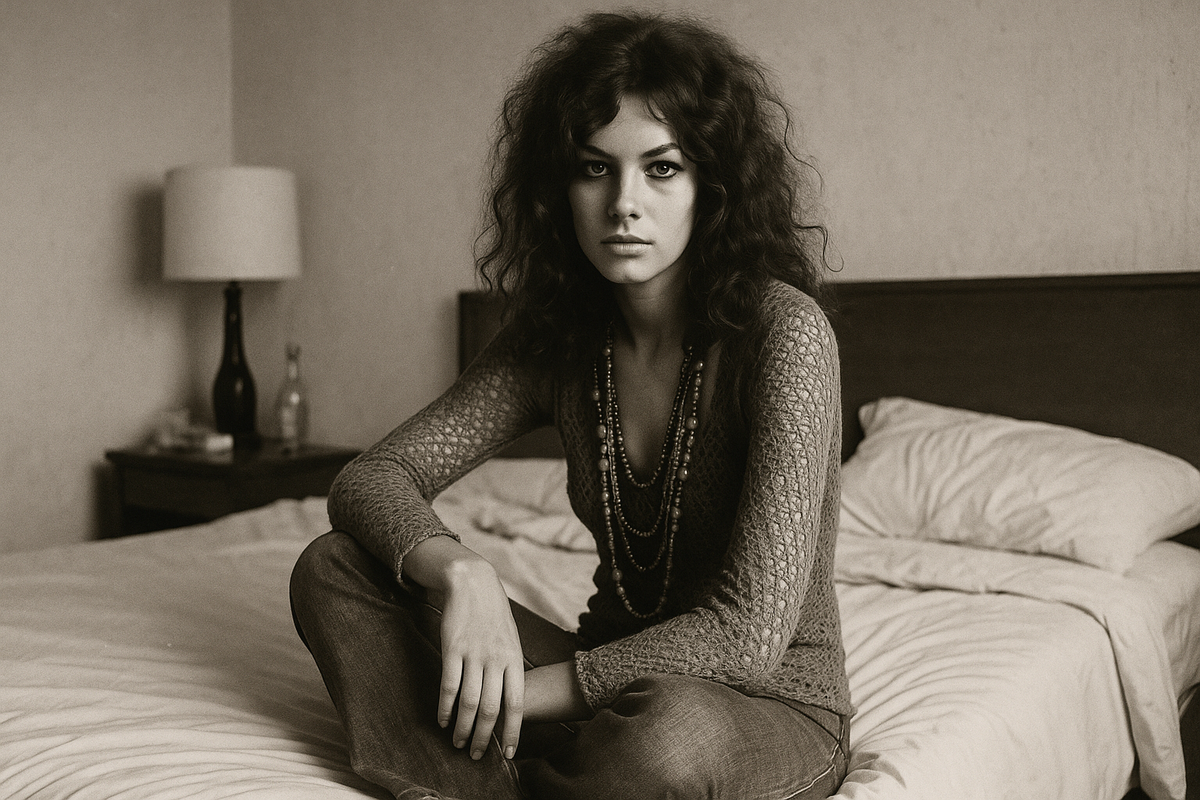
His photographs weren't voyeuristic. They were portraiture. Each frame gave its subject the dignity of stillness, of being seen rather than looked at. The women stared back: lace dresses and wild curls, yes, but also direct gazes that refused to play coy with the viewer.
The opening image set the tone—a woman in black, seated, her expression unreadable and commanding. Not a come-on. Not an apology. Just presence.
Inside the spread, Wolman's compositions moved between documentary realism and countercultural iconography:
Crocheted tops and beaded necklaces that would define hippie fashion for the next decade.
Black-and-white portraits that stripped away color to focus on bone structure, posture, personality.
Layouts that balanced text and image, creating a rhythm between testimony and visual evidence.
This wasn't Playboy. This wasn't even Vogue. This was photojournalism that understood its subjects as participants in history, not decorations for it.
Wolman's work has since entered the permanent collection of museums. Original prints command thousands at auction. But in 1969, these were just photographs in a magazine—which is precisely what made them revolutionary. High art arrived on newsstands for $0.35.
What the Feature Actually Said
The article navigated minefields that would explode across American culture for the next decade:
Agency versus Exploitation
Were these women pioneers of sexual liberation or casualties of a scene that valued them only as accessories to male genius? The feature refused easy answers.
The Generational Chasm
Older readers condemned groupie culture as moral decay. Younger readers saw it as freedom from the suffocating roles their mothers inhabited.
Drugs as Cultural Infrastructure
LSD and marijuana weren't just recreational—they were the social glue of the rock world, shaping relationships, creativity, and disaster in equal measure.
The Double Standard on Display
Male musicians slept their way across continents to applause. Women who did the same faced stigma and erasure. The article named this hypocrisy directly.
Fashion as Rebellion
The fringe, the beads, the thrift-store lace—groupie style influenced mainstream fashion more than Seventh Avenue wanted to admit.
The Human Cost
Personal quotes revealed motivations ranging from genuine love to desperate loneliness to the simple fact that being adjacent to greatness felt better than being nowhere at all.
The piece connected these individual stories to larger youth movements—the communes in Haight-Ashbury, the folk scene in Greenwich Village, the college protests erupting nationwide. Groupies weren't outliers. They were the counterculture's most visible manifestation of what happened when women claimed sexual autonomy in a world unprepared to grant it.
What Endures
The February 15, 1969 issue matters because it refused to simplify.
It didn't present groupies as saints. It didn't present them as victims. It presented them as people navigating the same currents of freedom, desire, and confusion that defined an entire generation—and doing so in a spotlight that would eventually burn most of them.
For modern readers, the feature offers a window into 1969 as it actually felt: uncertain, thrilling, dangerous, and utterly convinced it was inventing the future. Rock stars were gods. Youth culture was rewriting every social contract. And women were negotiating their place in a world that was changing too fast for anyone to control.
The article's honesty is what keeps it relevant. It captured a moment without knowing how the story would end.
Why Collectors Hunt This Issue
Historical Positioning
Published months before Woodstock, it captures the counterculture at maximum velocity, before the crash at Altamont turned the dream into a crime scene.
Wolman's Photographic Legacy
His images from this era now hang in galleries. Original issues featuring his photo essays are scarce and climbing in value.
Editorial Courage
Few American magazines in 1969 would touch sexuality and celebrity with this level of frankness. Rolling Stone's willingness to publish uncomfortable truths established its credibility for decades.
Physical Scarcity
Newsstand magazines from this era were printed to be disposable. Copies that survived five decades in readable condition are legitimately rare.
Cultural Documentation
This isn't just a magazine. It's primary source material for understanding how gender, power, and fame intersected at a defining moment in American culture.
Access the Archive
Thousands of original Rolling Stone magazines from the late 1960s through the 1970s are available in our collection. These issues trace entire decades of music, politics, and cultural upheaval as they were documented in real time—not through retrospective nostalgia, but through the eyes of journalists who were there, notebook in hand, when history happened.
Browse Rolling Stone Magazine CollectionWhether you're a collector, a cultural historian, or someone who understands that the past is never as simple as memory pretends—these magazines offer more than reading material. They are primary sources. Artifacts. Evidence that the counterculture existed, mattered, and left a paper trail.