
The Last Optimistic Breath: Inside the October 1983 Electronic Games That Documented an Industry on the Brink
How a single magazine issue captured gaming's golden age hours before the crash
In a cardboard box somewhere—an estate sale, a storage unit, a grandmother's attic—there's a magazine worth more than its cover price suggests. The October 1983 issue of Electronic Games Magazine sits in collections today not because it predicted the future, but because it perfectly captured the moment before everything changed. Flip through its pages and you're reading the last love letter to an industry that had no idea it was about to die.
Within three months of publication, the video game crash of 1983–84 would erase billions in market value, bankrupt dozens of publishers, and convince Wall Street that gaming was a fad that had finally burned out. But in October 1983, none of that had happened yet. The issue—titled Electronic Games' Third Annual Video Game Preview—arrived on newsstands as a roadmap to 1984's hottest releases. Instead, it became an eulogy.
Archive Details
Publication: Electronic Games Magazine
Issue Date: October 1983
Special Feature: Third Annual Video Game Preview
Historical Context: Published weeks before the 1983–84 video game crash
Archive Source: Original Magazines Collection
The Magazine That Made Gaming Matter
By 1983, Electronic Games had already done what no publication had attempted: treat video games as culture, not toys. Founded in 1981, it was the first American magazine devoted entirely to gaming, and it approached the beat with the seriousness of a trade journal and the enthusiasm of a fan zine. Editors didn't just review games—they contextualized them, compared them, and argued about them. For readers outside the industry, Electronic Games was the only bridge between the arcade and the boardroom.
The October 1983 preview exemplified that authority. Across its pages, readers encountered glossy photos of unreleased hardware, screenshots of arcade-to-home conversions, and full-page spreads for cartridges that would either define 1984 or vanish in the crash. Mythicon's Star Fox. Tigervision's Springer. SEGA's Buck Rogers. Synapse Software's Necromancer. Each preview wasn't just marketing—it was documentation. This was visual proof that gaming had moved beyond Pong and Pac-Man into something larger, stranger, and infinitely more ambitious.
The magazine made the industry real. And in doing so, it captured an industry at its most fragile.
What the Cover Revealed
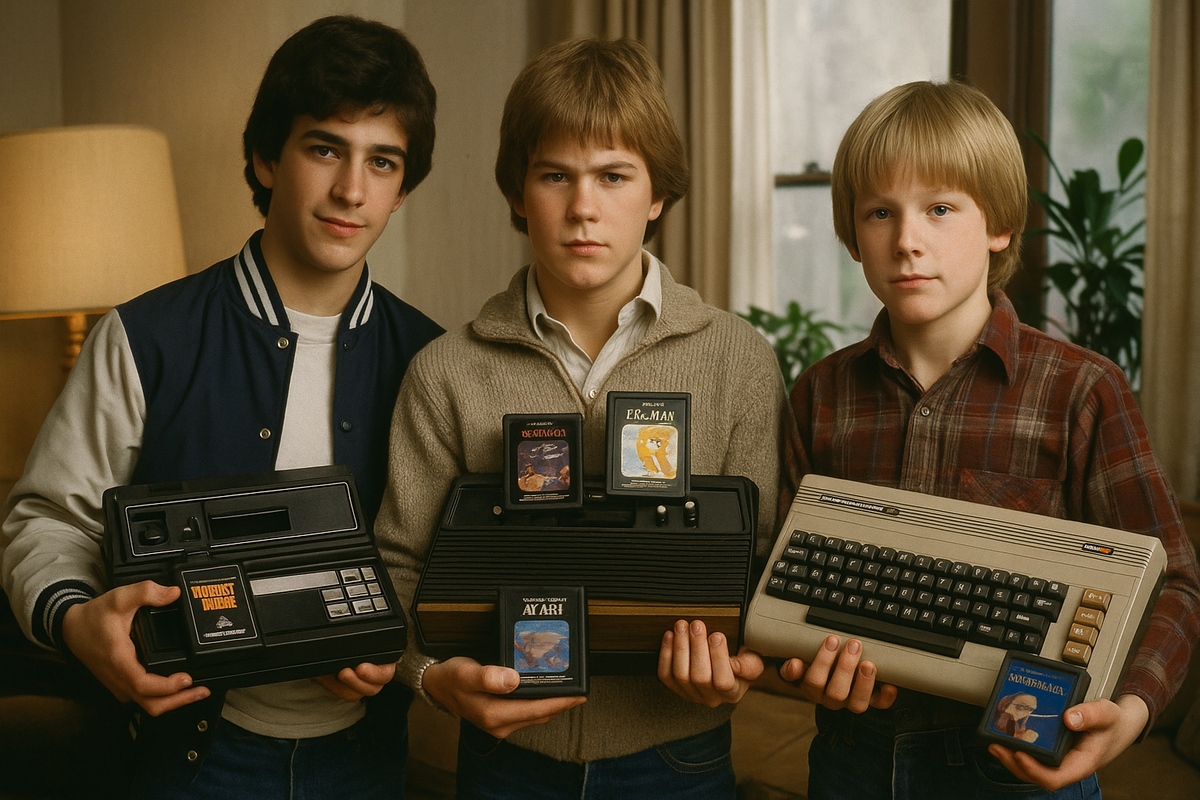
The October 1983 cover telegraphed everything. Instead of a single console or arcade cabinet, it showed a group of kids hauling armloads of cartridges, joysticks, and home computers. Behind them, a pixelated 8-bit sunrise glowed in neon orange and blue. The image wasn't aspirational—it was descriptive. By late 1983, video games had moved into the living room. They weren't a novelty anymore. They were infrastructure.
But the cover also hinted at the chaos beneath the optimism. Those kids weren't carrying just Atari and ColecoVision—they were lugging competing systems, incompatible formats, and a glut of software that was already beginning to overwhelm retailers. The sunrise in the background? It could just as easily have been a sunset.
Inside the Preview: Five Forces Colliding
The Third Annual Video Game Preview wasn't a simple product catalog. It was a snapshot of five simultaneous revolutions, each pulling the industry in a different direction.
The Joystick Wars
Entire spreads were devoted to controllers. ColecoVision's joystick-keypad hybrid. Wico's "Command Control" sticks with their arcade-grade microswitches. The Atari 5200's controversial analog stick. Electronic Games understood what many publishers didn't: hardware mattered as much as software.
Arcade Legends Coming Home
The promise of 1984 was simple: if you loved it in the arcade, you could own it at home. Solar Fox. Omega Race. Wizard of Wor. Domino Man. The magazine previewed dozens of arcade-to-console ports, each one promising faithful recreation of coin-op experiences.
The Memory Leap
Cartridges were getting bigger. More ROM meant more game—more levels, more enemies, more complexity. Previews for Xevious and Robotron: 2084 emphasized their technical sophistication, their ability to push the Atari 2600 and ColecoVision beyond what first-generation software had managed.
The Publisher Flood
Companies like Mythicon, Xonox, and Starpath flooded the preview pages with ambitious titles: Fire Fly, Sorcerer, Flashpoint, Nova Blast. The sheer volume of previewed software—dozens of titles from dozens of publishers—signaled opportunity to optimists and oversaturation to anyone paying attention.
The Computer Crossover
Tucked between console previews were spreads for the Commodore 64, Apple II, and IBM PC. Personal computers weren't just competing with consoles—they were beginning to eclipse them. Computers offered games and productivity, entertainment and education.
What Permanence Means in a Disposable Era
Gaming news today is instant and ephemeral. Announcements drop on Twitter, trailers stream on YouTube, and within hours the conversation has moved on. But in 1983, Electronic Games was permanent. Readers saved issues. They reread previews. They circled titles they wanted for Christmas and debated specs with friends. The magazine wasn't just consumed—it was kept.
That permanence is why vintage gaming magazines matter to historians and collectors. They aren't just records of hardware and software. They're records of anticipation, of community, of the moment before anyone knew what would happen next. They capture not just what was, but what could have been.
The October 1983 issue is the perfect example. Every preview, every screenshot, every advertisement represents a future that didn't quite arrive as planned. The optimism is real. The crash is coming. And the magazine sits between the two, frozen in time.
Why This Issue Became a Collector's Grail
Historical Timing
Published mere weeks before the crash began, this issue captures the industry at maximum expansion—and maximum vulnerability. It's the high-water mark before the tide went out.
Iconic Imagery
That cover—kids hauling consoles like treasure—became a visual shorthand for early-'80s gaming culture. It's been reproduced, parodied, and referenced in retrospectives for decades.
Firsthand Documentation
Previews of Necromancer, Star Fox, and Buck Rogers show exactly what gamers were anticipating. Some of these titles launched and flopped. Others never launched at all. The magazine preserved their existence before the crash erased them from memory.
Scarcity and Demand
Electronic Games ceased publication in 1985, a casualty of the same crash it unknowingly documented. Complete runs are rare. Annual preview issues are rarer. And the October 1983 issue—the last optimistic preview before the industry collapsed—is the crown jewel.
Holding this magazine isn't just nostalgia. It's holding a primary source.
Explore the Archive
Thousands of original Electronic Games issues—from the arcade golden age through the console wars—are available for collectors, researchers, and enthusiasts. Each one offers a window into gaming history as it was first reported, before retrospectives and Wikipedia entries smoothed out the chaos.
Browse Electronic Games Magazine CollectionThe Value of the Last Moment
The October 1983 Electronic Games endures because it documented an industry that believed in its own invincibility. The Third Annual Video Game Preview promised bigger games, better hardware, and endless growth. Within months, that promise collapsed. But the magazine remains—a snapshot of optimism, ambition, and the fragile moment before everything changed.
For anyone who values gaming history, this issue isn't just a collectible. It's a primary source, a cultural artifact, and a reminder that the future is never as certain as it seems.
The past speaks directly through these pages. All you have to do is listen.