
The Joy of Joysticks: Innovation, Competition, and the Battle for Control in Early 1980s Gaming
How Electronic Games Magazine documented the hardware revolution that defined a generation of players
When gamers picked up the March 1983 issue of Electronic Games Magazine, they weren't just browsing another gaming digest. They were stepping into the center of a fierce debate that defined the home console era: which joystick would deliver the competitive edge? The magazine's feature, "The Joys of Joysticks," provided an exhaustive survey of the home controller explosion—from bargain-bin sticks to precision competition-grade devices. For a generation mastering Pac-Man, Defender, and ColecoVision's expanding library, the controller wasn't mere hardware. It was the difference between victory and defeat.
For readers in 1983, this went beyond gadgetry. The feel of a joystick shaped how an entire medium was experienced. It signaled that video games had become serious business: manufacturers were innovating at breakneck speed, consumers were scrutinizing every detail, and the tools of play had become as competitive as the games themselves.
Archive Details
Publication: Electronic Games Magazine
Issue Date: March 1983
Feature Article: "The Joys of Joysticks"
Editors: Bill Kunkel, Arnie Katz, Joyce Worley
Historical Context: Published months before the 1983 video game crash
The Inflection Point: Winter 1982–83
The winter of 1982–83 marked a dramatic turning point. Only months earlier, arcades had peaked. Ms. Pac-Man, Donkey Kong Junior, and Defender were pulling millions of players nationwide. Simultaneously, the home console market had detonated. The Atari VCS (2600) occupied millions of living rooms, while challengers like Intellivision and ColecoVision delivered superior graphics and fresh experiences.
But by early 1983, cracks were forming. Oversaturation, collapsing quality control, and mounting consumer frustration were setting the stage for the industry's catastrophic crash. Against this backdrop, players redirected their attention—not just to games, but to the instruments of play: the joystick.
Unlike today's standardized controllers, early 1980s joysticks varied wildly in design, durability, and responsiveness. The standard Atari joystick was notorious for breaking down quickly under heavy use. Replacement sticks, deluxe upgrades, and experimental wireless designs flooded store shelves. Electronic Games captured this pivotal moment with unmatched thoroughness, becoming the first magazine to treat controllers as serious hardware rather than disposable toys.
Electronic Games as the Gamer's Authority
By 1983, Electronic Games Magazine had established itself as the premier publication for a rapidly growing gaming audience. Its editors—Bill Kunkel, Arnie Katz, and Joyce Worley—believed journalism could make sense of an industry still finding its footing. For gamers navigating the market with little guidance beyond packaging blurbs and word of mouth, Electronic Games became the trusted authority.
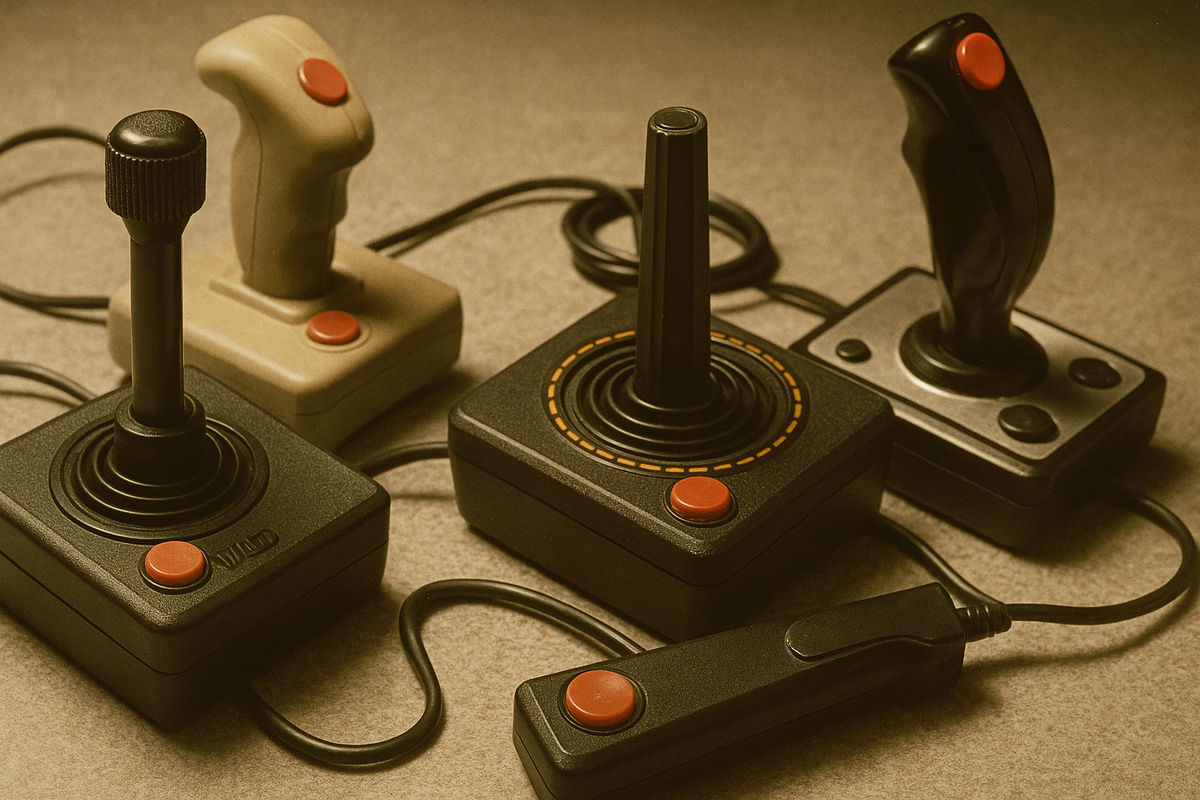
The March 1983 issue exemplified this mission. Its joystick feature combined hands-on reviews, price breakdowns, and technical analysis. Readers could compare the Wico Command Control, the Spectravision grip stick, the Supr Stick with micro-switches, and the experimental Cynex wireless joystick. This wasn't secondhand rumor—it was rigorous consumer reporting designed to empower players in a crowded, confusing market.
The impact was profound. Electronic Games didn't just review games; it legitimized gaming culture. It conveyed not just specifications, but sensory experience: the weight of plastic in the hand, the satisfying click of micro-switches, the frustration of loose sticks, and the thrill of arcade-style responsiveness at home. For many readers, these pages were as close as they'd come to testing every joystick on the market.
Visual Power and Cultural Authority
The cover of the March 1983 issue set the tone: bold, colorful, futuristic. Featuring a stern science-fiction villain looming over a glowing control panel, it projected both the power of gaming technology and the drama surrounding it. This wasn't a toy catalog—it was about mastery, innovation, and the very instruments of digital combat.
Inside, the joystick feature demonstrated what made Electronic Games indispensable. Controller images weren't mere illustrations—they were the story. Readers encountered close-ups of sleek grip handles, futuristic button placements, and rugged bases promising to withstand marathon Pac-Man or Defender sessions. Captions explained not just appearance, but function—how design influenced comfort, precision, and ultimately success.
Other publications might have offered little more than a price list. Electronic Games delivered a fusion of photography, narrative, and cultural context. This combination made the magazine iconic—and why issues like this remain powerful today.
The Hardware Revolution: Key Insights from "The Joys of Joysticks"
The article documented how standard Atari joysticks often failed under heavy use, forcing players to seek sturdier alternatives.
Controllers like the Supr Stick incorporated arcade-style micro-switches, promising precision and responsiveness at home.
Sticks such as the Spectravision grip model introduced ergonomic handles and multiple fire button placements, anticipating controller designs of later decades.
The Cynex remote joystick hinted at a cordless future, though its technical flaws revealed the technology wasn't ready.
With some sticks costing as much as $90, Electronic Games highlighted how controllers themselves had become big business.
Each review contributed to a larger narrative: controllers weren't accessories—they were extensions of the player. Choosing the right joystick could mean the difference between mastery and frustration.
Why This Feature Endures
Electronic Games' joystick feature endures because it was more than reporting—it was a time capsule. Every page carries the excitement, frustration, and ambition of early 1980s gaming culture. Today, when controllers are standardized across systems, this issue reminds us of an era when every joystick design was a gamble—and every choice shaped the experience of play.
That permanence is what makes vintage Electronic Games issues powerful for collectors. They are physical witnesses to gaming's adolescence, holding stories as relevant for understanding the past today as they were in 1983.
Collector Significance: Why This Issue Matters
For collectors of vintage gaming magazines, the March 1983 issue of Electronic Games transcends old paper—it's an artifact of gaming's first hardware revolution.
Why It's Collectible:
Released months before the video game crash, it documents a peak moment in industry experimentation.
Few magazines of the era devoted such space to controllers, peripherals, and accessories.
Owning this issue means holding the very pages that guided gamers in 1983 as they debated joystick supremacy.
Vintage Electronic Games magazines are consistently sought by retro gamers, hardware historians, and cultural archivists. Issues spotlighting controllers, arcades, or major consoles command especially high value.
When you hold this issue, you're not flipping through an old magazine. You're handling a document of video game history—the words and images that shaped how players understood their craft.
Explore the Collection
If you're looking to explore this issue or others like it, thousands of original Electronic Games magazines are available in our collection. From 1981 through the mid-1980s, you can trace the rise, fall, and rebirth of the video game industry as it was documented in real time.
Browse Electronic Games Magazine CollectionWhether you're a seasoned collector, a retro gamer, or someone honoring the history of the medium, these magazines offer something special: a chance to see gaming history as it was first reported.
Conclusion
The March 1983 issue of Electronic Games Magazine remains one of the most important hardware-focused publications of its era. Its coverage of the joystick explosion delivered both technical detail and cultural context to gamers at a crucial moment. Its reviews and commentary carry historical significance and collector value today.
Holding this issue is holding a moment when the battle for joystick supremacy mirrored the battle for the living room itself. Thanks to Electronic Games' unmatched coverage, those moments are preserved for us to revisit four decades later.
For anyone who values gaming history, vintage magazines like this aren't simply reading material—they are living artifacts. Through them, the past speaks directly to us.