
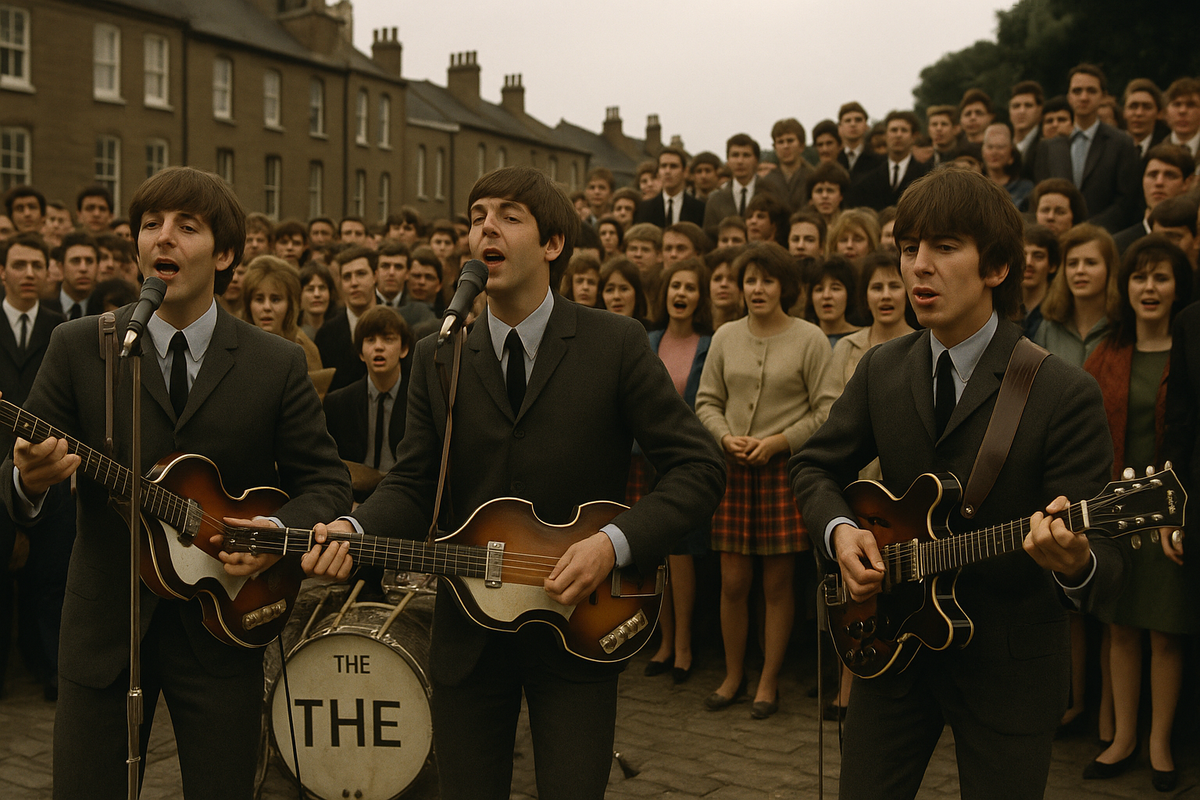
Rock 'n' Roll, The Beatles, and the Soundtrack of the Sixties
When Time Magazine recognized that guitars had become more powerful than politicians
May 21, 1965. Time Magazine put guitars on the cover.
Not politicians. Not generals. Not astronauts or corporate titans. Guitars. Amplifiers. Several famous groups from The Beach Boys to the Suprems. Inside the editorial featured the Beatles striding across a London street in matching suits. Dance floors packed with teenagers doing the Frug, the Jerk, the Monkey—moves their parents couldn't name and wouldn't attempt.
The cover line was direct: "Rock 'n' Roll: The Sound of the Sixties."
For Time's editors—accustomed to covering wars, elections, and diplomatic crises—this was a declaration: youth culture had graduated from distraction to dominant force. The music dismissed as teenage noise just a decade earlier now commanded serious attention from the magazine that shaped how America understood itself.
Seventy-three million people had watched The Beatles on The Ed Sullivan Show the previous year. Motown acts were climbing Billboard charts while the Civil Rights Movement challenged segregation. The Rolling Stones were bringing raw blues energy to suburban rec rooms. And across America, teenagers were dancing in ways that looked—to their horrified parents—less like choreography and more like revolution.
Time recognized what was happening: rock 'n' roll wasn't a fad burning out. It was the sound of cultural transformation.
Archive Details
Publication: Time Magazine, May 21, 1965
Cover Story: "Rock 'n' Roll: The Sound of the Sixties"
Featured Artists: The Beatles, The Rolling Stones, The Supremes, The Beach Boys, Elvis Presley, Chuck Berry, Chubby Checker
Cultural Context: Vietnam War escalation, Civil Rights Movement, British Invasion, Motown's rise
Dance Crazes Documented: The Frug, The Jerk, The Monkey, The Twist, The Watusi
1965: The Year Everything Accelerated
The world in May 1965 was balanced on multiple edges.
Vietnam was escalating. President Lyndon Johnson had authorized Operation Rolling Thunder—sustained bombing of North Vietnam—in February. The first U.S. combat troops had landed at Da Nang in March. By year's end, nearly 200,000 American soldiers would be deployed. Television brought the war into living rooms nightly, and college campuses were beginning to stir with protest.
The Civil Rights Movement was entering its most dangerous phase. "Bloody Sunday" in Selma had occurred two months earlier, with state troopers attacking peaceful marchers on the Edmund Pettus Bridge. The Voting Rights Act would pass in August, but the violence hadn't stopped—and wouldn't.
The Cold War maintained its grip. The space race continued. Nuclear anxiety persisted. Adults who had lived through World War II and Korea viewed the world through lenses of threat and containment.
And against this backdrop of tension and upheaval, teenagers were buying Beatles records, memorizing Supremes lyrics, and dancing to sounds their parents found incomprehensible.
Rock 'n' roll became the generational dividing line—not just music but identity, values, attitude. It was defiance set to a backbeat.
What Time Captured
The May 21, 1965 issue didn't just catalog hit songs. It traced rock's genealogy, acknowledged its power, and attempted to explain why this music mattered beyond the charts.
The Roots:
Time's reporters reached back to rhythm and blues, gospel, and the early pioneers who had scandalized America in the 1950s. Elvis Presley—once denounced as vulgar and dangerous—was now recognized as foundational. Chuck Berry's guitar work had created a template. Alan Freed's radio shows had broken racial barriers by playing Black artists to white audiences. Little Richard's manic energy had blown open possibilities.
These weren't nostalgia trips. They were acknowledgments that rock had legitimate artistic lineage, that it wasn't manufactured from nothing but had evolved from American musical traditions stretching back decades.
The British Invasion:
The Beatles dominated the narrative, and Time understood why. Four young men from Liverpool had arrived in America in February 1964 and triggered mass hysteria unlike anything since Frank Sinatra's bobby-soxer days. But The Beatles were different—they wrote their own songs, played their own instruments, projected intelligence and wit alongside charm.
The photographs showed them in sharp suits, hair perfectly styled, grinning with confidence. They looked simultaneously rebellious and respectable, dangerous enough to thrill teenagers but clean enough not to terrify parents completely.
The Rolling Stones occupied different territory. Where The Beatles charmed, the Stones menaced. Their blues-influenced sound was rawer, their image scruffier, their lyrics more explicitly sexual. Mick Jagger's stage presence suggested something primal that made Ed Sullivan's censors nervous.
Motown's Revolution:
While British groups grabbed headlines, Motown was achieving something equally significant: bringing Black artists into mainstream American pop culture during the Civil Rights era.
The Supremes—Diana Ross, Mary Wilson, Florence Ballard—weren't just singing; they were integrating radio stations that had previously refused to play "race records." Their polished sound, elegant presentation, and crossover appeal made them acceptable to white audiences while maintaining authenticity with Black listeners.
Smokey Robinson, Marvin Gaye, The Temptations, Martha and the Vandellas—Detroit's Hitsville U.S.A. was producing music that transcended racial boundaries through sheer quality and irresistible hooks.
Time noted this without fully grappling with the political implications. Motown's success occurred while Birmingham churches were being bombed and voting rights were being violently suppressed. The magazine recognized the phenomenon without deeply analyzing the contradiction.
The Dance Craze Documentation:
The photography was essential. Time's cameras captured teenagers in Chicago, Los Angeles, and Atlanta doing dances that had swept through youth culture: the Frug, the Jerk, the Monkey, the Watusi.
These weren't the formal partner dances their parents had learned. These were individual, improvisational, physical expressions of freedom. Bodies twisted, arms flailed, hips gyrated. The movements looked chaotic to older eyes but felt liberating to participants.
One image showed Chubby Checker mid-Twist, his body coiled with energy. Another captured a packed dance floor on NBC's "Hullabaloo," the camera angle emphasizing the crowd's collective motion.
The visual message was clear: this wasn't music for passive listening. It demanded physical participation, and teenagers were answering with their bodies.
Time's Editorial Perspective
The magazine's tone reflected institutional ambivalence.
The editors recognized rock's cultural dominance and economic power—the industry was generating hundreds of millions of dollars annually. They acknowledged the artistry of performers like The Beatles and the business acumen of figures like Berry Gordy at Motown.
But skepticism threaded through the coverage. Was this music profound or merely catchy? Revolutionary or commercially manufactured? Liberating or potentially corrupting?
The article left space for multiple interpretations, which was itself revealing. Time couldn't dismiss rock as trivial—the numbers and cultural impact were undeniable. But the magazine also couldn't fully embrace music that seemed to challenge established values and authority.
This tension captured the generational divide perfectly. Parents reading Time wanted to understand what their children were experiencing. The magazine offered explanation without endorsement, analysis without condemnation.
Why The Beatles Photograph Mattered
The image of The Beatles striding across a London street—confident, synchronized, sharply dressed—became iconic not because it showed wild rebellion but because it showed assimilation.
These were the dangerous rock 'n' rollers who had supposedly corrupted youth? They looked like well-groomed young professionals. Their hair was longer than traditional but neat. Their suits were fashionable but respectable. They smiled rather than sneered.
The photograph suggested that rock 'n' roll could be tamed, commercialized, made safe for mass consumption. It was reassuring and unsettling simultaneously—reassuring because The Beatles seemed manageable, unsettling because their manageable appearance made their influence more pervasive.
Parents couldn't point to The Beatles and say "that's obviously corrupting" the way they could with Elvis's hip swivels or Jerry Lee Lewis's piano-pounding mania. The threat was subtler, which made it harder to combat.
The Artifacts and the Message
Beyond the main feature, the issue contained standard Time elements: world news, business coverage, book reviews, advertisements.
The juxtaposition was striking. One page analyzed Vietnam strategy. The next showed teenagers dancing the Frug. Automobile ads promised power and prestige. Record company ads promised liberation and excitement.
This wasn't editorial confusion—it was accurate cultural documentation. America in 1965 contained multitudes: escalating war and expanding youth culture, racial violence and musical integration, traditional values and emerging counterculture.
Time presented these contradictions without fully resolving them, which was honest even if unsatisfying.
Collector Significance
The May 21, 1965 issue of Time Magazine is one of the most collectible cultural publications of the decade.
Cultural Milestone: It marks the moment rock 'n' roll was recognized not as a passing craze but as the dominant art form of the era.
Beatles Documentation: Any issue featuring The Beatles is highly prized by collectors, and this one captures them at the height of Beatlemania, just as they were transitioning from pop phenomenon to cultural force.
Visual History: The photographs of dance crazes, Motown groups, and early rock pioneers make this issue visually compelling—a primary source for understanding how the 1960s looked and moved.
Generational Divide: The issue embodies the cultural clash between generations, making it valuable to both music historians and collectors interested in broader social change.
Motown Integration: The coverage of The Supremes and other Motown artists documents a crucial moment in American racial history, when Black musicians were achieving mainstream success during the Civil Rights era.
Owning this issue means holding a piece of rock history—an artifact from when the music was raw, new, and world-changing.
The Long Echo
The May 21, 1965 issue marked a turning point in how mainstream media covered youth culture.
Prior to this, rock 'n' roll had been relegated to entertainment sections or dismissive trend pieces. By giving it cover treatment and serious analysis, Time acknowledged that cultural power had shifted.
The teenagers buying Beatles records in 1965 would be voting, protesting, and shaping policy by decade's end. The music wasn't separate from politics—it was training ground for the activism, experimentation, and social upheaval that would define the late 1960s.
Within three years, rock would soundtrack opposition to the Vietnam War. Within five, Woodstock would attempt to build a temporary utopia around music and communal values. Within a decade, punk would emerge to challenge rock's own commercialization.
But in May 1965, the revolution was still being sold in matching suits and polished dance routines. The explosion was coming, but it hadn't arrived yet.
Explore the Original Archives
From world wars to Woodstock, presidential elections to cultural revolutions, vintage Time magazines chronicled the 20th century as it happened—and every issue remains a collectible artifact of history.
Browse Time Magazine CollectionThe May 21, 1965 Time Magazine captured rock 'n' roll at a precise inflection point: no longer dismissible as teenage fad, not yet recognized as the revolutionary force it would become. The Beatles strode confidently inside the pages. Motown integrated the airwaves. Teenagers danced in ways that alarmed their parents. And Time's cameras documented all of it, preserving the moment when guitars became more powerful than politicians.