
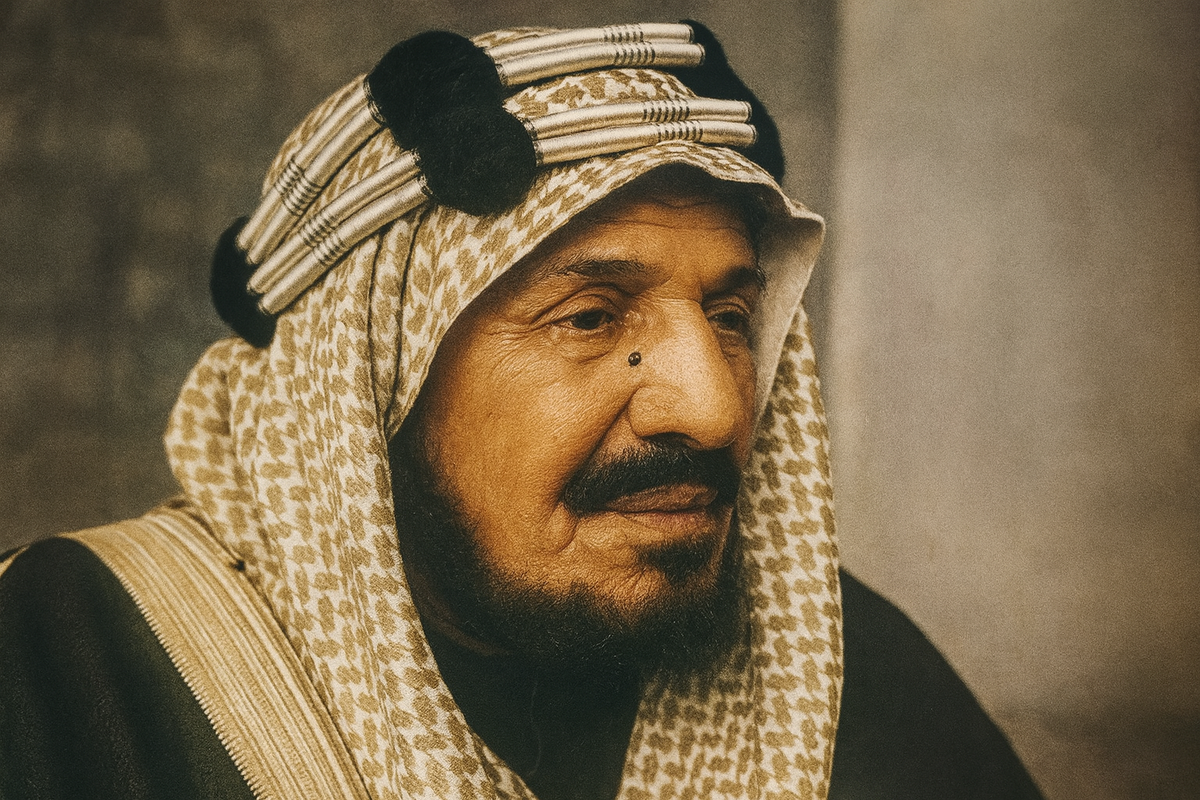
When Life Magazine Brought the King of Arabia to America's Living Rooms
On May 31, 1943, American households opened their mailboxes to find something extraordinary: the face of King Abdul Aziz ibn Saud staring back from the cover of Life Magazine—stark, regal, and utterly unfamiliar. For a nation deep in the machinery of World War II, this was not escapist entertainment. It was an introduction to a man and a kingdom that would reshape the century.
The feature inside, "The King of Arabia," was unlike anything Life had published. Here was a monarch who ruled a land most Americans couldn't locate on a map, yet commanded the holiest cities in Islam and sat atop oil reserves that would fuel empires. The timing was no accident. By spring 1943, Allied strategists were already sketching the postwar world, and Saudi Arabia—founded just eleven years earlier—was becoming impossible to ignore.
What made this issue unforgettable wasn't just the photography, though Robert Landry's images were stunning. It was the collision of worlds: falconers and oil derricks, Bedouin caravans and radio towers, ancient tribal justice and American petroleum engineers. And buried in the text was a diplomatic bombshell—Ibn Saud's first public statement opposing a Jewish homeland in Palestine, delivered in Arabic and translated for an audience of millions.
This wasn't travel writing. It was a geopolitical dispatch disguised as photojournalism.
Archive Details
Historical Figure: King Abdul Aziz ibn Saud, Founder of Saudi Arabia
Issue Date: May 31, 1943
Archive Source: Life Magazine
Photographer: Robert Landry
Writer: Noel Busch
The Desert Kingdom America Needed to Understand
In 1943, Saudi Arabia was barely a teenager as a nation. Ibn Saud had spent three decades uniting warring tribes through conquest, marriage alliances, and his authority as a religious leader descended from the Wahhabi movement. By the time Life arrived, his kingdom stretched across the Arabian Peninsula, anchored by Mecca and Medina—a spiritual dominion no Western power could rival.
But it was what lay beneath the sand that made Washington pay attention. Standard Oil of California, operating under what would become Aramco, had struck oil in Dhahran in 1938. By 1943, the wells were pumping, and American oilmen were building infrastructure in a land where camels still outnumbered cars. The contradiction was perfect for Life's lens: a medieval monarchy hurtling toward industrial modernity, with American capital greasing the wheels.
Ibn Saud understood the bargain. He needed revenue to consolidate power and modernize his fragile state. The Americans needed a reliable energy partner in a region crawling with British and French colonial interests. The alliance was pragmatic, not sentimental—and Life captured it at the moment of conception.
Photography as Diplomatic Intelligence
Life didn't just report on Saudi Arabia—it revealed it. For an American public conditioned to think of the Middle East through biblical imagery or Orientalist fantasy, Landry's photographs were a corrective and a provocation.
Readers saw Ibn Saud seated on his throne in Riyadh, radiating authority without Western trappings. They saw his sons—future kings among them—posed as both tribal heirs and modern statesmen. They saw women veiled in black beneath palace walls, markets bristling with commerce, and public punishments carried out under Sharia law. There were falconers and camel herders, yes—but also oil rigs silhouetted against the desert, radio antennas piercing the sky, and American engineers in khakis standing beside Bedouin guides.
The visual grammar was deliberate: this was a nation in transition, balanced between seventh-century tradition and twentieth-century ambition. And Life, with its unmatched distribution, made sure thirty million Americans saw it.
But the most significant image may have been the one readers couldn't see—the moment Ibn Saud chose Life as the vehicle for his first public comments on Palestine. Published in full, his opposition to Zionist settlement was framed as a defense of Arab sovereignty and Islamic heritage. For American Jews and Christian Zionists, this was jarring. For State Department officials, it was a preview of the diplomatic minefield ahead.
The magazine didn't editorialize. It didn't need to. The King had spoken, and Life had made him impossible to ignore.
Why This Issue Became Essential History
Eighty years later, the May 31, 1943 issue of Life is more than a collectible—it's a primary source. Scholars of Middle Eastern politics, oil diplomacy, and wartime journalism return to it because it captures a hinge moment: when Arabia transitioned from British sphere of influence to American strategic partner, when oil became the currency of superpower politics, and when a desert king became a player on the world stage.
For collectors, the appeal is layered. The issue is historically pivotal, visually arresting, and increasingly rare in good condition. It documents the origins of the U.S.-Saudi relationship—a partnership that would define energy markets, arm sales, and Middle Eastern geopolitics for decades. It's also a masterclass in Life's photojournalistic power: the marriage of Busch's prose and Landry's images created something closer to documentary filmmaking than magazine writing.
And then there's the artifact itself—the weight of the paper, the smell of aging ink, the knowledge that this exact issue sat on a coffee table in 1943 while families listened to war bulletins on the radio. These magazines are time capsules, and this one carries the DNA of the modern Middle East.
What Makes It Collectible Today
Unprecedented Access
Few Westerners had photographed Ibn Saud or entered Riyadh. This remains one of the earliest visual records of the Saudi court.
The Palestine Pronouncement
Ibn Saud's statement is a historical marker. Researchers studying the origins of the Israeli-Palestinian conflict consider this issue essential reading.
Oil's Origin Story
The images of early Aramco operations document the beginning of the petroleum age in Saudi Arabia. Energy historians treat these photographs as foundational.
Cultural Contrast
The juxtaposition of premodern tribal life with American-engineered modernity creates a visual tension that still resonates. This wasn't just reporting—it was anthropology in real time.
Wartime Context
Published as the Allies prepared for the invasion of Sicily, the issue reflects strategic thinking about postwar order. Arabia mattered because oil, Islam, and geography were converging into geopolitical leverage.
Photojournalistic Mastery
Robert Landry's images represent Life at its technical and narrative peak—documentary photography that shaped how Americans understood the world.
Collectors seek this issue not for nostalgia, but for substance. It's a document of consequence, beautifully executed.
The Artifact as Archive
There's a reason serious collectors preserve these magazines in archival sleeves and handle them with care. Unlike digital media, which can be altered or deleted, the physical magazine is immutable. What Life printed in 1943 stays printed—no revisions, no updates, no algorithmic filtering.
When you hold this issue, you're holding the same narrative that shaped American perceptions of Saudi Arabia during World War II. You're seeing Ibn Saud exactly as readers saw him when the outcome of the war was still uncertain. You're reading the Palestine statement as it was first delivered to a Western audience—unfiltered by seventy years of commentary and conflict.
For historians, that permanence is invaluable. For collectors, it's what separates ephemera from legacy.
Why Collectors Seek This Issue
Historical Timing
Published during World War II, it captures Arabia at the moment it was beginning to matter profoundly in global strategy—before most Americans understood why.
Groundbreaking Access
Few outsiders had ever been permitted to photograph Ibn Saud or Riyadh. This issue remains one of the earliest and most complete visual records.
Political Importance
The Palestine pronouncement adds immense historical significance, making this issue essential for scholars of the Middle East and diplomatic history.
Cultural Documentation
The juxtaposition of falcons, camels, and desert caravans with oil rigs and radios creates a time capsule of transition—a kingdom caught between worlds.
Building Your Collection
If you're drawn to magazines that document turning points in history—where culture, politics, and media intersect—the wartime issues of Life are unmatched. From Pearl Harbor to Hiroshima, from D-Day to the founding of the United Nations, Life was there, camera ready, and these issues remain the visual record of the era.
The May 31, 1943 Arabia issue stands among the most significant. It's not just about one king or one kingdom—it's about the forces that shaped the second half of the twentieth century, captured in real time by the most powerful photojournalism operation ever assembled.
Browse Life Magazines CollectionThe Issue That Still Speaks
The May 31, 1943 issue endures because it was built to. Life's editors knew they were documenting history, not just reporting news, and they approached the Arabia feature with the gravity it deserved. The result is a magazine that doesn't feel like journalism—it feels like prophecy.
Ibn Saud's kingdom did become a global power. The oil did reshape economies and wars. The Palestine question did dominate Middle Eastern politics for generations. And the photographs—camels against oil derricks, veiled women beside radio towers—became the visual shorthand for a region caught between past and future.
When you read this issue today, you're not looking back at quaint wartime reporting. You're watching the modern Middle East take shape, one photograph at a time. That's not nostalgia. That's architecture.
And that's why collectors keep searching for it.