
The Nazi-Soviet Pact, Stalin and Hitler's Deal, and the World on the Edge of War
How LIFE Magazine's September 4, 1939 issue captured the diplomatic earthquake that unleashed World War II
On September 4, 1939, Americans opened their mailboxes to find something more dangerous than a weekly magazine—they found the photographic proof that the world had just cracked open.
LIFE's coverage of the Nazi-Soviet Pact hit American breakfast tables with the force of a diplomatic bomb. Hitler and Stalin—sworn ideological enemies—had signed a deal in Moscow. Poland's fate was sealed. And Henry Luce's photographers had captured the exact moment two totalitarian powers decided to carve up Eastern Europe.
These weren't illustrations. They were evidence.
Archive Details
Publication: LIFE Magazine
Issue Date: September 4, 1939
Historical Event: Nazi-Soviet Non-Aggression Pact (Molotov-Ribbentrop Pact)
Key Figures: Joseph Stalin, Vyacheslav Molotov, Joachim von Ribbentrop, Adolf Hitler
Significance: Published as German troops invaded Poland, marking the beginning of World War II
The Week Everything Changed
Late August 1939 was thick with dread. Hitler had already swallowed Austria, gutted Czechoslovakia, and torn away the Sudetenland. Poland was next. Everyone knew it.
The question wasn't if Hitler would invade—it was whether Stalin would stop him.
On August 23, 1939, the world got its answer. Nazi Germany and the Soviet Union signed a non-aggression pact in Moscow, stunning diplomats from Washington to London. Hidden within the agreement was a secret protocol that turned Eastern Europe into a chessboard: Germany would take western Poland. The Soviets would seize the east. The Baltic states would follow.
Hitler's nightmare—a two-front war—evaporated overnight.
Eight days later, German tanks rolled across the Polish border.
LIFE Showed What Newspapers Could Only Tell
LIFE's genius in 1939 was its refusal to treat news as text. Photography was the story.
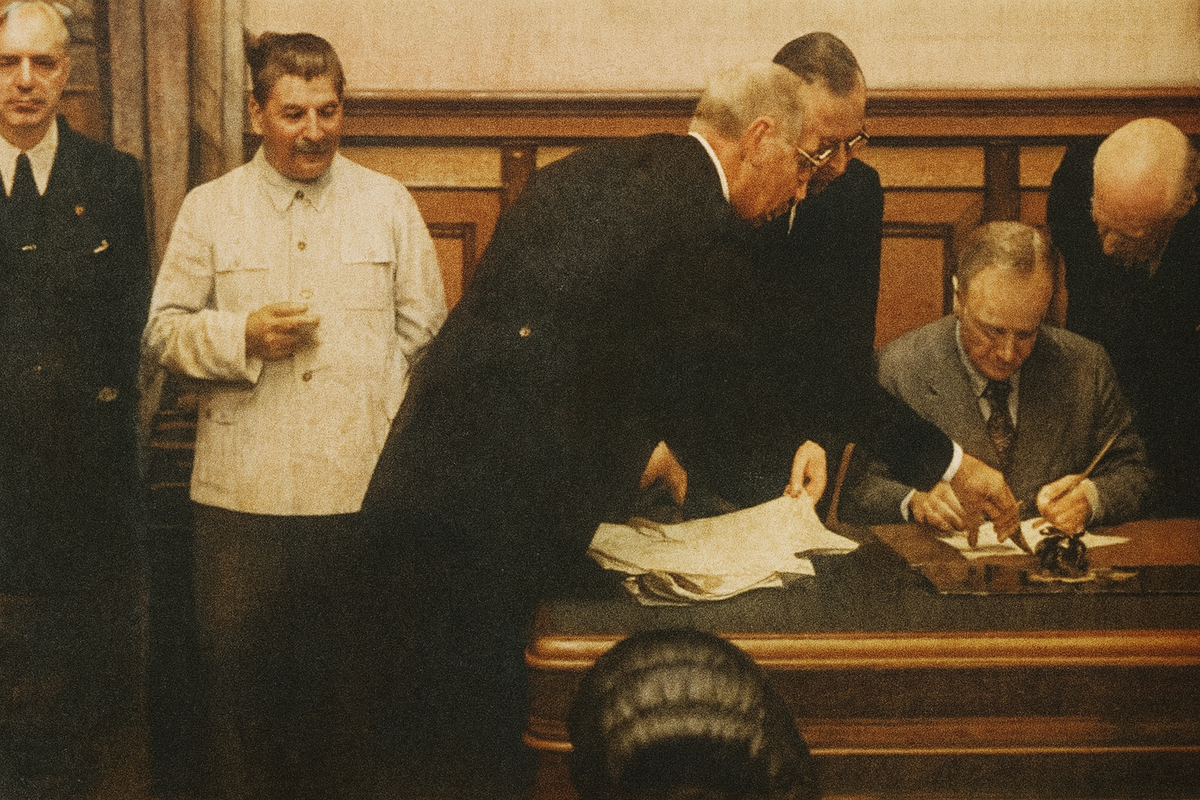
One image became iconic almost immediately: Stalin in his white tunic, cigarette in hand, watching as Foreign Minister Molotov bent over the treaty to sign. Beside him stood Ribbentrop—Hitler's emissary, representing a regime that had spent years denouncing Bolshevism as the ultimate evil. Now they were partners.
Another photograph showed Hitler greeting Ribbentrop upon his return to Berlin. The Führer's smile said everything: Poland was his, and no one would intervene.
LIFE didn't bury the story in diplomatic language. The magazine framed it in raw, ideological terms: two "political religions"—Nazism and Communism—had struck a devil's bargain. The betrayal felt across Britain, France, and the democratic world was palpable. Any hope of a united front against Hitler collapsed in a single signature.
For Americans reading at their kitchen tables, these images made the threat immediate. This wasn't abstract European diplomacy. This was the prelude to catastrophe.
Rosalind Russell and the Coming Storm
The cover of that September 4 issue featured actress Rosalind Russell promoting The Women—Hollywood glamour in full bloom. At first glance, the frivolity seemed absurd beside the gravity inside.
But that contrast was the point. LIFE understood American life in 1939: entertainment and looming war existed side by side. People still went to movies while Europe mobilized for slaughter.
Inside, the Nazi-Soviet Pact feature became the centerpiece—a masterclass in visual journalism:
The photographs weren't decorative. They were primary sources, freezing Stalin, Molotov, and Ribbentrop in the act of redrawing Europe's borders.
The narrative was visceral. LIFE used language like "screaming barrages of threats" and "nightmare of late August" to convey urgency without hysteria.
The analysis cut deep. LIFE understood the pact as cynical realpolitik: Stalin buying time to rebuild Soviet military strength, Hitler clearing his eastern flank to wage war without interference.
No other American publication combined speed, photography, and insight like this. LIFE wasn't just reporting history—it was creating the visual record.
What LIFE Captured That Week
Molotov and Ribbentrop formalized the agreement under Stalin's watchful gaze, a visual symbol of enemies turned expedient allies.
The Soviet dictator needed breathing space. His military purges had gutted officer ranks. The pact bought him time.
With his eastern border secured, Hitler could invade Poland without fear of Soviet retaliation.
Britain and France had been courting Stalin for months, hoping to encircle Germany. The pact shattered that strategy overnight, leaving Poland exposed.
LIFE described Nazism and Communism as competing faiths. Their sudden cooperation defied every assumption about 1930s geopolitics.
Germany's ally in the Anti-Comintern Pact suddenly found itself abandoned as the USSR pivoted westward.
LIFE documented German newspapers whipping up anti-Polish hysteria to justify the coming invasion.
The photographs captured something chilling: Stalin's quiet, calculating expression as he watched Ribbentrop sign. This was realpolitik stripped of any pretense.
LIFE didn't just report facts. It preserved the feeling of late August 1939—the dread, the confusion, the dawning realization that war was now inevitable.
For millions of U.S. readers, these pages were their first visual evidence of the deal that unleashed World War II.
Why Collectors Prize This Issue
Published as German troops crossed into Poland, it captures the precise moment when World War II began. There is no earlier American visual record of the crisis.
The images of Stalin, Molotov, and Ribbentrop in Moscow are among the most reproduced photographs of the pre-war period. Owning them in their original LIFE printing means possessing the first draft of history.
Millions of Americans formed their understanding of the Nazi-Soviet Pact through these pages. This magazine shaped public perception of the war's origins.
Issues tied to watershed moments—Pearl Harbor, D-Day, the liberation of concentration camps—command attention in the vintage magazine market. The September 4, 1939 issue ranks at the top.
Unlike digital scans or reprints, an original copy carries the physical presence of 1939—paper aged by time, ink that touched presses in the final days before the world went to war.
Why Original Magazines Matter
LIFE's power transcends nostalgia. These magazines function as time capsules, preserving not just historical facts but the emotional texture of the moment. The September 4, 1939 issue doesn't merely explain the Nazi-Soviet Pact—it shows how Americans first encountered it, before anyone knew how devastating the war would become.
In an era when news is ephemeral and digital, these printed artifacts endure as physical witnesses. They hold the weight of history in your hands.
Explore the Archive
Thousands of original LIFE magazines remain available—covering politics, war, culture, art, and daily life from the 1930s through the 1970s.
Browse Life Magazine CollectionWhether you're a serious collector building a World War II archive, a historian seeking primary sources, or someone honoring family memories from the era, vintage LIFE magazines offer something irreplaceable: the chance to see history as it was first reported—unfiltered, immediate, and unforgettable.
The September 4, 1939 issue of LIFE Magazine remains one of the most significant pre-war publications ever printed. Its coverage of the Nazi-Soviet Pact delivered a jolt to American readers—proof that old enemies could become partners when power demanded it, and that the world was hurtling toward a conflict no one could stop.
To hold this issue today is to hold the moment when peace finally shattered.