
The Magazine That Broke the Silence
When Ladies' Home Journal Published the Kinsey Report
September 1953. American women reached for their mailboxes and pulled out the latest issue of Ladies' Home Journal—expecting recipes, fashion spreads, and advice on keeping a tidy home. Instead, they found something that would be discussed in whispers over backyard fences for months to come: "What Women Want to Know About the Kinsey Book."
Barbara Benson's article about Dr. Alfred C. Kinsey's Sexual Behavior in the Human Female didn't just report on a scientific study. It detonated a conversation that had been suppressed in living rooms across America. For the first time, a mainstream women's magazine—one that sat on millions of coffee tables—dared to discuss female desire, marital dissatisfaction, and the private sexual lives that contradicted everything the era claimed to believe about women.
This wasn't a fringe publication or an academic journal. This was Ladies' Home Journal, the most trusted voice in American domesticity, and it had just handed its readers a lit match.
Archive Details
Publication: Ladies' Home Journal
Issue Date: September 1953
Featured Article: "What Women Want to Know About the Kinsey Book" by Barbara Benson
Cover Photography: Virginia Thoren
Historical Context: Published the same year as Sexual Behavior in the Human Female
The Perfect Storm of 1953
The timing was combustible. Dr. Kinsey had already rattled the nation in 1948 with Sexual Behavior in the Human Male, but his 1953 follow-up study on women struck a deeper nerve. In a culture that idealized women as moral guardians—chaste before marriage, satisfied within it—Kinsey's data revealed a starkly different reality. The survey documented premarital sex, extramarital affairs, and sexual frustration in marriages that looked picture-perfect from the outside.
Religious leaders denounced it from pulpits. Politicians called for investigations. Conservative commentators warned that Kinsey's research would corrupt American morals. But ordinary women? They wanted answers.
The gap between public morality and private reality had never been wider, and Ladies' Home Journal stepped directly into that void.
Why This Magazine Mattered
Ladies' Home Journal wasn't breaking cultural ground for shock value. As one of the most widely circulated women's magazines in America, it had built its reputation on understanding what its readers actually needed—not what society insisted they should want. The decision to publish Benson's article was strategic: translate explosive scientific findings into language that wouldn't alienate readers, but wouldn't patronize them either.
The article's genius lay in its structure. Benson framed Kinsey's findings as a Q&A, anticipating exactly what women were thinking but afraid to ask aloud:
Does this mean love is less important to women than to men?
Can frigid women make good mothers?
Each question received a careful answer grounded in Kinsey's data, but the editors protected themselves—and their readers—with strategic disclaimers: "The facts of behavior as reported… are not to be interpreted as moral or social justification for individual acts."
This tightrope walk was deliberate. The magazine needed to inform without appearing to endorse, to educate without seeming to corrupt. In doing so, it performed a high-wire act of cultural mediation that few publications could have managed.
The Readers Wrote Back—In the Margins
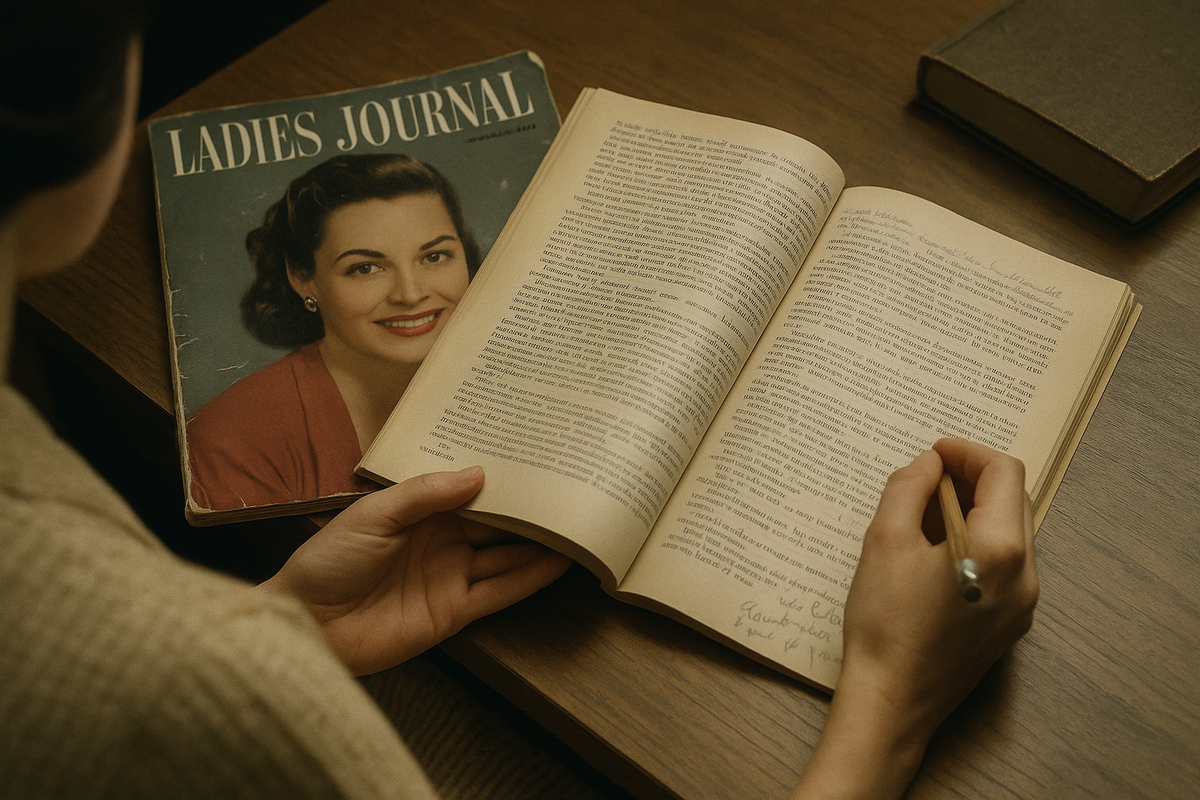
Surviving copies of the September 1953 issue reveal something extraordinary: readers didn't just consume this article passively. They engaged with it, pen in hand.
In the margins, women scribbled their reactions:
"It will be so much more understanding of my boy's problems now that I know what to expect."
These annotations—still visible in preserved copies today—transform the magazine from historical artifact into intimate testimony. The Kinsey Report wasn't an abstract scientific document to these readers. It was personal. It was ammunition for conversations they'd been afraid to start: with daughters preparing for marriage, with sons navigating adolescence, with husbands who had never asked what their wives actually wanted.
The handwritten notes prove that this article functioned as something more than journalism. It became a tool for change within individual families.
The Cover's Calculated Contradiction
Virginia Thoren's cover photograph for the September 1953 issue presented exactly what readers expected: elegance, poise, domestic refinement. The visual language was reassuring, even conservative. This was intentional.
The cover had to earn the reader's trust before the interior pages challenged everything that trust was built on. A magazine that looked radical on the outside would never have been opened by the women who needed to read Benson's article most. The domesticity of the cover was the very thing that gave the contents their power—a Trojan horse of scientific truth smuggled into homes under the guise of conventional femininity.
This wasn't deception. It was editorial strategy at its finest.
The Long Shadow of a Single Article
The 1950s are often remembered as monolithically conservative—an era of suburban conformity and rigid gender roles. But magazines like Ladies' Home Journal reveal the fissures in that facade. Beneath the polished covers and decorating tips, women were asking dangerous questions about autonomy, desire, and the terms of their own marriages.
This issue mattered because it legitimized those questions. By presenting Kinsey's research as something respectable women should understand, Ladies' Home Journal made scientific inquiry into female sexuality not just acceptable but essential. The conversations that began in those margins—between mothers and daughters, wives and husbands—were the same conversations that would eventually demand birth control access, reproductive rights, and an end to the sexual double standard.
Those movements didn't emerge from nowhere. They grew from living rooms where women read Barbara Benson's article and realized they weren't alone in their questions.
Why Collectors and Historians Prize This Issue
Historical Synchronicity
Published the same year as Sexual Behavior in the Human Female, it captures the immediate cultural shockwave—not the retrospective analysis that came decades later. This is primary source material documenting how Americans processed one of the century's most controversial scientific studies in real time.
The Annotations
Copies bearing reader notes in the margins are especially valuable. These handwritten responses provide unfiltered insight into how ordinary women—not academics, not critics—wrestled with Kinsey's findings in their own lives.
Cultural Inflection Point
This issue sits at the precise intersection of 1950s conformity and the emerging discourse that would fuel second-wave feminism. It documents the moment when private questions began demanding public answers.
Original Artifact
For researchers studying the history of sexuality, women's media, or mid-century American culture, this magazine is irreplaceable. It's not commentary about the era—it is the era, preserved in ink and paper.
A Magazine That Dared
The September 1953 issue of Ladies' Home Journal is more than a collectible. It's evidence of a publication that understood its cultural moment and refused to look away from it. At a time when silence around female sexuality was enforced as social policy, this magazine opened the door—carefully, cautiously, but unmistakably.
For collectors, it represents a rare confluence of cultural significance, historical timing, and preserved reader engagement. For historians, it's a window into how mainstream media shaped—and was shaped by—the most controversial science of its time. For anyone curious about how social change actually happens, it's a reminder that revolutions don't always announce themselves with manifestos. Sometimes they arrive in the mail, tucked between advertisements for dish soap and vacuum cleaners.
Explore the Archive
Browse the full collection of original Ladies' Home Journal magazines and discover decades of cultural history, from fashion and literature to the moments when ordinary publications captured extraordinary change.
Browse Ladies' Home Journal Magazine Collection