
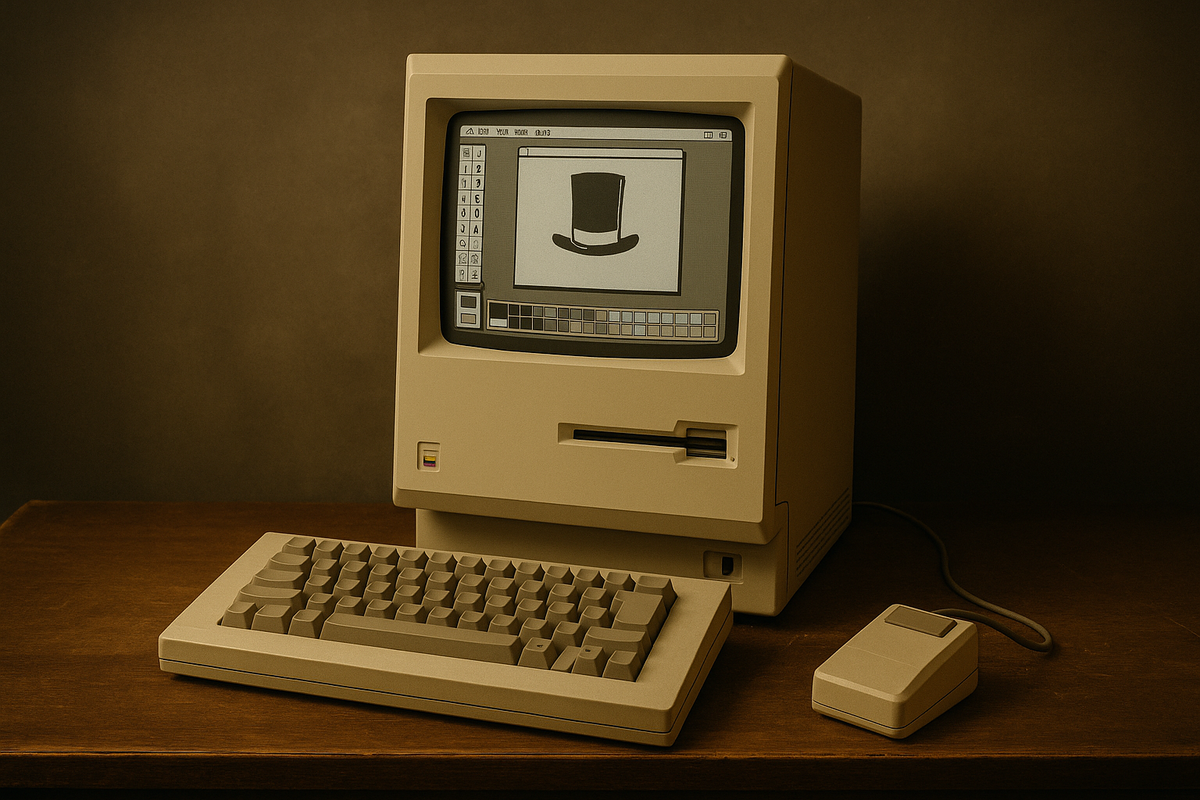
When Apple's Computer Wore a Top Hat
The Magazine That Saw the Mac as Magic
March 1985. The video game industry was still crawling out of the wreckage of its 1983 collapse. Atari had imploded. Arcades were closing. Wall Street had written off interactive entertainment as a fad that burned bright and died young.
And then Electronic Games Magazine did something audacious.
They put a Macintosh on their cover—dressed in a top hat and white gloves, fingers poised at the keyboard like a vaudeville magician about to pull a rabbit from a digital hat. The headline read: "Mac Magic: Apple's Toy for Adults."
This wasn't just a review. It was a manifesto. And holding that issue today is like holding a transcript of the future being argued into existence.
The Moment Everything Changed
Twelve months earlier, Apple had aired its now-legendary Super Bowl ad and launched the Macintosh into a skeptical world. The computer industry in 1984 was dominated by command-line interfaces, DOS prompts, and machines built for spreadsheets, not inspiration. The idea that a computer could be fun—that it could blur the boundary between tool and toy—seemed absurd to most observers.
But Electronic Games saw something else.
The magazine had built its reputation as the first serious voice in gaming journalism, treating video games as cultural artifacts rather than disposable amusements. When they turned their attention to the Macintosh in March 1985, they weren't reviewing hardware specs. They were documenting a paradigm shift.
The Mac had a mouse. It had a graphical interface. It had software like MacPaint and MacWrite that made creation feel like play. And crucially, it had networked games like Maze Wars—a primitive but prophetic 3-D shooter where players could hunt each other across connected machines.
This wasn't business computing. This was the birth of creative computing as a playground for adults.
Archive Details
Publication: Electronic Games Magazine
Issue Date: March 1985
Featured Article: "Mac Magic: Apple's Toy for Adults"
Historical Context: Published one year after the Macintosh debut (January 1984)
Cultural Significance: Documented the shift from business computing to creative computing
The Feature That Became a Prophecy
Inside the March 1985 issue, "Mac Magic: Apple's Toy for Adults" reads like dispatches from a future that hadn't quite arrived yet. The writers acknowledged the Mac's limitations—its lack of arcade-style color graphics, its price point that kept it out of most homes. But they also recognized something revolutionary.
The mouse was hailed as "a superior pointing device," a tool that made interaction intuitive rather than arcane. Bill Budge, the legendary creator of Pinball Construction Set, was already imagining 3-D space simulations on the platform—visions that would become Descent, Marathon, and eventually Halo.
Programs like MacPaint and SoundVision weren't just productivity software. They were instruments of play, systems where the act of creation itself became entertainment. The article argued that the Macintosh occupied a new category: not console, not mainframe, but something stranger and more potent—a machine where work and imagination were indistinguishable.
Electronic Games understood what many wouldn't grasp for years: the Macintosh wasn't competing with the Nintendo Entertainment System or IBM clones. It was inventing an entirely new form of human-computer interaction.
Why That Cover Still Matters
The image of the Macintosh in a top hat, performing tricks at its own keyboard, was more than clever design. It was semiotics made manifest.
Apple had positioned the Mac as a tool of empowerment, a computer "for the rest of us." But Electronic Games saw the theatrical potential—the way this machine could transform users into performers, creators, magicians conjuring experiences from pixels and code.
That cover remains one of the most iconic in 1980s gaming journalism because it captured the Mac's dual identity: serious enough for professionals, playful enough for dreamers, strange enough to suggest that computing itself was about to become something radically different.
Key Innovations Highlighted
The Mouse Revolution
The Mac's mouse was celebrated as "a superior pointing device" that made games and design far more intuitive than keyboard commands—a breakthrough that would define computing for decades.
Maze Wars & Multiplayer
The feature highlighted Maze Wars, a 3-D networked game where Mac users could battle across connected machines, foreshadowing the online multiplayer revolution.
Bill Budge's Vision
The legendary programmer imagined future 3-D space simulations on the Mac, pointing toward genres that would define gaming in the 1990s and beyond.
Creative Tools as Play
Programs like MacPaint, SoundVision, and MacVision blurred the line between work and entertainment, showing how creativity itself could be a form of gaming.
The Long Shadow of "Mac Magic"
The March 1985 issue of Electronic Games endures because it was written by people who understood that technology is only interesting when it changes what humans believe is possible.
The Mac's mouse, its GUI, its networked games, its creative software—none of these were just features. They were arguments about what computing could become. And Electronic Games, a magazine born from the arcade era, recognized that these arguments mattered.
Today, when every device seamlessly blends productivity and entertainment, when multiplayer gaming happens across continents in real time, when creation tools are accessible to anyone with a screen, the vision articulated in "Mac Magic" feels less like journalism and more like prophecy.
The writers couldn't have known that Apple would become the most valuable company on earth. They couldn't have predicted Myst, The Sims, or the iPhone. But they saw the pattern forming—the shift from computing as calculation to computing as imagination.
That's why this issue remains essential. It caught lightning in a bottle.
The Collector's Lens: Why This Issue Endures
Historical Placement
Published just one year after the Mac's debut, it captures the machine at its most vulnerable and most promising. This wasn't retrospective wisdom; it was real-time prophecy.
Visual Identity
The magician-themed cover is singular. No other publication of the era framed the Macintosh with such theatrical sophistication.
Cultural Documentation
The feature doesn't just review hardware; it documents the moment when computing culture split into two paths. One led to business productivity. The other led to creative play. The Mac promised to walk both simultaneously.
Cross-Disciplinary Appeal
Gaming historians want it. Apple collectors need it. Students of 1980s design culture hunt for it. Few issues speak to multiple collector communities with equal authority.
Explore the Archive
The March 1985 issue is one of thousands of original magazines available in our collection, documenting the evolution of gaming and computing from the arcade golden age through the home console revolution and the birth of personal computing.
For collectors, historians, and anyone captivated by the moment when technology became culture, these magazines offer something irreplaceable: the chance to see the future as it was first imagined, when the outcome was still uncertain and the possibilities felt limitless.
Browse Electronic Games Magazine CollectionThe Macintosh in the top hat wasn't just a clever illustration. It was a promise. And in March 1985, Electronic Games Magazine was there to document the moment that promise was made.