
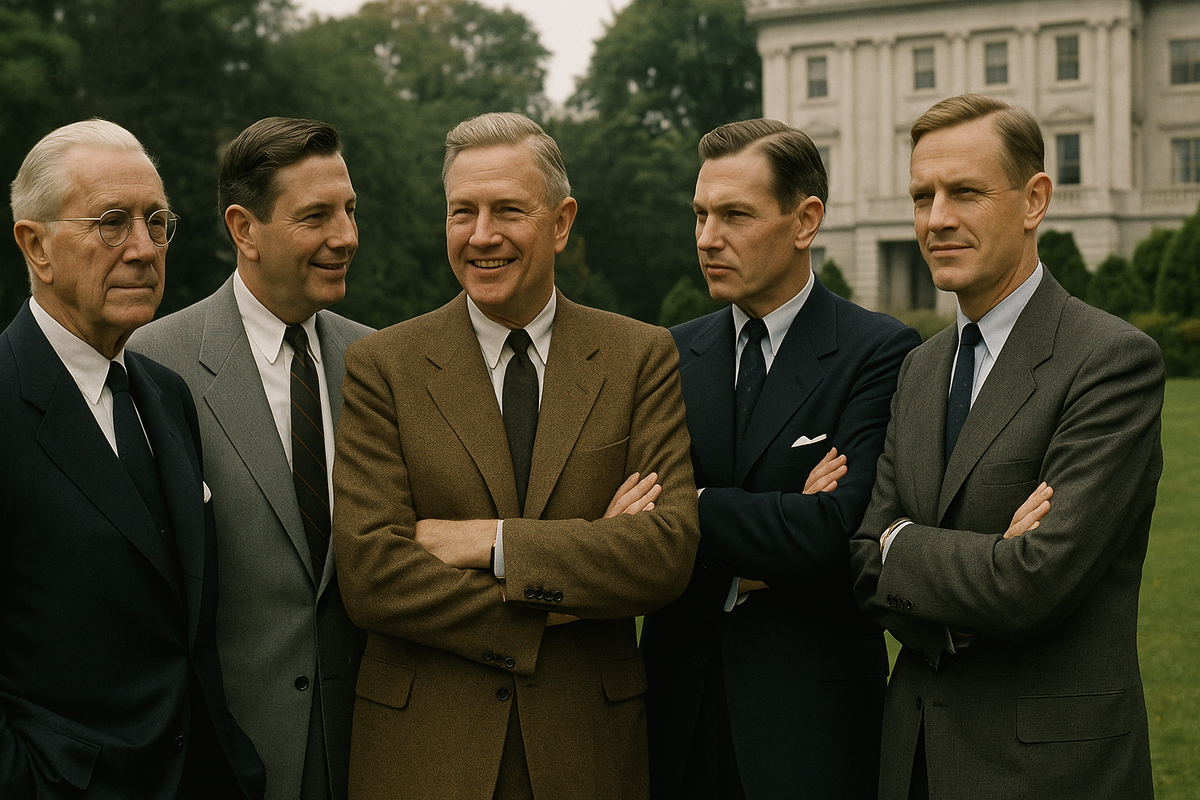
When America Met Its Richest Brothers
The Saturday Evening Post's 1951 Rockefeller Exposé and the Dawn of Cold War Capitalism
On a winter morning in 1951, millions of Americans opened their mailboxes to find something unexpected: an invitation into the most guarded family in the nation.
The January 6th issue of The Saturday Evening Post didn't just profile the Rockefeller brothers—it dissected them. Joe Alex Morris's feature, "The Rockefellers," was the first time the five sons of John D. Rockefeller Jr. had been examined collectively for a mass audience. What readers found wasn't a puff piece. It was a study in inherited power at a moment when America was deciding what kind of superpower it wanted to be.
This wasn't celebrity journalism. It was anthropology.
Archive Details
Publication: The Saturday Evening Post
Issue Date: January 6, 1951
Feature Article: "The Rockefellers" by Joe Alex Morris
Cover Artist: John Falter
Historical Context: Cold War Era, Korean War (8 months active)
Five Brothers, Five Americas
The brilliance of Morris's reporting lay in its structure. Rather than treat the Rockefellers as a monolith, he showed how each brother had carved out a distinct philosophy of wealth—and in doing so, embodied a different vision of postwar America.
John D. Rockefeller III was the methodical philanthropist, attempting to turn charity into a science. His obsession: how to give money away well. In an era when American foundations were becoming instruments of soft power abroad, John III was building the scaffolding for strategic giving that would shape global development for decades.
Nelson Rockefeller was already deep in politics by 1951, having served as Coordinator of Inter-American Affairs under FDR. Morris captured him at Rockefeller Center—not as a businessman, but as a public servant in waiting. The photographs showed a man at ease with power, foreshadowing his eventual rise to the governorship of New York and the vice presidency.
Laurance Rockefeller chose a quieter path: science and conservation. The article revealed his fascination with entomology—beetles, of all things—and his investments in medical research. While his brothers courted headlines, Laurance was funding the laboratories and wilderness preserves that would define his legacy.
Winthrop Rockefeller was the rebel. Morris documented his stint working manual labor jobs, a deliberate rejection of dynastic expectations. It was performance, perhaps, but it was also genuine—a man trying to understand the world his fortune had insulated him from.
David Rockefeller, the youngest, was already fixated on global finance. By 1951, he was positioning himself at the intersection of American banking and international diplomacy, a role that would make him one of the most influential private citizens of the Cold War era.
What made this article remarkable wasn't just the access—it was the implicit question Morris posed to readers: Is this what American aristocracy looks like?
Why This Issue Mattered in 1951
Context is everything. The Korean War was eight months old. McCarthyism was gaining momentum. The Marshall Plan had just finished rebuilding Western Europe, and the United States was locked in an ideological death match with the Soviet Union.
Into this charged atmosphere came a feature about five men who controlled more wealth than most nations. The timing was deliberate. The Saturday Evening Post was asking its readers to consider whether inherited wealth could coexist with democracy—and whether the Rockefellers, specifically, were using their fortune responsibly or simply perpetuating oligarchy.
The article didn't answer that question. It let readers decide. That restraint is why it remains valuable today.
The Post's Genius: Packaging Power for Middle America
By 1951, The Saturday Evening Post had perfected a formula: give Americans high-quality reporting wrapped in the comfort of Norman Rockwell covers and serialized fiction. The January 6th issue was no exception. John Falter's cover illustration—a snow-blanketed church in Doylestown, Pennsylvania—radiated postwar nostalgia and middle-class stability.
Then you turned the page and encountered the Rockefellers.
The juxtaposition was intentional. The Post understood that its audience craved both reassurance and revelation. The church on the cover promised tradition. The Rockefeller feature inside delivered something more unsettling: a portrait of American power that was both glamorous and alienating.
Morris's article was dense with photographs—the brothers as children in the 1921 Easter Parade, Nelson at his desk, Laurance in a laboratory, images of their father and grandfather. These weren't vanity shots. They were evidence. The Post was building a case for how privilege functioned across generations, and the visuals were exhibits.
Why This Issue Still Speaks
Seventy-plus years later, the questions Morris raised haven't been answered. How should dynastic wealth function in a democracy? Can billionaires be trusted to govern themselves? Is philanthropy public service or public relations?
The Rockefeller brothers spent their lives trying to prove that extreme wealth could be a force for good. Whether they succeeded is still being litigated—in headlines about contemporary billionaires, in debates over foundations and tax policy, in arguments about who gets to shape society.
The January 6, 1951 Saturday Evening Post doesn't resolve those debates. But it shows where they began, in an era when Americans still believed institutions like the Post could mediate between power and the public.
That makes it more than a collectible. It's a document of a vanished social contract.
What Collectors Need to Know
Historical Convergence
Published at the dawn of the Cold War, it captures American capitalism defending itself in real time. The Rockefellers weren't just wealthy—they were symbols of whether democracy could survive concentrated wealth.
Archival Completeness
This was the definitive Rockefeller profile of the early 1950s. Historians studying postwar philanthropy, political dynasties, or Cold War culture cite this article. Owning the original means owning the primary source.
Cover Artist Premium
John Falter covers are highly collectible. His work, alongside Norman Rockwell's and Stevan Dohanos's, represents the golden age of American illustration. Condition matters, but even well-read copies of Falter issues hold value.
Scarcity of Context
Few magazines from this era combined this level of reporting with this degree of cultural impact. The Post wasn't just covering the Rockefellers—it was helping Americans process what the Rockefellers meant.
Own the Archive
From the Gilded Age through the Cold War, the Post chronicled America's becoming.
These aren't reproductions—they're artifacts. Holding one is holding the conversation America was having with itself.