
The Karate Reinvention: When Superstar Billy Graham Became Wrestling's Most Dangerous Experiment
How Pro Wrestling Illustrated's April 1983 issue captured the moment wrestling changed forever—and one legend's desperate gamble to survive it
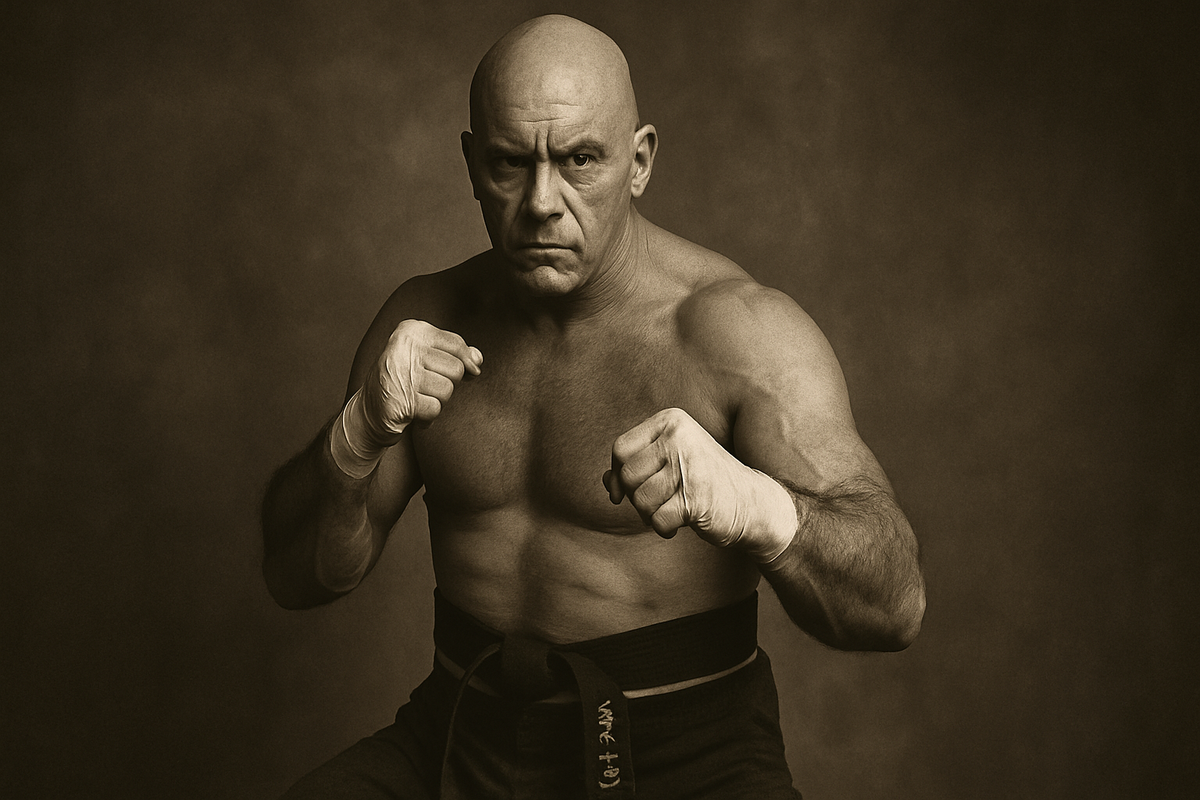
In April 1983, wrestling fans opening their monthly copy of Pro Wrestling Illustrated expected the usual: territory updates, championship disputes, maybe another feature on Dusty Rhodes bleeding his way through Florida. What they got instead stopped them cold—a full photo spread of Superstar Billy Graham, bald-headed and ferocious, wrapped in a black belt with Japanese characters, his taped fists frozen in karate stances that looked nothing like the tie-dye peacock who had held the WWWF title six years earlier.
The feature was titled "The Eye of the Tiger," borrowing from Rocky III's cultural juggernaut of a theme song. But this wasn't movie mythology. This was Billy Graham betting his career on transformation at the exact moment professional wrestling itself was about to explode—or collapse—depending on which territory you asked.
Archive Details
Historical Figure: Superstar Billy Graham (Wayne Coleman)
Issue Date: April 1983
Archive Source: Pro Wrestling Illustrated
Feature Title: "The Eye of the Tiger"
Historical Context: Final years of the territory system before WWF national expansion
The Territorial System's Last Stand
By 1983, the architecture of professional wrestling was cracking. For decades, the National Wrestling Alliance, the American Wrestling Association, and a constellation of regional promotions had operated like feudal kingdoms—each controlled its geography, protected its champions, and produced stars for local television audiences who had never seen a wrestler from two states over. The system worked because it was insular. It survived because it was stable.
Vince McMahon had other plans.
The WWF was already pushing past the Northeast, testing cable television's reach and preparing the infrastructure for what would become national—then global—domination. Hulk Hogan was months away from his coronation. The spectacle was getting bigger, the production values glossier, the storytelling more theatrical. But the old guard wasn't rolling over quietly. Ric Flair, Harley Race, and Dusty Rhodes were still drawing blood and selling out arenas in territories that would soon vanish from the map.
Wrestling fans in 1983 could feel the ground shifting. They just didn't know which way to run.
Why PWI Mattered
This is where Pro Wrestling Illustrated became indispensable. Unlike promotion-owned magazines that served as kayfabe propaganda, PWI covered the entire wrestling landscape with editorial independence and institutional credibility. It published cross-territory rankings that attempted to answer the impossible question: who was really the best? It ran long-form features that walked the tightrope between performance and reality, giving readers both the myth and the man behind it.
The magazine's photography alone elevated wrestling from carnival sideshow to legitimate sport. The images were sharp, dramatic, and composed with the seriousness of Sports Illustrated. PWI didn't just document wrestling—it dignified it.
And in April 1983, they pointed their lens at Billy Graham's most radical gamble.
The Man Who Had Already Changed Wrestling Once
Billy Graham didn't need to reinvent himself. He had already revolutionized the sport.
In the 1970s, his bleach-blonde hair, tie-dye tights, and bodybuilder physique made him wrestling's first rock-and-roll champion. He talked like Muhammad Ali, looked like a psychedelic superhero, and carried himself with the arrogance of someone who knew he was rewriting the rulebook. When he beat Bruno Sammartino for the WWWF Championship in 1977, he didn't just win a title—he proved that charisma could sell as many tickets as blue-collar toughness.
Hulk Hogan later admitted he built his entire persona from Graham's blueprint. Jesse Ventura borrowed the look. Scott Steiner lifted the intensity. Graham was patient zero for the larger-than-life showman-athlete that would define wrestling's next decade.
But by 1983, injuries had ravaged his body. The tie-dye era was over. The spotlight had moved on.
Graham made a choice: disappear or transform.
The Karate Experiment
The photos in PWI's April 1983 issue tell the story better than words:
Visual Transformation
A bald head where bleach-blonde curls once cascaded. Taped hands clenched into fists, posed in traditional karate stances.
Symbolic Discipline
A black belt inscribed with Japanese lettering, draped across his bare chest—a martial arts mystique replacing cartoon flamboyance.
Kayfabe Narrative
The implication of serious training and discipline, suggesting Graham had emerged as something harder, more dangerous, more real.
Reality Subtext
For readers who understood the business, the photos hinted at desperation and survival—a veteran fighting to stay relevant.
This wasn't a gimmick adjustment. This was a complete identity overhaul.
The "Eye of the Tiger" feature leaned into the martial arts mystique—the implication that Graham had shed his old skin and emerged as something harder, more dangerous, more real. The kayfabe narrative suggested serious training and discipline. The subtext, for readers who understood the business, hinted at desperation and survival.
PWI threaded that needle masterfully. The magazine gave fans the dramatic reinvention they wanted while acknowledging the stakes Graham was playing for. It was mythology with a pulse.
A Moment Frozen in Transition
The rest of the April 1983 issue captured wrestling at its inflection point:
Kevin Sullivan's occult storylines were terrifying Florida audiences with psychological warfare that blurred entertainment and genuine unease.
Greg Valentine was feuding his way through multiple territories, proving that technical brutality still drew money in an increasingly spectacle-driven industry.
Dusty Rhodes was cementing his "American Dream" persona—the working-class hero who would become the emotional counterweight to McMahon's cartoon empire.
These weren't just wrestlers having matches. They were the final generation of territory stars fighting to stay relevant as the ground dissolved beneath them. Some would make the leap to national prominence. Others would be erased from mainstream memory within three years.
The magazine itself would later create the PWI 500—an annual ranking that became wrestling's unofficial record book. But in April 1983, it was still operating in the pre-list era, when long-form features and striking photography defined its authority.
The Fight to Stay Remembered
Billy Graham's karate transformation didn't save his career. The injuries were too severe, the business too unforgiving. But the attempt itself—captured in PWI's pages—says something profound about wrestling's nature: survival demands reinvention, and relevance is always one injury or one creative shift away from extinction.
The April 1983 issue documents that fight with unusual clarity. It shows a man refusing to vanish, a sport refusing to stay regional, and a magazine refusing to treat wrestling as anything less than serious cultural business.
Forty-two years later, the magazine remains. The photos endure. And Billy Graham's bald-headed, black-belt stare still asks the question every wrestler—and every fan—eventually faces:
When the spotlight moves, do you fade away or transform into something new?
Why This Issue Matters Now
The Billy Graham Feature
This martial arts spread is one of the most visually distinct wrestler profiles of the early 1980s. It documents a reinvention that wrestling historians still debate—was it a legitimate creative risk or a desperate last act?
Territorial Preservation
The coverage of Sullivan, Valentine, and Rhodes captures the final years before the WWF's national expansion decimated regional wrestling. These articles preserve voices and storylines that exist nowhere else.
Photography as Art
The karate photos represent PWI at its visual peak—treating wrestling with the compositional seriousness it rarely received outside these pages.
Pre-Digital Scarcity
Unlike modern wrestling content that lives forever online, these magazines were disposable newsstand products. Copies in good condition are increasingly rare. The paper yellows. The spines crack. The history fades.
Own a Piece of Wrestling's Turning Point
Original issues of Pro Wrestling Illustrated from this era are becoming harder to find as collectors recognize their historical significance. Each magazine offers more than nostalgia—it's primary source material from the moment wrestling changed forever.
Browse Pro Wrestling Illustrated Magazine CollectionWhether you're building a serious archive, researching wrestling's territorial era, or simply want to hold the moment Billy Graham went from tie-dye to karate in your hands—these magazines tell stories that exist nowhere else.