
The Day America Saw Itself Rebuilt
LIFE's 1937 Portrait of the Roosevelt Revolution
On January 4, 1937, millions of Americans opened their mailboxes to find something extraordinary: a 22-page visual reckoning with their own recent past. The latest issue of LIFE Magazine—barely a year old as a publication—had devoted nearly a quarter of its pages to a single photo-essay titled "The Roosevelt Rule (1933–37): A Pictorial Record."
This wasn't nostalgia. Roosevelt's first term had ended just weeks earlier. The banks that had collapsed, the factories that had shuttered, the farmers who had faced foreclosure—all of it was still fresh memory. What Henry Luce's editors had assembled was something more radical than retrospective: a visual codification of the New Deal itself, fixing in photographs what millions had experienced as chaos, hope, and transformation.
For collectors and historians today, this issue remains one of the most significant artifacts of Depression-era journalism—not because it reported the New Deal, but because it crystallized it.
Archive Details
Historical Figure: Franklin D. Roosevelt, 32nd President of the United States
Issue Date: January 4, 1937
Archive Source: LIFE Magazine Photo-Essay, "The Roosevelt Rule (1933–37): A Pictorial Record"
Feature Length: 22 pages
Publisher: Henry Luce / Time Inc.
The Nation LIFE Captured
By March 1933, when Roosevelt took the oath of office, the United States had descended into economic freefall. One in four workers was unemployed. Banks had evaporated, taking life savings with them. The mood wasn't just pessimistic—it was paralytic.
Roosevelt's inaugural promise—"the only thing we have to fear is fear itself"—landed not as rhetoric but as resuscitation. And LIFE's January 1937 issue walked readers back through every jolt of that recovery: the First 100 Days, when Roosevelt reopened banks and launched the "alphabet soup" of federal agencies (the Agricultural Adjustment Administration, the Civilian Conservation Corps, the National Recovery Administration, the Public Works Administration, the Tennessee Valley Authority). The Blue Eagle parades, where 250,000 Americans marched down Fifth Avenue in September 1933, rallying behind the NRA's promise of fair wages and labor reform. The backlash from the courts, culminating in the Supreme Court's 1935 dismantling of the NRA in the "sick chicken case" (Schechter Poultry v. United States).
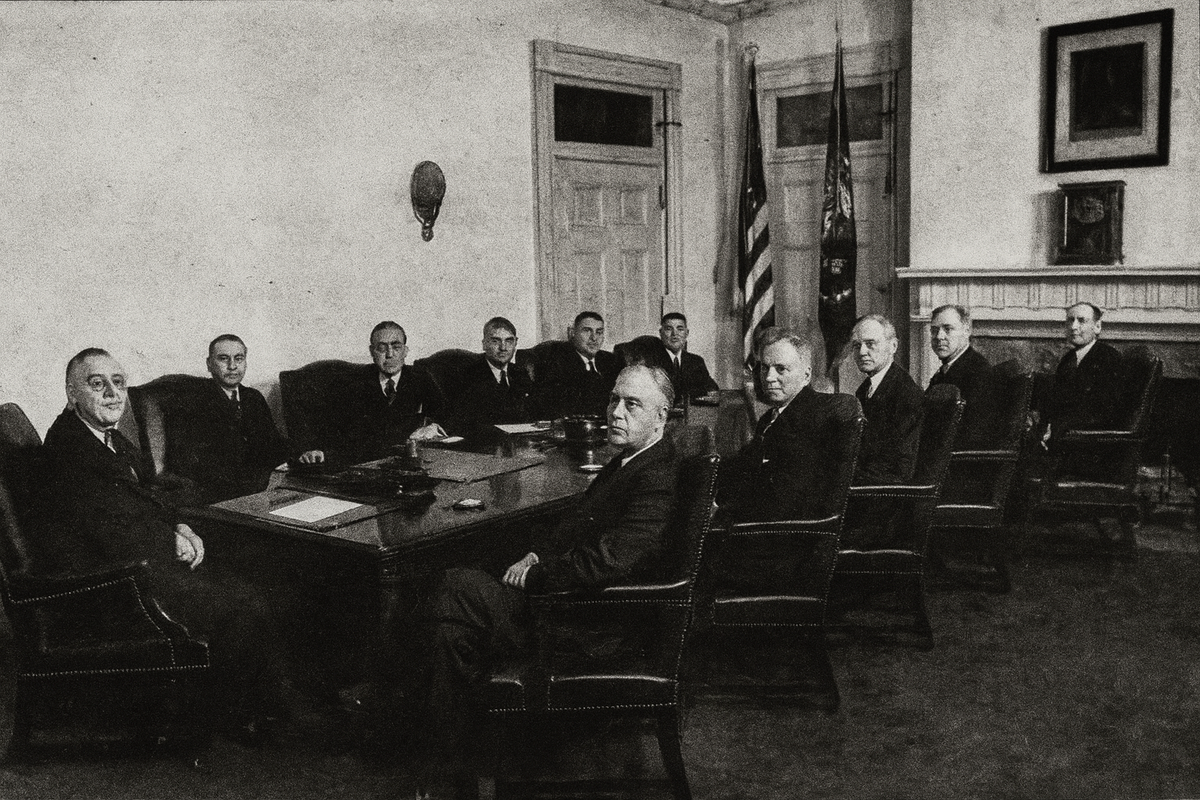
What made LIFE's coverage definitive wasn't comprehensiveness—it was access. The magazine's photographers had captured images almost no one else could: the Supreme Court in session, the Senate chamber mid-filibuster, Roosevelt's first cabinet seated around the table. These weren't publicity stills. They were primary documents.
The Visual Grammar of the New Deal
Founded in 1936, LIFE had staked its reputation on a single conviction: that photography could tell stories words alone could not. The Roosevelt issue proved it.
The magazine opened with a full-page portrait of the President—photographed by Harris & Ewing—that conveyed neither triumph nor propaganda, but something closer to solemn duty. No illustrated cover. No stylization. Just the face of the man who had reordered American government.
Inside, the photo-essay unfolded in a rhythm LIFE would perfect over decades: full-page spreads where images dominated, close-ups of individuals paired with wide shots of assemblies, and captions that didn't merely describe but contextualized. Every photograph carried explanatory text that told readers not just what they were seeing, but why it mattered.
The Cabinet Revealed
Roosevelt's first cabinet featured Frances Perkins (the first woman ever to serve in a presidential cabinet), Harold Ickes, Henry Wallace, and Daniel Roper. LIFE gave them faces.
The Blue Eagle Spectacle
A photograph of 8,000 schoolchildren arranged in the shape of the NRA's Blue Eagle in San Francisco captured how Roosevelt's reforms had penetrated civic imagination.
The Hidden Influencer
Frances Robinson, secretary to NRA administrator General Hugh Johnson, was profiled as sharp, witty, and influential—a figure history might have overlooked entirely.
Unprecedented Access
Images of the Supreme Court in session and the Senate chamber mid-debate were rarities in 1937—LIFE made the workings of democracy visible.
What the Cameras Caught
The chronological spine of the photo-essay moved through Roosevelt's first term with surgical precision:
Roosevelt's first fireside chat, where his radio voice steadied a panicked nation and restored faith in reopened banks.
The NRA parade in New York, where the Blue Eagle became a symbol of mass participation—not just policy, but movement.
Senator Huey Long filibustering, the fiery Louisiana populist captured mid-oration, embodying the political opposition Roosevelt faced from his own party's left flank.
The Supreme Court in session, photographed in the act of striking down the NRA—an unprecedented image of constitutional confrontation.
The "sick chicken case": LIFE published photographs of the Schechter brothers, the Brooklyn poultry dealers whose lawsuit ended the NRA, giving faces to the legal abstraction that reshaped Roosevelt's presidency.
These weren't illustrations of history. They were history—frozen, transmitted, preserved.
Why This Issue Endures
For collectors, the January 4, 1937 LIFE represents something rarer than scarcity: it captures a completed first act. Published at the close of Roosevelt's first term, it offered Americans a chance to see what they had just lived through—not as daily news, but as national narrative.
The photographs inside are not easily found elsewhere. Images of the Senate chamber in debate, the Supreme Court deliberating, the mass demonstrations of NRA support—these were rarities in 1937 and remain so in archival collections today. LIFE had secured access other publications couldn't, and the results were images that would shape how Americans remembered the New Deal long after the policies themselves had evolved.
This issue also reflects LIFE's early editorial DNA. Henry Luce's magazine was less than a year old, still defining what photojournalism could be. The Roosevelt retrospective became a proof of concept: that a magazine could serve as both journalism and archive, both reportage and artifact.
For modern collectors, owning this issue means holding the same pages through which 1930s Americans understood their government, their recovery, and their role in both. These weren't newspapers, discarded after a single read. Families saved LIFE. They studied it. They passed it down.
The Artifact as Memory
What distinguishes vintage LIFE magazines from digitized archives or reprints is their physicality. These were objects meant to be handled, left on coffee tables, returned to. The glossy pages, the bold layouts, the weight of the issue itself—all of it contributed to LIFE's authority as a cultural record.
The January 4, 1937 issue preserved not just Roosevelt's policies but the experience of the New Deal: the parades, the protests, the faces of the cabinet, the drama of the courts. It documented a moment when government reinvented itself, and Americans reinvented their relationship to it.
For anyone drawn to this era—whether as collector, historian, or descendant of those who lived through it—original LIFE magazines offer something irreplaceable: the chance to see history exactly as it was first reported, before revision or reinterpretation.
Collector Significance
Historical Timing
Published at the close of Roosevelt's first term, this issue captured a complete retrospective of the New Deal's formative years—a visual codification created while the events were still lived memory.
Iconic Photography
Contains rare images of the Senate in session, the Supreme Court deliberating, and mass NRA parades—photographs that are seldom seen outside archival collections.
Cultural Documentation
Documented the New Deal not as abstract policy but as lived experience—parades, protests, speeches, and the faces of those who rebuilt American government.
Editorial DNA
Reflects LIFE's earliest editorial vision, produced when the magazine was less than a year old and still defining the possibilities of photojournalism.
Explore Original LIFE Magazines
Own the original pages through which 1930s Americans understood their government, their recovery, and their role in history. These are not reprints or digital scans—they are the authentic artifacts.
Browse Life Magazine CollectionHolding History
The January 4, 1937 issue of LIFE Magazine is more than a collector's item. It is a primary source—a visual record of how Roosevelt's first term was understood in real time, by the people who experienced it. From the reopening of the banks to the Blue Eagle parades, from Roosevelt's cabinet to the Supreme Court's rebuke, LIFE's cameras captured the architecture of American recovery.
Today, it stands as both artifact and argument: that photography, when practiced with access and intention, doesn't just document history—it shapes how history is remembered.
These magazines are not reprints. They are not scans. They are the original pages, preserved across nearly nine decades, waiting to be read again.