
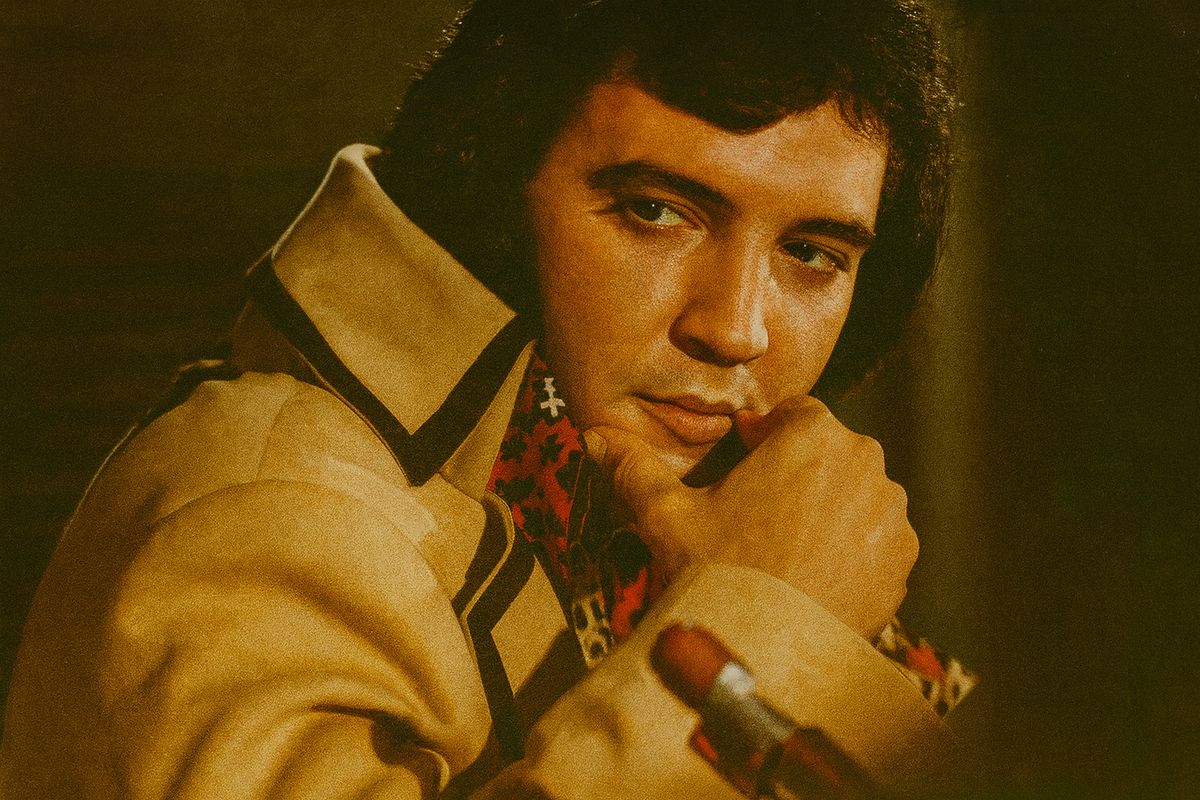
The Night Elvis Walked Back Into Vogue—And America Looked Up
How the August 1, 1972 issue captured the King at his crossroads and defined a cultural moment
August 1972. Lauren Hutton's face stares out from the newsstands with that gap-toothed confidence that would redefine American beauty. Grace Mirabella's Vogue has shed Diana Vreeland's baroque fantasies for something leaner, sharper, more attuned to a nation coming apart at the seams. Inside, buried in the People Are Talking About section, a headline stops you cold:
Archive Entry
Historical Figure: Elvis Presley
Issue Date: August 1, 1972
Archive Source: Vogue Magazine
Feature: "Elvis Presley: The Return of the Blue Suede Voice"
Editor: Grace Mirabella
"Elvis Presley: The Return of the Blue Suede Voice."
Not a comeback. A return. The distinction matters.
This wasn't nostalgia. This was Vogue—the arbiter of what mattered in American culture—declaring that Elvis Presley, at 37, mattered again. Not as a memory. As a presence.
The Landscape: America at the Breaking Point
To understand why Vogue put Elvis on its cultural radar in August 1972, you have to understand what America looked like that summer.
Vietnam was a wound that wouldn't close. College campuses smoldered with rage. The Watergate break-in had occurred six weeks earlier—just another burglary story, or so it seemed. The Civil Rights Movement had fractured into a hundred different fights: Black Power, women's liberation, gay rights, Chicano activism. The center wasn't holding.
The Beatles were gone, shattered two years prior. Rock had splintered into a dozen tributaries—hard rock, glam, folk-rock, funk—each claiming to be the future. Fashion was undergoing its own revolution: Halston's minimalism, Yves Saint Laurent's Le Smoking, Diane von Fürstenberg's wrap dress. Clean lines. Bold statements. Women who knew what they wanted.
And then there was Elvis. No longer the dangerous hips of 1956. Not yet the bloated tragedy of 1977. The 1968 NBC Comeback Special had jolted him back to relevance, and his Las Vegas residencies—starting in 1969—had transformed him into something unprecedented: a middle-aged rock god who could command a room in rhinestone-studded jumpsuits, backed by full orchestras and gospel choirs.
Vegas wasn't a retreat. It was a coronation.
Why Vogue Cared: The Mirabella Vision
Grace Mirabella inherited Vogue in 1971 with a mandate: make it matter to real women. Vreeland's surrealist extravaganzas were out. Cultural literacy, practicality, and relevance were in.
The People Are Talking About column embodied this shift. Short, sharp profiles of figures shaping the global conversation. In that August 1972 issue, Elvis appeared alongside Alfred Hitchcock, Judy Garland, and Anna Karina. The layout was stark—bold headlines, minimal text, striking black-and-white photography.
But Elvis's entry dominated the page.
The headline positioned him not as a relic but as an active force. The tone was celebratory, almost defiant: this man still shapes the present. The implication was clear—Elvis's influence transcended music. His style, his presence, his mythology were woven into the cultural fabric itself.
For Vogue's readers, Elvis's Vegas-era persona wasn't kitsch. It was theater. It was aspiration. Those jumpsuits? Couture by any other name. The stagecraft? Performance art before the term became fashionable. The charisma? Undeniable.
Vogue understood what others dismissed: Elvis had become high fashion.
Inside the Issue: Fashion Meets the King
The juxtaposition was deliberate. Lauren Hutton on the cover represented the new American woman—natural, modern, accessible. Inside, Elvis represented something equally vital: the enduring icon who refuses to fade, who reinvents rather than retreats.
The typography was bold. The cultural commentary was direct. Elvis wasn't positioned as a 1950s throwback but as a living legend whose voice still defined America. The editorial placement made an argument: in 1972, fashion and music were inseparable. Presley's sequined jumpsuits and stage persona were as much about image as sound—maybe more so.
This was Vogue saying: we see you, Elvis. We see what you're building. We see that it matters.
What the Feature Revealed
The Voice Endures
Elvis's singing hadn't diminished—it had deepened. The "blue suede voice" carried weight now, authority earned through years of survival.
Vegas as Cultural Hub
What others saw as decline, Vogue framed as reinvention. Elvis had turned Sin City into a global stage, proving that spectacle and artistry could coexist.
The All-American Icon
Elvis was no longer just a rock star. He'd become a representative of American identity itself—resilient, adaptable, larger than life in an era of uncertainty.
Fashion as Performance
Those jumpsuits blurred the line between music and couture, foreshadowing what David Bowie, Madonna, and Lady Gaga would later perfect. Elvis understood: the costume is part of the song.
The Legacy: Why We're Still Looking Back
Searches for "Vogue magazine August 1972," "vintage Vogue magazines," "Elvis Presley Vogue," and related terms continue to spike. The reason is simple: people recognize what that issue represented.
Elvis endures not because he was perfect—he wasn't—but because he understood reinvention. His influence wasn't limited to music. It extended to style, charisma, aspiration, and the very idea of what an American icon could be.
For fashion historians, this Vogue issue proves the magazine's reach extended far beyond runways. For Elvis devotees, it's evidence that his cultural impact penetrated even the most rarefied spaces.
For collectors, it's simply essential.
Collector Significance: Why This Issue Matters
Vintage Vogue issues are always collectible, but certain editions carry disproportionate cultural weight. The August 1, 1972 issue is one of them.
Historical Timing
It captures Elvis in the narrow window between comeback and tragedy—a mature artist in control of his narrative, his voice, his image.
Editorial Transition
Early Mirabella issues mark Vogue's pivot toward modern cultural journalism. For collectors of magazine history, these editions are foundational.
Cross-Market Appeal
Elvis collectors and fashion collectors both seek this issue, driving value and interest across multiple communities.
Cultural Snapshot
The placement of Presley alongside Hitchcock and Garland creates a perfect artifact of 1972's cultural climate—the moment when old Hollywood, new Hollywood, and rock royalty existed in uneasy equilibrium.
To hold this issue is to hold a turning point.
Where to Find It
If you're drawn to Elvis Presley's legacy or the cultural upheavals of the early 1970s, the August 1, 1972 issue of Vogue isn't just memorabilia—it's testimony. It captures a moment when America was reinventing itself, when its icons were doing the same, and when a fashion magazine had the clarity to recognize what that meant.
Explore the Archive
Whether you're a fashion historian, Elvis devotee, or vintage magazine collector, this issue offers something rare: a living artifact of style, music, and cultural transformation.
Browse Vogue Magazine CollectionConclusion: The Moment When Everything Aligned
The August 1, 1972 issue of Vogue remains more than a magazine. It's a document of cultural convergence—the point where high fashion met rock mythology, where editorial vision captured American identity in flux.
For readers in 1972, Elvis symbolized resilience and reinvention. For readers today, the issue captures Vogue's unique ability to blend fashion, commentary, and celebrity mythology into something larger than the sum of its glossy pages.
To hold this issue is to hold proof: the moment when the blue suede voice met editorial brilliance, and America at a crossroads saw itself reflected back.