
The Rouge and the Black: When Time Magazine Captured Ford at the Breaking Point
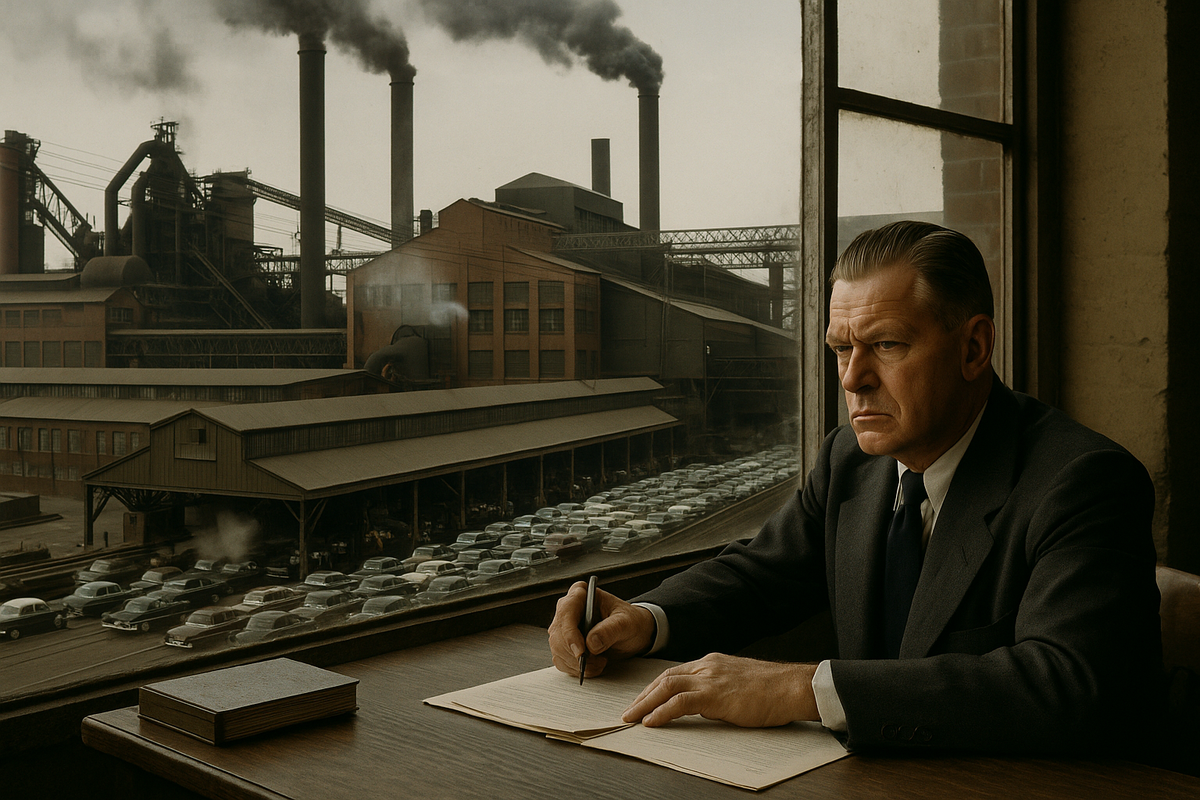
May 18, 1953 — The smokestacks told the story before the words did
The smokestacks told the story before the words did.
On May 18, 1953, Time Magazine placed the River Rouge plant on America's breakfast tables—not as a monument to industrial triumph, but as a symbol of empire in decline. Black smoke billowed over Dearborn. Assembly lines that once represented the future now wheezed under the weight of inefficiency. And somewhere in that sprawling complex, Henry Ford II carried a burden no 35-year-old should bear: rescuing his grandfather's crumbling dynasty while the entire nation watched.
This wasn't business reporting. It was an autopsy of the American Dream, conducted while the patient was still breathing.
Archive Details
Publication: Time Magazine
Issue Date: May 18, 1953
Cover Story: "The Rouge & the Black"
Historical Figure: Henry Ford II and the Ford Dynasty
Archive Source: Original Magazine Collection
When Detroit's Heart Stopped Beating in Rhythm
By 1953, the cracks in American automotive supremacy had become chasms. Henry Ford—the man who gave America the assembly line in 1913, who made the automobile democratic rather than aristocratic—had been dead for six years. His grandson inherited more than a company. He inherited a mythology that was devouring itself from within.
The numbers were catastrophic. Ford had hemorrhaged $85 million in 1946 alone. Despite robust sales volume, the company bled money with each passing quarter. General Motors and Chrysler weren't just competing—they were lapping Ford on styling, innovation, and management efficiency. The moving assembly line that once symbolized American ingenuity had become a relic, outpaced by competitors who understood that the postwar consumer wanted more than Model T efficiency. They wanted chrome. They wanted style. They wanted tomorrow.
Meanwhile, Walter Reuther's United Auto Workers had transformed from nuisance to kingmaker. The UAW didn't just negotiate wages—it rewrote the social contract between American capital and labor. Every strike, every settlement, every concession reshaped what it meant to build cars in Detroit. The old certainties had evaporated.
The River Rouge plant—once hailed as the most efficient industrial complex on Earth—now embodied the paradox of American manufacturing. Monumental. Sprawling. Magnificent. And increasingly obsolete.
Dynastic Crisis
Three generations of Fords, one empire, and the crushing weight of legacy as Henry Ford II attempted to rescue his grandfather's failing vision.
Labor Revolution
Walter Reuther and the UAW transformed worker power from marginal to central, forcing Detroit to reckon with organized labor's demands.
Financial Hemorrhage
Despite strong sales, Ford lost $85 million in 1946 alone—a staggering sum that revealed deep structural failures within the company.
Competitive Decline
General Motors and Chrysler outpaced Ford in styling, technology, and management—leaving the once-dominant automaker scrambling to catch up.
Time Magazine as Industrial Historian
Time understood what made this story resonate beyond the boardroom. This wasn't merely corporate struggle—it was dynastic drama playing out against the backdrop of American identity itself.
The magazine's approach was surgical. Blunt analysis of Ford's financial hemorrhaging shared space with intimate portraits of three generations of Fords. The "Deuce," as Henry Ford II was known, stared out from photographs with the exhausted determination of a man trying to outrun his grandfather's ghost. Time showed readers the assembly line in painstaking detail—a full-page diagram mapping the journey from raw steel to rolling automobile—while simultaneously documenting how that very system was failing.
The visuals weren't decoration; they were argument. Smoke-choked skies over the Rouge. The Ford family arranged like a Renaissance portrait, wealth and worry visible in equal measure. Assembly line workers reduced to component parts in an industrial ballet that no longer danced in time.
Time transformed corporate crisis into American mythology. The Rouge plant wasn't just a factory—it was Ozymandias in Michigan, a monument to hubris and the hubris of monuments themselves.
The Article That Became an Artifact
"The Rouge & the Black" captured Ford at the precise moment when American exceptionalism confronted its own mortality. The postwar boom was supposed to lift all boats. Instead, it revealed which vessels had been taking on water all along.
Time detailed the generational transfer of power with novelistic precision. Henry Ford II wasn't just managing a company—he was attempting to reconcile his grandfather's autocratic genius with mid-century realities of organized labor, sophisticated competitors, and shareholders who cared more about quarterly returns than founding myths.
The magazine documented the UAW's ascendance under Reuther, showing how worker power had become inseparable from automotive identity. It mapped the competitive landscape where GM's management sophistication and Chrysler's engineering prowess made Ford look antiquated. It showed, in crystalline detail, how even dominant market share couldn't save a company bleeding money through organizational sclerosis.
The assembly line diagram alone justified the cover price—a visual dissertation on how complexity scaled, how precision demanded coordination, how the industrial sublime could be both magnificent and fragile.
The Permanent Record
Time Magazine in 1953 possessed something modern business media has largely lost: the ability to make corporate struggle feel consequential beyond the C-suite. Life Magazine brought war into American living rooms through photography. Time brought capitalism—with all its drama, dysfunction, and desperate nobility—into focus with equal power.
The May 18, 1953 issue endures because it refused to reduce Ford's crisis to spreadsheets and stock prices. It understood that business stories are fundamentally human stories, tangled with family pride, worker dignity, and national identity. When Time examined the Rouge plant, it was examining America itself—asking whether the systems that built the 20th century could survive it.
Today, when corporations exist primarily as ticker symbols and quarterly earnings calls, this magazine reminds us that businesses were once inseparable from place, from dynasty, from the communities that made them possible. The Rouge wasn't just Ford's factory—it was Dearborn's reason for being.
Why Collectors Prize This Issue
Inflection Point Documentation
This issue captures American industry at a critical juncture—when the automobile defined national identity and Ford's faltering made the entire edifice of democratic capitalism seem vulnerable.
Dynastic Drama
The Ford family saga elevates this beyond business journalism into Greek tragedy—three generations, one name, an empire that might not survive its own success.
Visual Richness
The Rouge plant photography, assembly line diagrams, and family portraits capture mid-century American manufacturing before globalization reshaped what it meant to make things.
Primary Source Material
For automotive historians, business scholars, and enthusiasts of mid-century Americana, this magazine isn't memorabilia—it's essential documentation of when cars were still made entirely in Detroit.
The Smoke Still Rises
The River Rouge plant still stands, though what it means has changed. The smokestacks that Time photographed in 1953—symbols of both industrial might and industrial exhaustion—have become monuments to a different America. One that built everything in-house, believed in dynastic succession, and couldn't yet imagine a world where Detroit didn't mean destiny.
The May 18, 1953 issue of Time Magazine captured Ford at the breaking point and, in doing so, captured something larger: the moment when American exceptionalism looked in the mirror and saw mortality staring back.
For collectors and historians, this magazine is more than documentation. It's evidence that even empires built on moving assembly lines can grind to a halt. It's proof that smoke always clears eventually, revealing what was really burning underneath.
Hold this issue in your hands, and you're holding the weight of American industry at its most vulnerable—when the Rouge was still black with smoke, and the future belonged to whoever could imagine past the assembly line.
For the Serious Collector
If you collect automotive history, industrial Americana, or the golden age of photojournalism, the May 18, 1953 Time Magazine belongs in your archive. This isn't casual reading—it's witness testimony from the moment American manufacturing began its long, complicated reckoning with its own limitations.
Browse Time Magazine CollectionEvery issue is a time capsule. Every cover is a conversation with the past about futures that never quite arrived as promised.