
The Monarch on the Magazine
When Time Held Up a Mirror to Iran's Last Shah
On September 12, 1960, Americans opened their mailboxes to find a king staring back at them.
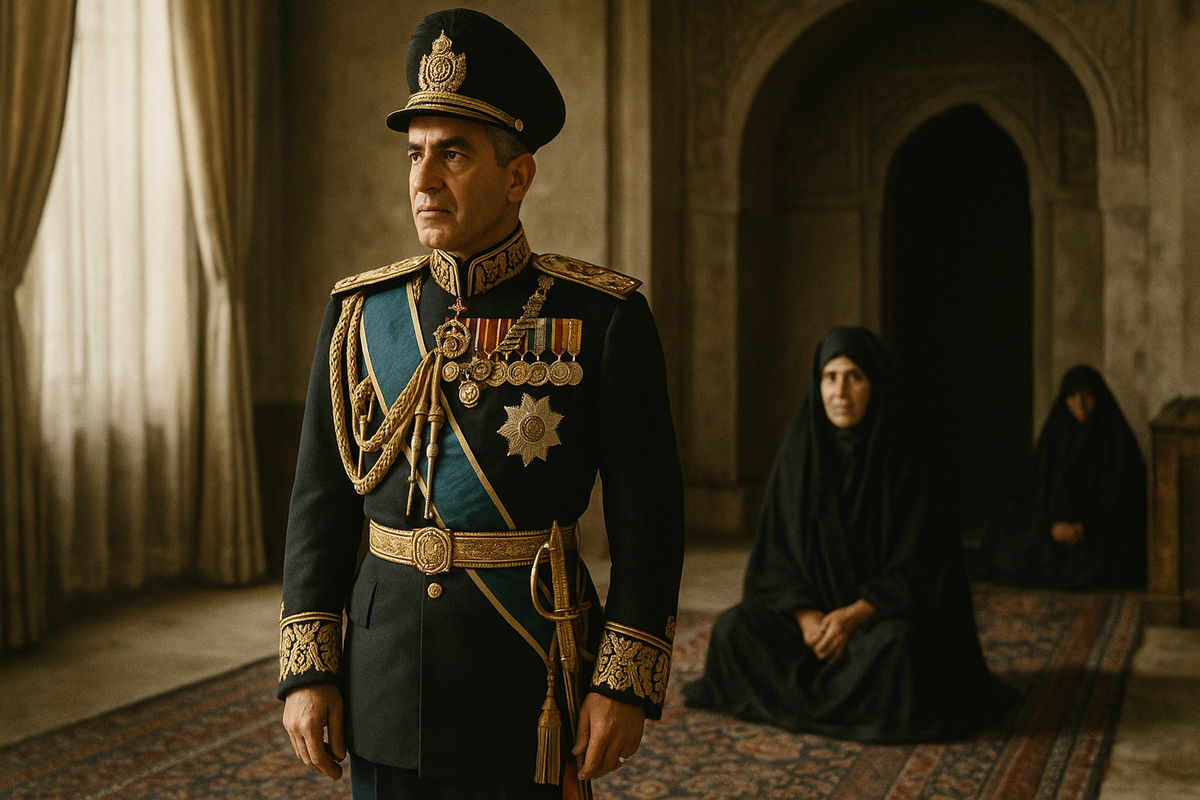
Not just any king—Mohammad Reza Pahlavi, the Shah of Iran, rendered in Time Magazine's signature illustrative style, wearing the towering shako of ceremonial military dress. The cover line read simply: "Iran: Reformer in Shako." For subscribers sipping morning coffee in suburbs from Connecticut to California, this was an invitation into a world most would never see—a throne room in Tehran where ancient Persian tradition collided with Cold War realpolitik, where American oil interests tangled with Soviet ambitions, and where one man's gamble to modernize a nation would determine the future of the Middle East.
This was not celebrity gossip. This was the frontline.
Archive Document
Historical Figure: Mohammad Reza Pahlavi, Shah of Iran
Issue Date: September 12, 1960
Archive Source: Time Magazine
Cover Story: "Iran: Reformer in Shako"
A Throne Built on Foreign Soil
Seven years before Time's cameras turned toward the Shah, the Central Intelligence Agency and Britain's MI6 had executed Operation Ajax—the 1953 coup that toppled Prime Minister Mohammad Mossadegh after his audacious move to nationalize Iran's oil industry. The operation restored the Shah to power, but it also chained his legitimacy to Washington and London. By 1960, that debt had come due.
Iran's economy was growing, yet fracturing under the weight of corruption and inequality. The Shah faced a devil's bargain: push land reform and industrial modernization to satisfy a restless, urbanizing population—or protect the landowners and clerics whose support kept him on the throne. Time's September 12 issue captured this knife's edge with uncommon clarity, showing American readers that Iran's internal struggles were not abstractions. They were immediate. They were human. And they would determine whether the West's most strategic Middle Eastern ally would hold or fall.
The Soviet Union loomed across Iran's northern border. Stability was not optional—it was existential.
The Magazine That Explained the World
By 1960, Time had achieved something rare in American journalism: it had become both mirror and lens. Middle-class households, corporate boardrooms, and State Department offices all relied on its weekly dispatches. Time didn't just report events—it framed them, interpreted them, gave readers a way to hold the sprawling chaos of the Cold War in their hands.
The Iran feature exemplified this power. The article transported readers from the Shah's palace halls to the rug factories of Tabriz, from bustling Tehran streets to villages where tradition still governed every aspect of life. Photographs of the Shah and maps of Iran's strategic position—wedged between the Soviet Union, Iraq, and Afghanistan—made the distant tangible. For Americans who would never set foot in the Middle East, Time offered something more valuable than travel: it offered comprehension.
This was visual journalism as statecraft.
Anatomy of a Cover Story
The cover itself was classic Time—bold, illustrative, unapologetically serious. While other magazines chased movie stars and sports heroes, Time positioned world leaders as the real celebrities, the figures whose decisions shaped history. The Shah's portrait, executed in the magazine's distinctive painted style, signaled gravity before a reader turned a single page.
Inside, the layout married photography with commentary in seamless rhythm. A map labeled "Iran" showed the nation at the crossroads of East and West. Images juxtaposed Tehran's modernizing skyline—cranes, traffic, industry—against traditional scenes of craftsmen weaving carpets and religious ceremonies unfolding in mosques. This was not mere documentation. This was narrative architecture, designed to make readers feel they were witnesses to Iran's transformation, participants in a historical drama still unfolding.
Five Themes That Defined the Shah's Moment
The Reluctant Monarch
Time portrayed the Shah as a man thrust into leadership when his father, Reza Shah, was forced to abdicate in 1941. His youth, his insecurities, his cautious approach to reform—all were presented as both assets and liabilities. This was not a confident autocrat. This was a king trying to become one.
Land Reform as High-Wire Act
The Shah's push to redistribute land and expand industry was bold, Time noted, but fraught with risk. Alienate the landlords and clerics, and the throne could crumble. Fail to deliver change, and the population would revolt. The magazine understood what was at stake: everything.
Tradition Versus Tomorrow
How do you modernize a nation without destroying the cultural fabric that holds it together? Time framed this as the Shah's central dilemma—a question that would haunt him until his overthrow in 1979.
The Ghost of Mossadegh
Though not the article's focus, the shadow of the 1953 coup hung over every page. Time made clear that the Shah's power was inseparable from foreign intervention—a legitimacy crisis that no amount of reform could fully resolve.
Cold War Chessboard
Throughout the piece, Time reminded readers that Iran was not just another country. It was a buffer state, a test case, a place where American influence faced its most crucial examination. If Iran fell, the dominoes would follow.
Time's Superpower: Context as Currency
What separated Time from daily newspapers was not speed but depth. Newspapers delivered facts; Time delivered frameworks. Each issue became a historical capsule, complete with analysis, portraiture, and visual storytelling that remains instructive decades later.
Time's voice in 1960 was unapologetically American, shaped by Cold War priorities and a confidence that bordered on paternalism. But that perspective is precisely what makes the magazine valuable today—it reveals not just what happened in Iran, but how Americans were taught to understand it. The magazine didn't just report history. It constructed it.
Why Collectors Covet This Issue
Historical Inflection Point
This issue captured Iran just before the Shah launched his White Revolution—the ambitious 1960s reform program that would modernize the economy, emancipate women, and ultimately sow the seeds of his downfall. It is a snapshot of a monarchy at the precipice, unaware of the revolution to come.
Iconic Cold War Portraiture
The Shah's cover remains one of the era's defining images—a visual shorthand for the intersection of Middle Eastern politics and superpower rivalry. It belongs in the same conversation as Time's covers of Khrushchev, Castro, and Kennedy.
Cultural Artifact of the Kennedy Era
This magazine sat on coffee tables during the 1960 presidential campaign between John F. Kennedy and Richard Nixon. It connected domestic anxieties to international crises in ways that feel strikingly contemporary. To own it is to hold the same document that shaped American understanding of the Middle East at a pivotal moment.
Collector Demand and Rarity
Issues focused on Cold War leaders and Middle Eastern geopolitics command premium prices among serious collectors. For historians, educators, and families with ties to Iran, they function as primary sources—original voices from a world that no longer exists.
A Document Worth Holding
If you collect Cold War ephemera, study Middle Eastern politics, or simply recognize the power of original sources, the September 12, 1960 Time Magazine belongs in your archive. This is not a digital facsimile or a Wikipedia entry. This is the artifact itself—the ink, the paper, the weight of history in your hands.
Browse Time Magazines CollectionThe Precipice, Preserved
The September 12, 1960 issue of Time Magazine captured a moment when Iran's future seemed open, when modernization looked possible, when the Shah's gamble might still pay off. Within two decades, revolution would sweep him from power, and the Islamic Republic would reshape the Middle East in ways no American magazine could have predicted.
But in 1960, the story was still unwritten.
To hold this issue today is to hold that uncertainty—to see the Shah not as a historical footnote but as a living figure wrestling with impossible choices. Time's reporting offers more than analysis or nostalgia. It offers a frozen voice from the past, a window into how Americans once viewed Iran, and a reminder that history is always written before we know how it ends.