
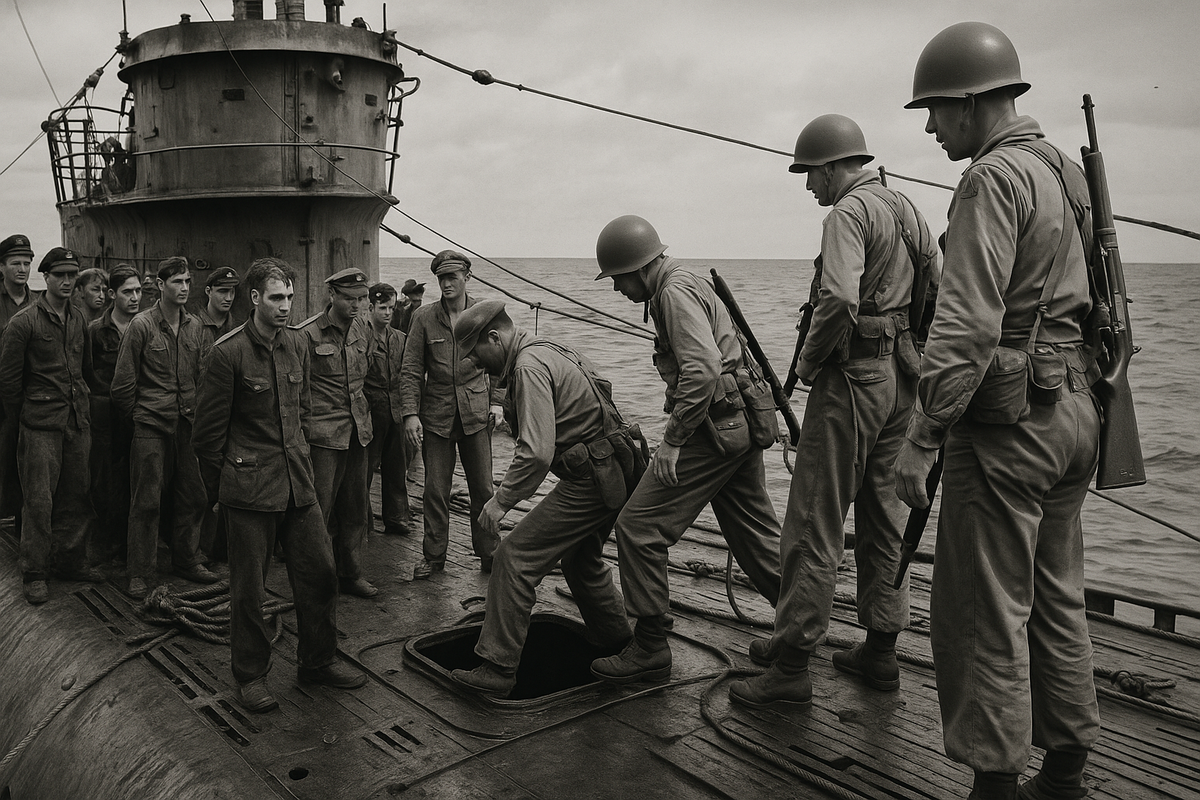
The Surrender of the U-805
When The New Yorker Brought Germany's Collapse Home
On a humid July afternoon in 1945, American readers opened their mailboxes to find something more dangerous than they realized: evidence.
The July 21st issue of The New Yorker looked innocuous enough—a pastoral farm scene on the cover, children working under gathering storm clouds. But inside, buried between the cartoons and theater reviews, was a piece of wartime reportage so visceral it made victory real. "The Surrender of the U-805" didn't just report Germany's defeat. It let readers board it.
For six years, Americans had consumed war through wire reports and government bulletins. Now, two months after V-E Day, The New Yorker did what it does best: it showed them what surrender actually looked like. Smelled like. Felt like in your gut when you climbed into a steel tomb that had spent years hunting Allied ships.
This wasn't propaganda. This was journalism at the hinge of history.
The Atlantic War Comes Ashore
Germany had surrendered in May. Hitler was dead. Europe was exhaling. But the psychological residue of the U-boat campaign—the years of torpedoed convoys, the maritime stranglehold that nearly starved Britain—didn't evaporate with a signature on surrender documents.
These submarines had been ghosts. Invisible predators. To see one handed over intact, its crew photographed and described in clinical detail, was to witness the demystification of terror.
The New Yorker's "Reporter at Large" feature stripped away the mythology. The U-805 wasn't staffed by supermen or fanatics. It was crewed by exhausted, lice-ridden sailors living in their own filth, surviving on wretched rations, decorating bulkheads with pin-up girls. The banality was the revelation.
Archive Snapshot
Issue: The New Yorker, July 21, 1945
Feature: "The Surrender of the U-805" (Reporter at Large)
Historical Context: Published two months after V-E Day, three weeks before Hiroshima
Vessel: German submarine U-805, surrendered to Allied forces
Commander: Bernadelli (German Naval Officer)
Literary Journalism Meets Military Reality
What separated this article from standard war coverage was precision married to observation. The New Yorker didn't editorialize. It documented.
The magazine gave readers what newsreels couldn't: proximity without propaganda.
The Cover as Counterpoint
That pastoral cover—the American farm scene with its gathering thunderstorm—wasn't accidental. While Europe sorted through rubble and corpses, American soil remained unbombed. The contrast was the point.
The New Yorker understood irony better than any publication of its era. In a single issue, readers encountered surrender documentation alongside satirical cartoons, cultural criticism alongside military reportage. The juxtaposition wasn't disrespectful. It was honest. American life in July 1945 was that contradiction—relief and normalcy coexisting with accounts of atrocity and collapse.
This tonal balance is why The New Yorker mattered. It refused to shout. It presented the U-805's surrender with the same composed intelligence it applied to book reviews. That refusal to sensationalize gave the reporting more weight, not less.
What Wartime Magazines Preserve
The endurance of vintage New Yorker issues lies in what they refuse to be: retrospective. They don't interpret with the clarity of hindsight. They document with the confusion of the present.
In July 1945, no one knew if Japan would surrender or require invasion. No one knew the atomic bomb was three weeks from deployment. Readers absorbing "The Surrender of the U-805" were processing German defeat while preparing psychologically for years more of Pacific combat.
That uncertainty—that unresolved tension—is what makes original wartime magazines more valuable than history books. They preserve the moment before the outcome was known.
Why This Issue Matters to Collectors
Historical Timing
Published at the exact inflection point between European victory and Pacific uncertainty, this issue captured a nation processing triumph while bracing for more casualties.
Reportorial Rarity
Firsthand accounts from inside captured enemy submarines weren't common. The level of access and detail in "The Surrender of the U-805" gave civilian readers intelligence they'd never receive anywhere else.
Art-History Intersection
That cover—folk-art pastoral against grim wartime reporting—represents The New Yorker's genius for cultural synthesis. Collectors prize these moments when high art meets historical documentation.
Original Artifact Status
This isn't a reprint or a digitized scan. These are the actual magazines American readers held in July 1945, printed on wartime paper stock, delivered to homes and newsstands while the war's outcome was still uncertain.
For Collectors and Historians
If you collect cultural artifacts that document how Americans experienced their own history, the July 21, 1945 New Yorker belongs in your archive.
Browse The New Yorker Magazines CollectionFrom the Jazz Age through the postwar reckoning, each issue preserves not just events but the cultural temperature of its moment—satire, literature, art, and unflinching reportage in a single publication.
The Artifact Endures
"The Surrender of the U-805" gave Americans something they needed in July 1945: evidence that the Atlantic nightmare had ended. Not through triumphalism, but through documentation. Not by celebrating victory, but by showing what defeat actually looked like when you boarded it, inventoried it, and watched its crew surrender their hidden knives.
To hold this issue now is to hold that transition—from the U-boat as hunter to the U-boat as museum piece, from Germany as existential threat to Germany as defeated state under Allied occupation.
For anyone who values primary sources, literary journalism, or the artifacts that preserve a generation's lived experience of global war—this isn't memorabilia.
This is evidence.