
James Baldwin, the October 1961 Ebony, and the Essay That Refused to Whisper
How "The Angriest Young Man" became essential reading at the height of the Civil Rights Movement
When readers opened the October 1961 issue of Ebony Magazine, they didn't just find James Baldwin. They found a reckoning.
The profile—titled "The Angriest Young Man"—was part literary portrait, part cultural lightning rod. Allan Morrison's narrative, paired with searing photography, brought Baldwin's uncompromising critique of racial injustice into American homes at the precise moment the Civil Rights Movement reached its flashpoint. For Black readers, it was confirmation: their rage was justified, their voices undeniable. For white America, it was a warning dressed in prose.
This wasn't just another magazine feature. It was Baldwin at full voltage, published in the one magazine that could deliver his fire to millions.
Archive Details
Historical Figure: James Baldwin
Issue Date: October 1961
Archive Source: Ebony Magazine
Feature: "The Angriest Young Man" by Allan Morrison
1961: The Year America Stopped Pretending
The early 1960s didn't ease into change—they detonated. That same year, Freedom Riders faced firebombs in Alabama. Sit-ins spread like wildfire across the South. African nations were shedding colonial chains one by one, and the hypocrisy of America preaching democracy abroad while enforcing Jim Crow at home had become impossible to ignore.
Baldwin saw it all clearly. His diagnosis, delivered in Ebony's pages, was blunt:
"The American Negro can no longer, nor will he ever again, be controlled by white America's image of him. This fact has everything to do with the rise of Africa in world affairs."
It wasn't anger for anger's sake. It was precision. Baldwin connected Harlem to Accra, Birmingham to the Cold War's ideological battlefield. The essay wasn't just personal—it was geopolitical.
Why Ebony Mattered
By 1961, Ebony had already established itself as the most influential Black publication in America. Unlike mainstream magazines that either ignored or caricatured Black life, Ebony documented and celebrated it—politics, business, culture, beauty, intellect. It gave African Americans something the dominant culture refused: visibility with dignity.
The Baldwin feature exemplified this mission. Morrison's text and the magazine's photographers didn't position Baldwin as a radical outsider. They placed him at the center of American cultural life—where he belonged.
The photographs told their own story:
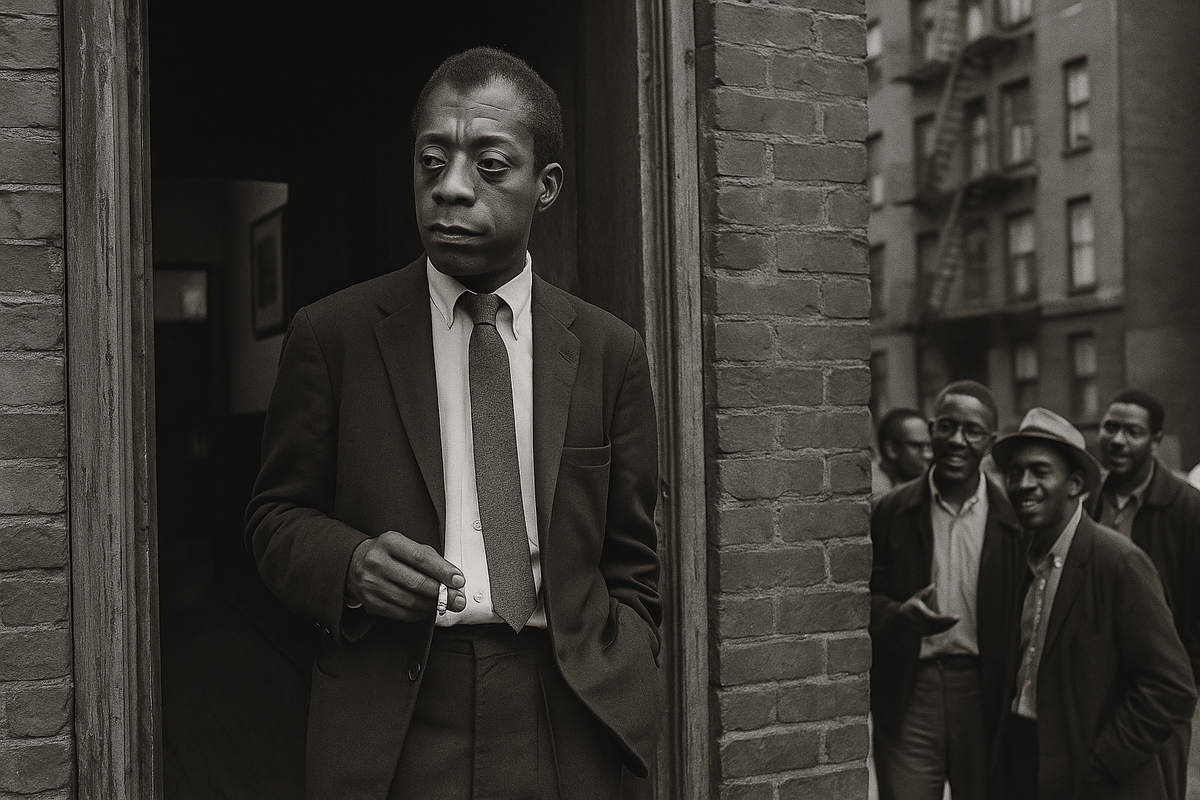
- Baldwin in a Harlem doorway, solitary and defiant—exile and prophet in one frame
- Walking familiar streets, still tethered to the community that shaped him
- In conversation with peers, the intellectual as everyman
- At home, chain-smoking over a typewriter, surrounded by paper—a writer consumed by his work
- Positioned alongside images of African leaders, underlining the global stakes of his thought
This was Ebony's genius: using photography not as decoration but as argument. Readers didn't just absorb Baldwin's ideas—they saw the weight he carried in his eyes, his posture, his surroundings.
The Duality: Glamour and Grenades
The October 1961 cover featured Ebony's Fashion Fair—a celebration of Black beauty and style. At first glance, it seems disconnected from Baldwin's essay. But that's the point.
Ebony refused to choose between elegance and militancy. The magazine's editorial strategy was both/and: glamour on the outside, unflinching social critique on the inside. It mirrored the complexity of Black life itself—celebration and struggle, joy and fury, all coexisting in the same breath.
That tension made Ebony essential. It didn't flatten Black experience into a single note. It held multitudes.
What Baldwin Said—And What It Cost Him
The Ebony profile captured Baldwin's worldview at a pivotal moment. Some of its sharpest themes:
Anger vs. Bitterness
Baldwin drew a hard line. Anger was a response to injustice. Bitterness was defeat. He chose the former.
The Lie of White Innocence
America's race problem, he argued, wasn't created by Black people. It was the product of white society's refusal to confront its own guilt.
Patriotic Rage
Baldwin loved America enough to demand it live up to its promises. As he put it: "I love America more than any other country in the world… and exactly for this reason, I insist on the right to criticize her perpetually."
Africa as Mirror
He saw African independence movements as inseparable from the Black American freedom struggle. Liberation was global or it was nothing.
The Writer's Burden
The profile revealed Baldwin's work ethic: sleepless nights, coffee, liquor, cigarettes, stacks of manuscript pages. Writing wasn't just craft—it was survival, exorcism, mission.
Exile and Return
Baldwin had fled to Paris to escape American racism, but he came back. He couldn't write about America from a safe distance. He had to stand in the fire.
The Soul of the Nation
Baldwin believed America's redemption hinged on liberating its Black citizens. Fail at that, and democracy itself would collapse under the weight of its own hypocrisy.
Personal Cost
Every word Baldwin wrote came at a cost—exhaustion, alienation, the relentless scrutiny of being a Black intellectual in a country that wanted him silent.
Ebony's Larger Mission
The Baldwin profile wasn't an outlier—it was part of Ebony's broader project. For decades, the magazine gave space to intellectuals, activists, and artists, helping define African American identity in the twentieth century.
It celebrated beauty and success while refusing to sanitize injustice. In doing so, it challenged stereotypes and built cultural pride across generations.
For Baldwin, Ebony provided mass reach within the Black community, ensuring his ideas circulated far beyond literary or academic circles. For readers, the magazine offered something equally vital: proof that their struggles, their brilliance, and their culture mattered.
Why This Issue Still Matters
Baldwin at the Threshold
Published just before Another Country (1962), this issue captures Baldwin as his influence surged toward its peak.
Civil Rights Snapshot
With Freedom Riders dominating headlines and Martin Luther King Jr. ascending as a national figure, the magazine is a time capsule of 1961's seismic shifts.
Rare Visual Record
The photographs of Baldwin in Harlem are among the few candid images of his daily life during this period.
Ebony's Cultural Power
The issue exemplifies why Ebony remains one of the most important magazines in American history—not just Black history, but American history.
Enduring Relevance
Baldwin's words on race, justice, and identity haven't aged. They've compounded.
Historical Evidence
For collectors, this isn't memorabilia. It's evidence. Proof that the arguments of 1961 are still unresolved, still urgent, still burning.
The Magazine That Refused to Look Away
The October 1961 issue of Ebony, featuring "The Angriest Young Man," remains one of the most vital publications of its era. It delivered Baldwin's uncompromising analysis to millions and positioned him at the cultural center of Black America.
To hold this issue today is to hold a moment when literature and politics converged, when one man's fury became a nation's mirror, and when Ebony proved it wasn't just covering history—it was shaping it.
For anyone who values the archive, vintage Ebony magazines aren't just reading material. They're living documents. Through them, the voices of the past still speak—clear, urgent, and unfinished.
For Collectors and Historians
If you care about literature, Civil Rights history, or the documentation of African American culture, the October 1961 Ebony is foundational.
From the 1940s through the 1980s, Ebony captured decades of African American life—triumph, struggle, resilience, and joy.
Browse Ebony Magazines Collection