
The Thin Blue Line: Policing, Protest, and Power in 1968 America
When Time Magazine documented the badge as America's most contested symbol
They didn't know they were holding a prophecy.
When Americans pulled the July 19, 1968 issue of Time Magazine from their mailboxes that summer, they weren't just reading the news—they were witnessing the birth of a debate that would never end. The cover story, "Police: The Thin Blue Line," arrived in a country still reeling from two assassinations, burning with riots in a dozen cities, and splitting apart over a war half a world away. The badge had become the most contested symbol in American life.
More than half a century later, that symbol hasn't lost its power. Neither has this magazine.
1968: The Year America Broke Open
The summer of 1968 wasn't just volatile—it was a rupture.
Three years after Watts exploded in 1965, the geography of unrest had spread nationwide. Newark burned. Detroit burned. Washington, D.C. burned. The assassinations of Martin Luther King Jr. in April and Robert F. Kennedy in June didn't just shock the nation—they detonated it. Grief turned to rage turned to confrontation, and at every flashpoint stood the same figure: the police officer, trapped between the demand for order and the cry for justice.
On college campuses and city streets, Vietnam War protests turned violent with increasing frequency. Richard Nixon was surging toward the White House on a single promise: law and order. The question wasn't whether police mattered. The question was what kind of country they were protecting—and from whom.
Time understood the stakes. This wasn't a crime story. It was the story of American democracy under maximum pressure.
Why Time Mattered in 1968
By mid-century, Time Magazine had become the nation's editorial referee—the publication that decided which stories mattered and how they should be understood. Its influence reached beyond newsstand sales into boardrooms, classrooms, and dinner table arguments. When Time committed its cover and lead feature to a subject, that subject became unavoidable.
The July 19 issue deployed every weapon in Time's editorial arsenal. The prose was surgical. The scope was national. The reporting pulled together fragmented local incidents—a riot here, a police shooting there—and forged them into a single, coherent portrait of law enforcement at a crossroads.
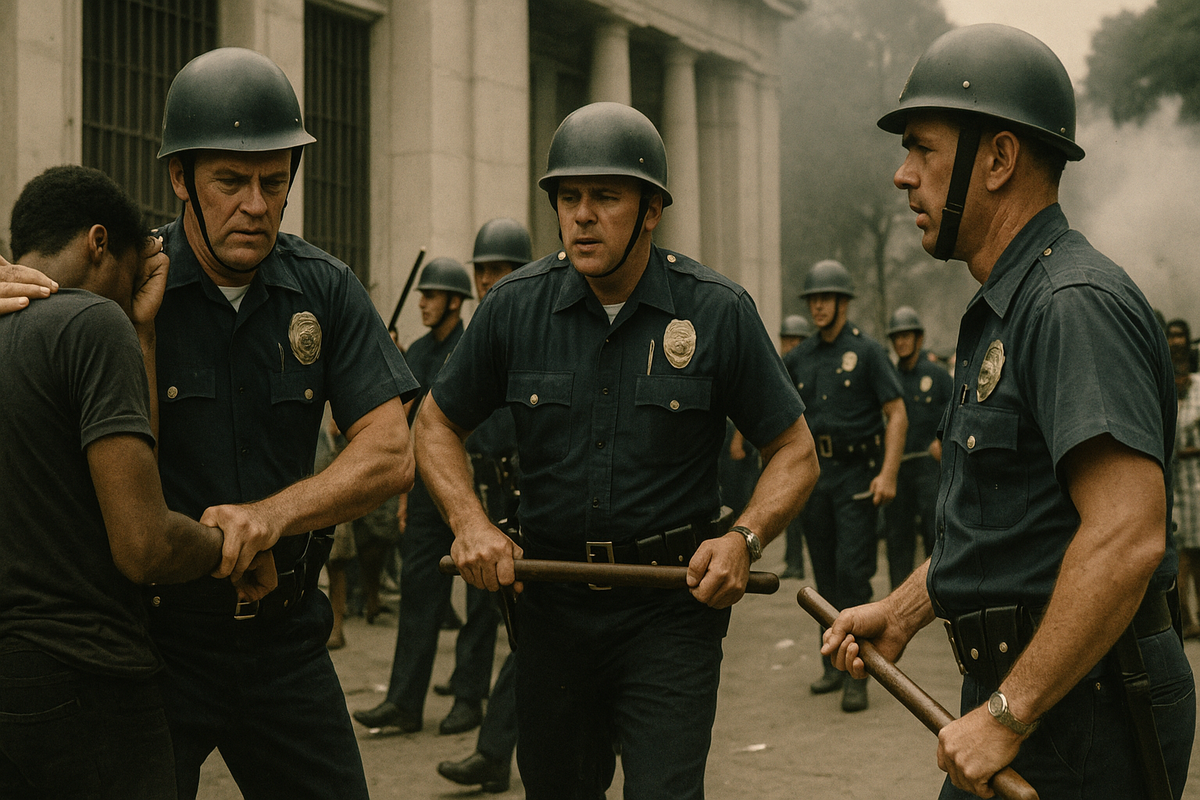
Readers saw arrests during riots, where officers became lightning rods for rage. They saw newly militarized training formations as departments adopted paramilitary tactics. They encountered the grinding stress of daily patrol, where cops faced both suspicion and legitimate danger. And they were reminded of the human cost: officers killed in the line of duty, their deaths used to justify ever-escalating force.
For most Americans in 1968, this magazine was the closest they would come to understanding both sides of the thin blue line.
Issue Details
Publication: Time Magazine
Issue Date: July 19, 1968
Cover Story: "Police: The Thin Blue Line"
Historical Context: Published months after the assassinations of Martin Luther King Jr. and Robert F. Kennedy, during nationwide civil unrest and Vietnam War protests
Archive Status: Highly collectible original issue
Inside the Issue: What Time Saw
The paradox at the heart of the issue was inescapable: police were indispensable for order, yet they had become the focal point of conflict. Time didn't resolve that paradox. It documented it.
Why Vintage Time Endures
These magazines refuse to be relics. They remain active participants in contemporary debates because the debates never resolved. When protesters face riot police today, when politicians campaign on "law and order," when cities wrestle with police reform—the vocabulary, the imagery, the underlying tensions all trace back to moments like July 1968.
That's the power of holding the original magazine. It's not a summary or a retrospective. It's the first draft of history, written in real time, by people who didn't yet know how the story would end.
Because in many ways, it hasn't.
Why Collectors Covet This Issue
Owning this issue isn't nostalgia. It's historiography.
Start Your Collection
If this issue speaks to you, it's not alone. Thousands of original Time magazines from the 1930s through the 1970s are available—each one a window into the decade that shaped it. From the New Deal to Watergate, from World War II to Vietnam, from the Civil Rights Movement to the Culture Wars, these magazines documented America as it happened.
Browse Time Magazine CollectionWhether you're a collector building an archive, a historian conducting research, or someone honoring a family member who lived through these years, these magazines offer something digital databases cannot: the physical artifact, exactly as it was printed, held, read, and debated more than half a century ago.
The July 19, 1968 issue of Time Magazine captured something rare: the exact moment when a national debate crystallized. "Police: The Thin Blue Line" wasn't just reporting—it was prophecy. The dangers officers faced, the grievances of communities, the collision of race and authority and justice—all of it documented with the precision and urgency that made Time essential reading in mid-century America.
More than fifty years later, that thin blue line hasn't disappeared. It's only become more contested.
Holding this issue now is holding a question America still can't answer. And that's why it matters.