
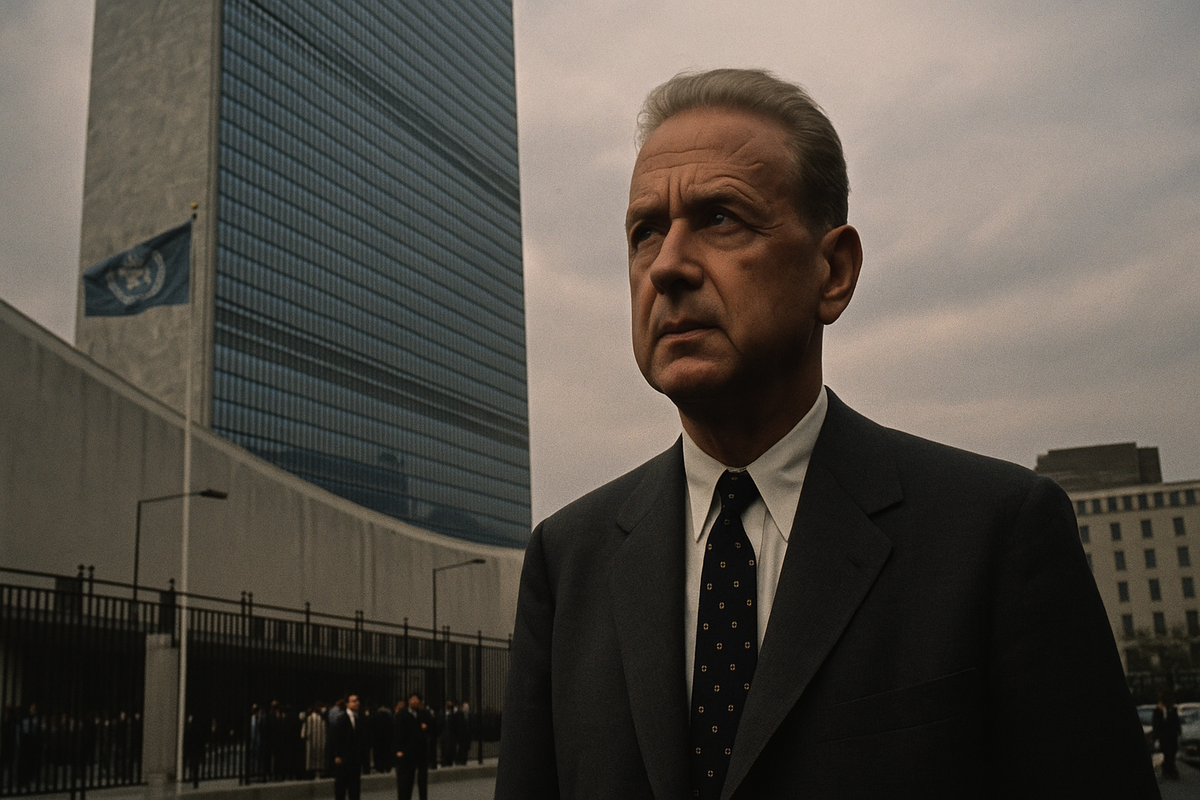
The U.N. in Crisis, Hammarskjöld's Death, and the Cold War Battle for Global Power
How the September 29, 1961 issue of Time Magazine captured the moment when international order hung in the balance
The plane went down in Northern Rhodesia just past midnight on September 18, 1961. When the wreckage was found hours later near Ndola, U.N. Secretary-General Dag Hammarskjöld was dead—along with fifteen others aboard the DC-6. He had been flying to negotiate a ceasefire in the Congo Crisis. Within days, Soviet Premier Nikita Khrushchev moved to reshape the U.N. itself.
Eleven days after the crash, Americans opened their mailboxes to find the September 29, 1961 issue of Time Magazine waiting. The world order, it told them, was fracturing. And the one institution built to hold it together might not survive.
Archive Details
Historical Figure: Dag Hammarskjöld, U.N. Secretary-General
Issue Date: September 29, 1961
Archive Source: Time Magazine
Historical Context: Published 11 days after Hammarskjöld's death in plane crash
Hammarskjöld's Death and Khrushchev's Gambit
Dag Hammarskjöld had been the second Secretary-General of the United Nations, a Swedish diplomat known for moral independence that frustrated both Washington and Moscow. His sudden death created a vacuum. Khrushchev filled it immediately with a demand: replace the Secretary-General's office with a "troika" system—three leaders representing the Western bloc, Communist nations, and the non-aligned world.
Moscow framed this as fairness. The West saw it clearly: paralysis by design. A three-headed U.N. leadership would require consensus on every decision. The institution would freeze.
Time didn't bury this story in diplomatic abstractions. It presented Khrushchev's proposal as what it was—a Cold War power play dressed as reform. The magazine's cartoonists illustrated a U.N. chariot pulled by three stubborn animals, each straining in different directions. Satire as analysis.
The Expanding Assembly
But the troika debate played out against a more fundamental shift: the U.N. was no longer a Western club. By September 1961, membership had surged to 99 nations—nearly double the original 51 signatories of 1945. Dozens of newly independent African and Asian states had joined in the early 1960s alone.
This wasn't symbolic. These nations brought their own priorities: decolonization, economic development, recognition of Communist China. The General Assembly had become unpredictable terrain where Cold War allegiances could no longer be taken for granted. What Time captured was the precise moment when postcolonial politics collided with superpower rivalry on the global stage.
The demographic transformation of the U.N. made Hammarskjöld's death even more consequential. His integrity had bridged ideological divides. His absence left the organization vulnerable to the very fractures the troika would formalize.
How Time Framed the Crisis
Time Magazine in 1961 occupied a singular position in American media. It was the most influential newsweekly in the country—not just reporting events but interpreting them, shaping how millions understood their place in the world. The magazine's visual grammar matched its editorial authority: high-contrast photography, bold typography, and illustrations that doubled as editorial argument.
The September 29 issue deployed all these tools. Photographs of Hammarskjöld showed him in moments of solitary thought, casting him as martyr rather than bureaucrat. The prose was brisk and unapologetic, asking readers the questions that mattered: Would the U.N. survive? Could international cooperation endure when superpowers preferred stalemate to compromise?
Time made no pretense of neutrality. It framed the troika as absurd and dangerous. It presented the U.N.'s expansion as both promising and chaotic. But it grounded everything in specifics—names, votes, proposals—giving readers not just opinion but the architecture of the debate.
For families reading over breakfast tables across America, Time translated the intimidating machinery of diplomacy into a story of personalities and power. It made the abstract urgent.
Key Themes in This Issue
Hammarskjöld as Martyr
Photographs and prose memorialized the Secretary-General as a man of integrity whose sudden death exposed the U.N.'s fragility.
The Soviet Assault
Khrushchev's troika proposal presented as a transparent attempt to paralyze the institution through forced consensus.
Postcolonial Politics
Dozens of new African nations reshaped debates, marking the dawn of a truly global General Assembly.
Cold War Theater
The U.N. portrayed as a stage where ideological battles were fought through votes, speeches, and institutional design.
The Permanence of Print
Vintage magazines endure because they preserve not just information but framing. Digital archives can reproduce text, but they can't replicate the experience of encountering these stories as readers first did—bound in physical form, delivered by mail, read in specific moments.
The September 29, 1961 Time exists as a material witness to Hammarskjöld's death and its aftermath. The paper itself carries the weight of that moment. For collectors, historians, and anyone interested in how the 20th century was chronicled, these magazines offer something irreplaceable: permanence.
Why This Issue Matters to Collectors
Immediacy
Published eleven days after Hammarskjöld's death, it reflects the shock and uncertainty before narratives hardened. Later accounts would have context; this issue has rawness.
Cold War Theater
Few moments laid bare the ideological battle for institutional control as starkly as the troika proposal. This issue documents not just the demand but the reaction.
Demographic Transformation
The doubling of U.N. membership marked the entry of postcolonial nations into global politics. Time's coverage shows how this shift was understood at the time.
Cultural Artifact
The magazine's design, editorial voice, and visual approach capture how Americans processed world events in 1961—a snapshot of Cold War anxiety.
Explore the Archive
Discover thousands of original Time magazines spanning World War II through the Cold War and beyond. Each issue is a direct connection to history—not as memory, but as evidence.
Browse Time Magazine CollectionThe September 29, 1961 issue of Time Magazine captured the United Nations at its most vulnerable. Hammarskjöld was dead. Khrushchev was maneuvering. The General Assembly was expanding. The institution meant to preserve peace stood exposed to the very conflicts it was designed to contain.
Time's coverage gave Americans both facts and perspective when they needed both. Its blend of reporting, analysis, and visual argument made complex diplomacy accessible without making it simplistic. More than sixty years later, the issue remains a primary source for understanding how the Cold War was fought through institutions, not just arsenals.
To hold this magazine is to hold a question that was genuinely open in 1961: Would the U.N. survive? We know the answer now. They didn't.