
Abundance at War: Norman Rockwell, Carlos Bulosan, and the Dream of Plenty
When a Thanksgiving painting and a radical's manifesto collided on the cover of America's most beloved magazine
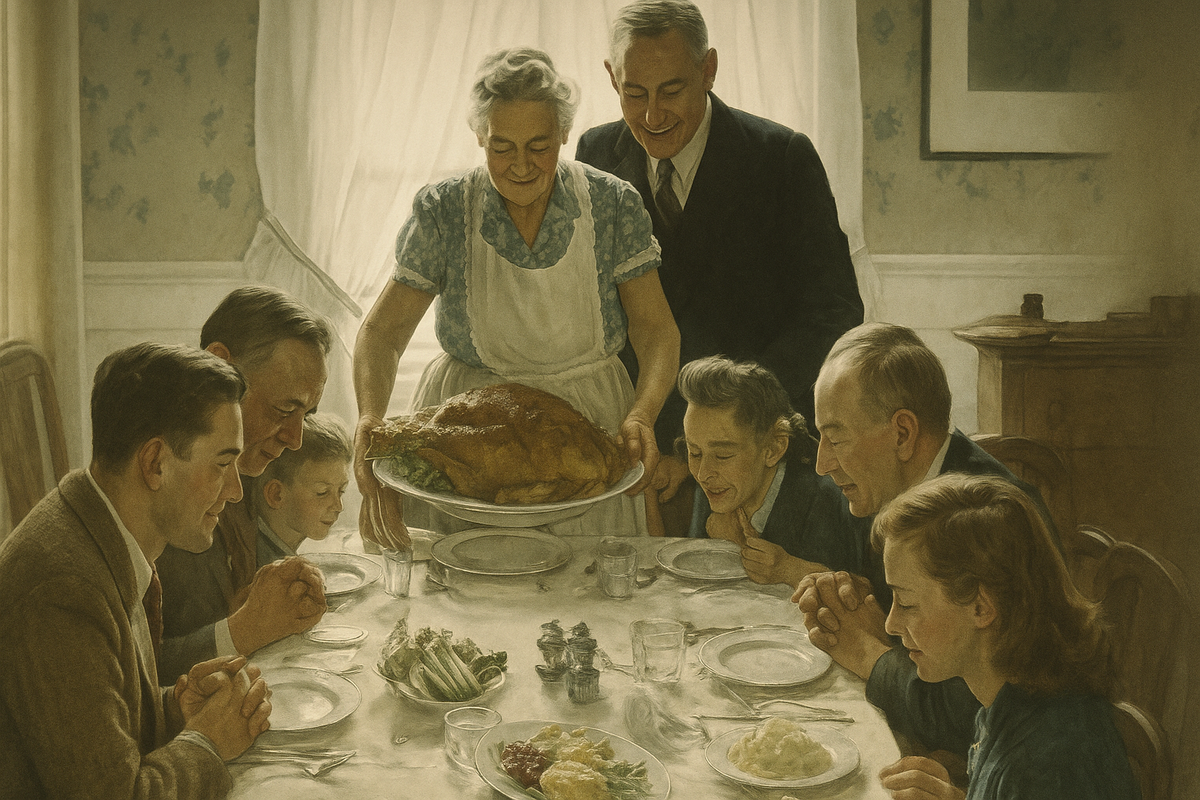
The turkey gleamed under studio lights. White tablecloth, crystal glasses, faces bright with anticipation. Norman Rockwell had painted something dangerous: a promise America couldn't yet keep.
When the March 6, 1943 issue of The Saturday Evening Post hit newsstands, readers confronted more than a holiday fantasy. Rockwell's "Freedom from Want" dominated the cover—a Thanksgiving table groaning with abundance while American kitchens rationed sugar, coffee, and meat. But the real subversion lay inside: an essay by Carlos Bulosan, a Filipino-American labor activist who would not let readers mistake prosperity for justice.
Together, they hijacked one of Franklin D. Roosevelt's Four Freedoms and turned it into something combustible.
Archive Context
Publication: The Saturday Evening Post
Issue Date: March 6, 1943
Cover Artist: Norman Rockwell
Featured Essay: Carlos Bulosan's "Freedom from Want"
Historical Context: Published during World War II, part of Roosevelt's Four Freedoms series
War, Sacrifice, and the Promise That Kept Morale Alive
Early 1943. American troops fought across North Africa. The Pacific theater devoured supplies. Families surrendered butter, rubber, steel. Yet morale held because of a bargain: endure now, prosper later.
Roosevelt had articulated his Four Freedoms in January 1941—freedom of speech, freedom of worship, freedom from fear, freedom from want. Stirring rhetoric. But rhetoric required visualization. The Saturday Evening Post, America's cultural bellwether since the 19th century, commissioned Rockwell to translate Roosevelt's abstractions into images ordinary people could believe in.
"Freedom from Want" arrived at the series' midpoint. Readers had already seen "Freedom of Speech" and "Freedom of Worship." Now came the material promise: that once fascism fell, the table would be full. Not just for some. For all.
The painting worked as wartime propaganda precisely because it sidestepped propaganda's usual bombast. No waving flags. No battlefield heroics. Just a family, a turkey, a moment of peace. Rockwell understood that Americans would tolerate present hardship if they could visualize future security. The painting became a promissory note.
Bulosan's Counter-Narrative: Who Gets to Eat?
Rockwell painted aspiration. Bulosan wrote reckoning.
His essay, paired with the painting, refused to let readers mistake the image for reality. Where Rockwell showed the dream, Bulosan catalogued the work—and the workers—required to make it real:
"The field hands, mill hands, searching, building and molding structures" who carried the nation forward.
The immigrants from Puget Sound to Florida, the miners in Pennsylvania, the laborers in Oregon fields. Bulosan insisted that Roosevelt's freedoms meant nothing if they excluded the millions whose labor built American abundance.
He warned: "Unless democracy extends to all people, the powers of darkness will trample our lives." Not gentle language. Not reassuring. But necessary—a reminder that the war wasn't only overseas. The fight for freedom from want required dismantling poverty, exploitation, and discrimination at home.
Then the rallying cry: "We are marching!"
Not "we will march" or "we should march." Present tense. Active. A declaration that the struggle had already begun, whether comfortable readers chose to join it or not.
This is what made the March 6, 1943 issue extraordinary: The Saturday Evening Post, beacon of middle-class America, had published a radical's manifesto alongside a painter's idyll. The tension between them was the point. Rockwell showed what America wanted to be. Bulosan showed what America had to do.
Why The Post Mattered in Wartime
The Saturday Evening Post wasn't just a magazine—it was the nation's mirror. For decades, it had chronicled American life through fiction, journalism, humor, and illustration. By 1943, it reached millions of households weekly, shaping how Americans understood themselves.
Where newspapers tallied casualties, The Post interpreted meaning. The Four Freedoms series represented the magazine at its peak influence: visual art by America's most beloved illustrator, essays by serious writers, and a message that framed military sacrifice within moral necessity.
The choice to pair Rockwell with Bulosan was either brilliant or subversive, depending on your politics. Rockwell's work celebrated tradition, family, small-town values—the mythic America. Bulosan challenged that myth by centering immigrants, laborers, and the dispossessed. One voice said, "This is who we are." The other said, "Not yet."
The Post gave both voices equal weight. That editorial decision—intentional or not—captured America's wartime duality: confident in its ideals, uncertain about its ability to deliver them.
The Painting That Became a National Icon
Rockwell's "Freedom from Want" has been reproduced so often it risks cliché. The grandmother serving turkey. The grandfather standing beside her. The multigenerational family leaning in, faces glowing. Everything warm, everything safe.
But in 1943, the image carried weight beyond nostalgia. It functioned as wartime reassurance: This is what victory looks like. Not conquest. Not revenge. Just the right to gather, to eat, to be secure.
The painting also revealed what Rockwell understood about American iconography: domesticity sells better than ideology. He could have painted breadlines or soup kitchens to illustrate "freedom from want"—images of deprivation overcome. Instead, he painted abundance achieved. The aspirational beat the cautionary.
Yet the painting's universality sparked debate. Critics noted the all-white family, the middle-class setting, the absence of urban poverty or rural hardship. Whose freedom from want was this? Rockwell had painted his neighbors in Arlington, Vermont—hardly representative of America's full diversity.
Bulosan's essay functioned as correction. His words insisted that the table had to expand, the guest list had to grow. The painting was a vision; the essay was a demand.
What Endures
Rockwell's painting still appears every November, often divorced from its wartime context. Bulosan's essay, less famous, deserves rediscovery. Together, they articulated a version of the American Dream that was neither naive nor cynical—a dream rooted in material security but insistent on shared prosperity.
The tension between Rockwell's image and Bulosan's text hasn't resolved. America still argues about who deserves abundance, who earned it, who built it. The March 6, 1943 issue doesn't settle that argument. It frames it.
For anyone who studies American culture, this issue matters because it shows how art and activism could coexist in a mass-market magazine. For collectors, it matters because it's beautiful, rare, and historically significant. For everyone else, it matters because the questions it raises—about security, justice, and belonging—remain urgent.
Why Collectors Covet This Issue
The March 6, 1943 Saturday Evening Post ranks among the most sought-after issues in the magazine's history. Several factors drive its value:
Historical Timing
Published during World War II's pivotal year, it captures American culture at the intersection of sacrifice and hope. Owning it means possessing a primary source from the moment when the war's outcome remained uncertain.
Rockwell's Masterwork
The Four Freedoms paintings became instant classics, eventually touring the country to raise war bonds. Any issue featuring one of these covers commands collector interest. "Freedom from Want" is the most recognizable of the four.
Bulosan's Voice
The pairing with a Filipino-American writer gives the issue unexpected depth. Bulosan's essay is now studied in American literature and ethnic studies courses, making this issue valuable beyond its visual appeal.
Cultural Artifact
This isn't a reprint or a poster. It's the original publication—how millions of Americans first encountered these ideas. For historians, the issue offers context: the surrounding articles, advertisements, and ephemera that reveal wartime life's texture.
Well-preserved copies fetch significant prices at auction. Collectors value condition, but even issues with minor wear hold worth. These magazines function as time capsules, offering tactile connection to 1940s America.
Explore the Archive
If this issue resonates, you'll find similar artifacts that capture America's defining moments. From the Depression through the Civil Rights era, The Saturday Evening Post chronicled the nation's evolution through art, literature, and commentary. These aren't just collectibles—they're primary sources, family heirlooms, and cultural touchstones.
Browse The Saturday Evening Post Magazine CollectionConclusion
The March 6, 1943 issue didn't just document World War II—it argued for what the war should mean. Rockwell painted the destination. Bulosan mapped the journey. Both understood that freedom from want wasn't automatic. It required vision, labor, and a willingness to expand the table until everyone had a seat.
Holding this issue now means holding that argument, frozen in newsprint and illustration. The turkey still gleams. Bulosan's words still challenge. And the question lingers: whose freedom? whose want? whose America?
The magazine won't answer. But it will make you ask.