
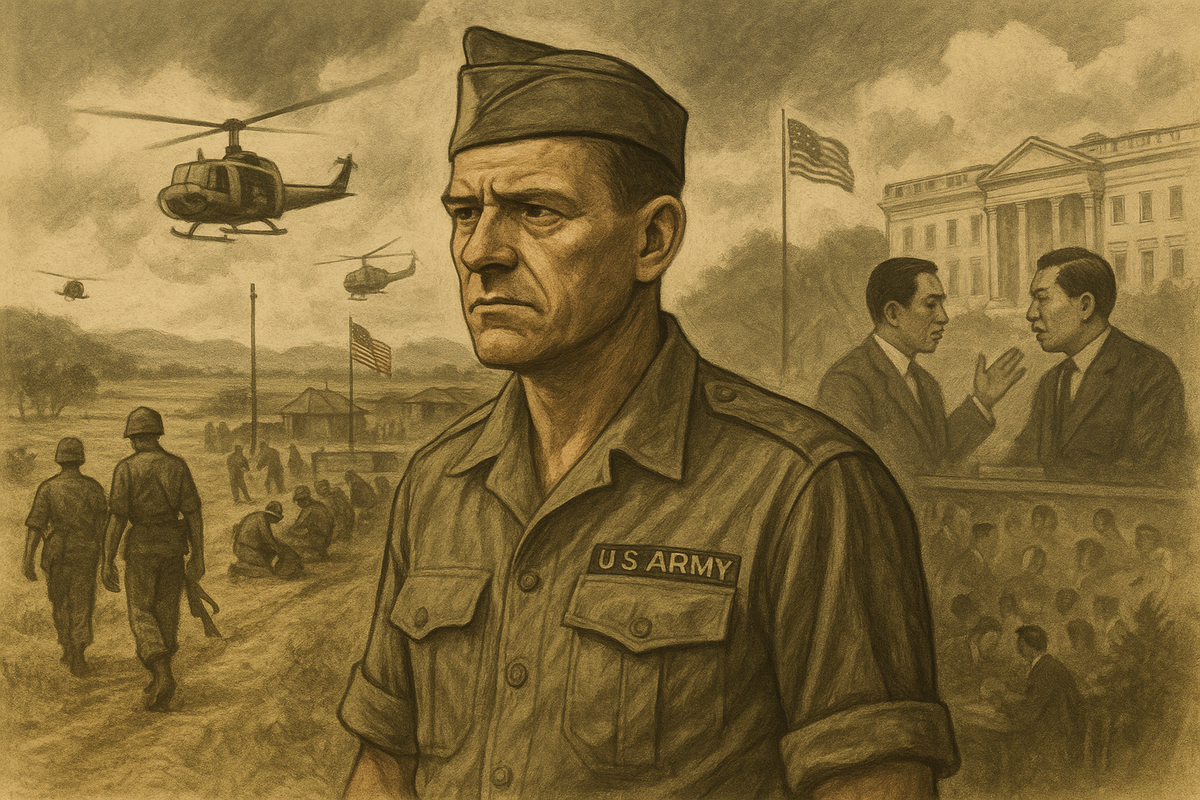
The Magazine That Predicted the Quagmire
Esquire's November 1964 Warning on Vietnam
In November 1964, most Americans still believed Vietnam was winnable. The official line from Washington promised that advisory support, superior technology, and South Vietnamese resolve would contain communism without a full-scale war. But readers who opened that month's issue of Esquire encountered something entirely different: a searing, unsparing portrait of failure titled "The Ugliest American in Vietnam."
David Halberstam's profile of Lieutenant Colonel John Paul Vann was not a celebration. It was an autopsy—performed while the patient was still alive.
Published mere months before the Gulf of Tonkin Resolution transformed American involvement from advisory to combat, this article stands as one of the earliest public warnings that the United States was marching into a war it could not win. For anyone who collects mid-century journalism or studies the origins of America's longest conflict, this issue is not simply vintage media. It is a historical alarm bell, ringing in real time.
Historical Record
Featured Article: "The Ugliest American in Vietnam" by David Halberstam
Central Figure: Lieutenant Colonel John Paul Vann
Publication: Esquire Magazine, November 1964
Historical Context: Published months before Gulf of Tonkin Resolution escalated U.S. involvement
Archive Significance: One of the earliest mainstream critiques of American strategy in Vietnam
The Battle That Changed Everything
Halberstam opens with the Battle of Ap Bac, fought in January 1963 in the Mekong Delta. On paper, it should have been a rout: American helicopters, armored personnel carriers, and air support versus a smaller Viet Cong force. Instead, it ended in chaos. South Vietnamese commanders hesitated. Units refused orders. American advisors watched in frustration as superior firepower dissolved into confusion and retreat.
For Halberstam, Ap Bac was not an anomaly. It was a revelation. It exposed what official briefings concealed: that South Vietnam's military suffered from corruption, poor leadership, and a fatal lack of will. Technology could not fix these problems. Neither could American advisors.
John Paul Vann saw this clearly. And unlike most of his peers, he refused to pretend otherwise.
The Man Who Wouldn't Lie
Vann was a contradiction: brilliant and abrasive, disciplined yet politically reckless. He criticized South Vietnamese commanders openly. He filed reports that contradicted Pentagon optimism. He told journalists what the briefing rooms would not: that the war was being lost, that the numbers were lies, and that American strategy was built on illusions.
This honesty made him invaluable to reporters like Halberstam. It also made him a pariah within the military establishment. By the time Esquire profiled him, Vann had resigned from the Army in frustration, only to return to Vietnam as a civilian advisor—unable to stay away from a war he knew was doomed.
Halberstam's title borrows from The Ugly American, the 1958 bestseller that praised humble, effective Americans working abroad. But Halberstam inverts the concept. Vann's "ugliness" is not humility—it is his refusal to smooth over inconvenient truths. He is ugly because he tells the truth in a system that rewards delusion.
Esquire as Cultural Battleground
By 1964, Esquire had evolved far beyond its origins as a men's fashion magazine. Under editor Harold Hayes, it became a forum for the best writers in America—a publication where Tom Wolfe, Gay Talese, and Norman Mailer dissected politics, culture, and identity with surgical precision. This was the golden age of New Journalism, and Esquire was its flagship.
Halberstam's piece exemplified this ethos. It combined battlefield reporting with biography, policy critique with character study. The prose was dense, literary, and uncompromising. The photographs of Vann—grainy, black-and-white, starkly composed—reinforced the weight of the subject. This was not a puff piece. It was an indictment.
Elsewhere in the issue, readers found fashion spreads, cultural commentary, and satirical illustrations. But "The Ugliest American in Vietnam" anchored the magazine's intellectual gravity. It proved that Esquire could hold its own against Harper's or The Atlantic—that style and substance were not mutually exclusive.
What the Article Got Right
The Illusion of Technological Supremacy
American helicopters and bombers could not compensate for a lack of political legitimacy or popular support. Firepower without strategy is theater, not warfare.
The Corruption Problem
South Vietnam's leadership was more interested in self-preservation than national defense. Vann understood this. So did Halberstam. Washington preferred not to.
The Credibility Gap
Long before the Pentagon Papers, this article documented the gap between official optimism and battlefield reality. Vann's honesty was an early crack in the facade.
The Human Cost of Denial
By profiling one man's disillusionment, Halberstam personalized an abstract policy failure. Vann's story was a warning: ignoring the truth does not make it disappear.
Within a year, the U.S. would begin sustained bombing campaigns. Within two years, ground troops would number in the hundreds of thousands. Within a decade, 58,000 Americans would be dead. Halberstam saw it coming. So did Vann. Esquire gave them a platform to say so.
A Document of Foreknowledge
The tragedy of the November 1964 Esquire is that it was right. Halberstam and Vann saw what was coming. They wrote it down. They published it in a widely read magazine. And the war escalated anyway.
Today, this issue stands as proof that the warning signs were visible. The information was available. The truth was in print. What was missing was the will to act on it.
That makes this magazine more than a collectible. It is a monument to the cost of ignoring inconvenient truths.
Why Collectors Should Care
Historical Timing
This was published at the tipping point—after early failures, before full escalation. It captures the moment when the truth was still visible but not yet widely acknowledged.
Authorial Prestige
Halberstam would win the Pulitzer Prize for his Vietnam reporting. He would later write The Best and the Brightest, the definitive account of how American elites led the nation into disaster. This Esquire article is the foundation of that work.
Cultural Artifact
Unlike government documents or sanitized news reports, this magazine offered unfiltered analysis. It was not declassified decades later—it was sold on newsstands in 1964. That contemporaneous honesty makes it invaluable.
Rarity and Condition
Mid-century Esquire issues in good condition are increasingly scarce. Those tied to major historical events command premium interest among serious collectors.
Design and Production
The issue's visual storytelling—stark photography, dense investigative prose, ironic illustrations—reflects the magazine's editorial ambition. It is a complete document, not just an article.
Primary Source Material
For historians, educators, and collectors, this is not nostalgia. It is primary source material—a record of how some Americans understood Vietnam before the consensus collapsed.
Explore the Archive
If you want to hold this piece of history in your hands—or explore other defining issues from the 1960s—you can browse hundreds of original Esquire magazines spanning decades of cultural journalism.
Whether you are a seasoned collector, a student of Vietnam War history, or simply someone fascinated by the journalism that shaped a generation, these magazines offer something irreplaceable: the chance to see history as it was first reported, before hindsight smoothed the edges.
Browse Esquire Magazines Collection