
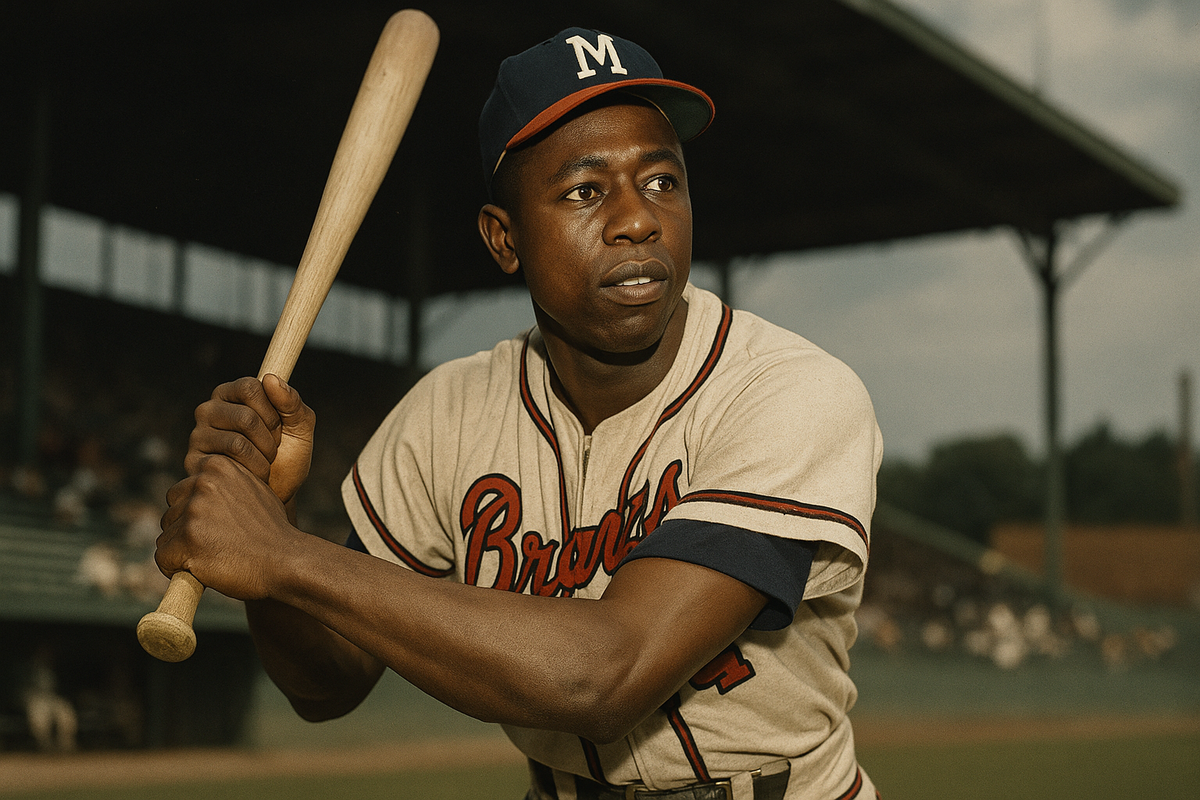
When Hank Aaron's Bat Threatened Baseball's Most Sacred Number
Jet Magazine, June 1959, and the Pursuit of .400
On June 18, 1959, Jet Magazine put a 25-year-old ballplayer on its cover with a headline that read like a weather report: "Red-Hot Hank." But this wasn't just another slugger having a good week. Hank Aaron was chasing .400—a batting average no one had touched since Ted Williams in 1941, a threshold so rare it existed in the realm of myth.
For Jet's readers, this wasn't simply sports news. It was vindication. Proof. A quiet kid from segregated Mobile, Alabama was rewriting the record books in a country that had spent generations insisting Black athletes didn't belong on the same field as white ones. Aaron's bat wasn't just winning games for the Milwaukee Braves. It was dismantling arguments that had propped up Jim Crow for decades.
And Jet made sure everyone knew it.
Historical Record
Featured Article: "Hank Aaron's Red Hot Bat"
Central Figure: Hank Aaron, Milwaukee Braves outfielder
Publication: Jet Magazine, June 18, 1959
Historical Context: Published during the height of the Civil Rights Movement, documenting Black excellence in segregated America
Archive Significance: Early documentation of Aaron's pursuit of baseball immortality, years before breaking Babe Ruth's home run record in 1974
The Context: 1959 and the Battle for Recognition
Twelve years after Jackie Robinson broke baseball's color barrier, the game had changed—but America had not. In 1959, lunch counters across the South were still segregated. Schools resisted integration with armed resistance. The Civil Rights Movement was building toward the explosive decade ahead.
Yet on baseball diamonds from Milwaukee to San Francisco, Black players were dominating. Hank Aaron, Willie Mays, and Ernie Banks weren't just competing—they were redefining excellence. Aaron, in particular, embodied something that made segregationists uncomfortable: he was undeniable.
By mid-June 1959, Aaron was hitting at a pace that forced baseball writers to confront an uncomfortable question: What if the next player to join Williams, Hornsby, and Cobb in the .400 club was a Black man from Alabama?
Jet understood what mainstream sports media often missed: Aaron's statistics were inseparable from the larger struggle for Black dignity and recognition. Every base hit was a counter-argument. Every home run was a refutation.
The Magazine: Jet's Compact Power
Jet was small enough to fit in a back pocket, but its cultural reach was enormous. Founded in 1951 by John H. Johnson, it became the most widely read Black publication in America—a weekly digest that covered everything from politics to entertainment to sports, always centering the Black experience with uncompromising clarity.
The June 18, 1959 cover was quintessential Jet: Aaron in full Milwaukee Braves uniform, bat resting on his shoulder, eyes steady. No gimmicks. No exoticization. Just a supremely confident athlete at the peak of his powers, framed by Jet's signature red-and-white design.
Inside, the article delivered what Jet always delivered: substance. The piece analyzed Aaron's approach at the plate—his reputation as a "bad-ball hitter" who could turn pitches outside the strike zone into line drives. It quoted teammates, managers, and rival pitchers, all marveling at his discipline and power. It noted his use of film study, a technical innovation that placed him ahead of most players in the late 1950s.
But Jet also did something mainstream sports magazines rarely attempted: it situated Aaron's achievement within the broader narrative of Black progress. This wasn't just a batting streak. It was a statement about capability, excellence, and the collapse of white supremacist mythology in America's national pastime.
The magazine's pocket-sized format made it easy to pass from hand to hand—in barbershops, churches, community centers, and living rooms across Black America. Jet didn't just report the news. It circulated it, ensuring that Aaron's dominance became common knowledge in neighborhoods where mainstream newspapers either ignored or minimized Black athletic achievement.
What Made Aaron Dangerous
Key Elements from the Jet Feature
The .400 Chase: At 25, Aaron was the closest any hitter had come to the mythical .400 batting average since Ted Williams in 1941. Baseball analysts openly debated whether he could join that exclusive pantheon.
Bad-Ball Mastery: Aaron admitted he wasn't a classic "wait-for-your-pitch" hitter. He thrived on difficult pitches, turning balls outside the zone into base hits—a skill that made him nearly impossible to defend.
Pitcher's Nightmare: Opposing managers spent entire meetings strategizing how to contain Aaron. The consensus: there was no reliable way. His ability to spray hits to all fields eliminated defensive advantages.
Unshakeable Calm: Known for his quiet demeanor, Aaron famously claimed he didn't think about averages or pressure. He just focused on swinging the bat.
Inevitable Comparisons: Writers were already ranking him alongside Mickey Mantle and Stan Musial, with some predicting he would surpass Williams and Hornsby in the record books.
What made Aaron particularly dangerous was his refusal to conform to pitchers' expectations. Most elite hitters of the era were disciplined to the point of rigidity—they waited for their pitch, their zone, their moment. Aaron didn't wait. He attacked. Pitches that should have been balls became doubles. Mistakes became home runs. Even good pitches weren't safe.
This adaptability—this genius for making the most of imperfect situations—mirrored something larger about the Black experience in 1959 America. You couldn't wait for perfect conditions. You couldn't wait for fairness. You took what was thrown at you and turned it into something extraordinary.
Jet's Enduring Legacy
Jet succeeded because it understood something fundamental: representation isn't a luxury. For Black Americans in 1959, seeing Hank Aaron on a magazine cover—presented with respect, authority, and celebration—was a political act.
Mainstream media often covered Black athletes through a lens of exoticization or faint surprise, as if their excellence required explanation. Jet simply documented greatness as a fact. No hedging. No condescension. Just the record.
This approach made Jet indispensable. It wasn't just reporting news—it was creating a counter-narrative to the dominant culture's erasure and minimization of Black achievement. When Aaron's batting average climbed, Jet readers knew first. When he faced discrimination on the road, Jet reported it. When he broke records, Jet celebrated without apology.
The June 18, 1959 issue exemplifies this mission. It gave Aaron's achievement the coverage it deserved, contextualized it within the broader struggle for Black equality, and ensured that Black communities across America could share in his success.
Why This Issue Matters to Collectors
Historical Timing
This issue captured Aaron at the beginning of a career that would culminate in breaking Babe Ruth's home run record in 1974. It documents the rise of one of baseball's greatest players before the full scope of his achievement was visible.
Civil Rights Artifact
Published at the height of segregation and just before the sit-in movement exploded across the South, this issue links Black athletic excellence to the broader struggle for equality. It's a primary source for understanding how sports intersected with politics in the late 1950s.
Iconic Cover
Aaron's photograph—calm, powerful, unadorned—is one of Jet's most memorable sports covers. It's an image that communicates both individual greatness and collective pride.
Cross-Collector Appeal
Baseball memorabilia collectors, civil rights historians, and enthusiasts of Black cultural history all seek this issue, ensuring sustained demand and increasing rarity.
Mainstream Absence
Unlike Sports Illustrated or Life, which covered Aaron intermittently, Jet centered him in its narrative. This makes the magazine an irreplaceable record of how Black media documented Black achievement when white-dominated outlets looked away.
Cultural Weight
For collectors, this isn't just a magazine. It's an artifact from a time when every batting title and home run carried symbolic weight—when sports success was inseparable from the fight for dignity and recognition.
A Piece of Living History
If you collect vintage magazines, study civil rights history, or simply revere baseball's greatest players, the June 18, 1959 Jet Magazine is essential. It captures a singular moment: a 25-year-old Hank Aaron, bat in hand, chasing baseball immortality while America wrestled with its own contradictions.
Whether you're preserving family heritage, building a collection focused on Black cultural history, or honoring the memory of one of baseball's greatest champions, owning this issue means holding a piece of the record—the one Jet made sure was written correctly.
Browse Jet Magazines Collection