
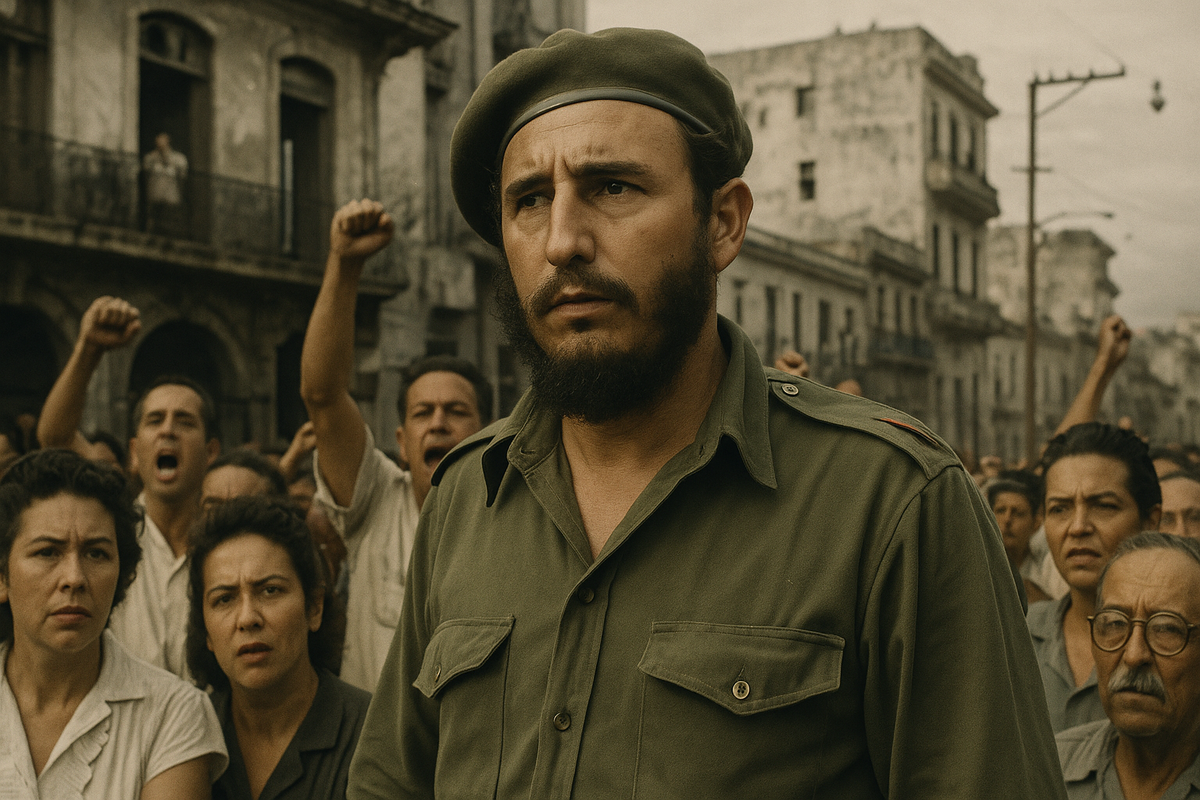
The Vengeful Visionary
How Time Magazine Introduced America to Fidel Castro
On January 26, 1959, Americans opened their mailboxes to find a stranger staring back at them.
The man on Time Magazine's cover wore olive-green fatigues and a dense black beard. His eyes carried the intensity of someone who had just emerged from two years of jungle warfare—and won. For most readers, this was their first sustained look at Fidel Castro, the 32-year-old lawyer who had done the impossible: overthrown a U.S.-backed dictator with fewer than 300 guerrillas.
The revolution was twenty-five days old. Fulgencio Batista had fled Havana on New Year's Day. Castro's rebels had marched into the capital to delirious crowds. And now, firing squads were executing Batista's officers in public stadiums while throngs cheered.
Time's coverage arrived at the single most volatile moment in modern Cuban history—when everything hung in the balance, when Castro could have become either a democratic reformer or a Communist dictator, and when no one, not even Castro himself, seemed certain which path he would take.
This issue didn't just report on the Cuban Revolution. It shaped how Americans would understand it for decades.
Historical Record
Publication: Time Magazine
Issue Date: January 26, 1959
Cover Subject: Fidel Castro
Historical Context: 25 days after Castro's forces entered Havana
Archive Significance: First major U.S. magazine profile of Castro post-revolution
The Revolution That Shocked the Hemisphere
Castro's victory defied every military and political logic of the era.
Batista commanded a 40,000-man army, lavishly funded and trained by the United States. Castro began his insurgency in December 1956 with 82 men. Within days of landing, his force was nearly annihilated—reduced to fewer than twenty survivors hiding in the Sierra Maestra mountains.
Two years later, Batista was gone.
The speed of the collapse stunned Washington. American intelligence had assured policymakers that Castro's guerrillas posed no serious threat. State Department cables from late 1958 still predicted Batista would crush the rebellion within months. Instead, the regime's moral authority had rotted from within. Soldiers deserted. Batista's own commanders lost faith. On the final night of 1958, the dictator boarded a plane with $300 million in cash and flew to the Dominican Republic.
Castro entered Havana on January 8, 1959. He was mobbed by hundreds of thousands. This was not a coup. This was a popular uprising that had succeeded against impossible odds—and the entire Western Hemisphere was watching to see what came next.
Time's Portrait: Charisma, Violence, and the Unknown
Time's January 26 issue captured the revolution at its most raw and unfiltered.
The magazine's correspondents had witnessed the executions firsthand. In the days following Castro's takeover, his regime brought dozens of Batista's military officers, secret police chiefs, and torturers before firing squads. Some trials lasted hours. Others, minutes. Time described crowds of 17,000 packing Havana's sports stadium to watch the proceedings, erupting in cheers when death sentences were announced.
The photographs were unflinching. Men blindfolded against stone walls. Rifle squads taking aim. Bodies slumping forward. For American readers accustomed to sanitized Cold War diplomacy, these images delivered a visceral shock: revolutions were not polite affairs.
But Time's reporting went deeper than spectacle. The magazine profiled both Castro brothers—Fidel, the magnetic orator who spoke in marathon speeches and quoted José Martí; and Raúl, the quieter sibling whose Communist sympathies were already well-documented. Time noted Raúl's presence at the trials, his friendship with Soviet-aligned leftists, and the quiet influence he wielded over his brother's inner circle.
The portrait that emerged was of a revolution still crystallizing. Fidel himself remained ideologically ambiguous—hostile to American imperialism, yes, but not yet openly Communist. He spoke of land reform, not collectivization. Of nationalism, not Marxism. Time framed him as "a vengeful visionary," a phrase that captured both his appeal and his danger.
The question looming over every page: Which Fidel would prevail? The democratic reformer who promised free elections? Or the authoritarian who had already begun consolidating power?
Key Revelations from the Issue
Public Executions
Time documented the mass trials and firing squads that shocked American readers, with crowds of thousands witnessing revolutionary justice in sports stadiums.
Raúl's Influence
The magazine identified Raúl Castro's Communist ties and his growing role in the new government—foreshadowing Cuba's eventual Soviet alignment.
Ideological Ambiguity
Castro's true intentions remained unclear. Time captured the uncertainty that defined this pivotal moment before Cuba's political path solidified.
Popular Support
Despite the violence, Cubans overwhelmingly rallied behind Castro, seeing him as the liberator who ended Batista's corrupt dictatorship.
Why This Cover Became an Icon
Time's January 26, 1959 cover is now one of the most recognizable images of the Cold War—not for what it revealed, but for what it anticipated.
Within two years, Castro would declare Cuba a socialist state. Within three, he would invite Soviet missiles onto the island, bringing the world to the brink of nuclear war. The bearded revolutionary on Time's cover would become one of the most polarizing figures of the twentieth century—hero to anti-imperialists worldwide, demon to Miami's Cuban exiles, obsession to eleven American presidents.
But in January 1959, none of that had happened yet. The cover captured Castro at the single moment when his revolution could still have gone in multiple directions. It is a historical document of pure contingency—a snapshot of the instant before the future locked into place.
For this reason, collectors prize the issue. It represents not just the Cuban Revolution, but the end of American hemispheric dominance, the opening act of the 1960s, and the beginning of a proxy war that would span four decades.
The Artifact and Its Afterlife
Original copies of the January 26, 1959 Time Magazine survive in surprising numbers, but condition matters. Newsstand issues often show wear—creased spines, tanned pages, address labels obscuring the cover. Subscriber copies in protective sleeves command premiums. Issues with intact centerfolds and minimal foxing are increasingly scarce.
What makes this particular issue a cornerstone for Cold War collectors is its timing. This was the first major American publication to give Castro sustained, in-depth coverage after his victory. Life Magazine would follow with its own feature in February. Newsweek ran profiles in March. But Time was first—and in the media landscape of 1959, being first meant shaping the narrative.
For Cuban exiles and their descendants, the issue carries additional weight. Many families saved this magazine as a marker of the moment their homeland changed forever. It appears in estate sales in Miami, in attics in Union City, in archives across Latin America. Each copy is a relic of a world that vanished overnight.
Collector Significance
Historical Timing
Captured Castro at the most uncertain moment of the revolution—before his ideology crystallized, before Soviet alignment, before the world knew what Cuba would become.
Cold War Milestone
Marks the beginning of a geopolitical shift that would culminate in the Cuban Missile Crisis and define U.S.-Latin American relations for decades.
Cultural Symbolism
For Cuban exiles and Latin American historians, this issue represents the turning point when Cuba became the center of world attention and Cold War intrigue.
Archive Rarity
As a first major U.S. cover profile, this issue holds premium value among Cold War collectors and Cuban history enthusiasts worldwide.
Why It Still Matters
The January 26, 1959 issue of Time Magazine is not merely a collectible. It is primary evidence of how the United States encountered one of the pivotal figures of the Cold War—at the exact moment when his intentions were still opaque, when diplomacy might have changed outcomes, when history had not yet hardened into myth.
Reading it now, you experience the dissonance of watching contemporaries struggle to interpret events that you already know the ending to. You see American journalists trying to assess whether Castro is a threat or an opportunity. You watch them puzzle over the executions, the mass rallies, the ideological contradictions. They were reporting in real time, without the benefit of hindsight, and their uncertainty bleeds through every sentence.
That uncertainty is what makes the issue invaluable. It returns us to a moment when the future was genuinely unknown—and reminds us that every historical turning point looked like chaos to the people living through it.
Explore the Archive
Discover thousands of original Time magazines spanning the 1920s through the 1990s—the entire arc of the twentieth century preserved in its original form.
Browse Time Magazine Collection