
The Magazine That Proved Small Towns Could Beat Empires
How The Saturday Evening Post captured Green Bay's impossible triumph—and preserved American identity on the eve of World War II
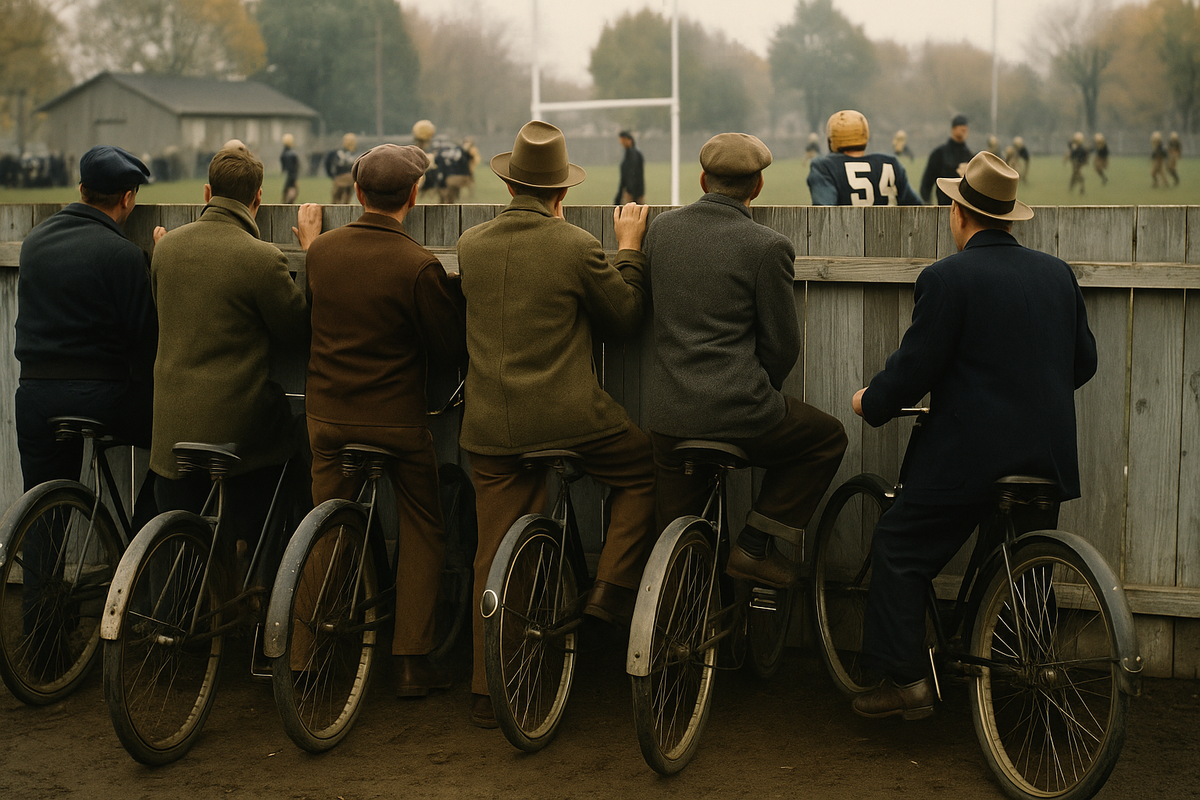
November 30, 1940. A barber in Green Bay, Wisconsin, closes his shop early. A factory worker cashes his paycheck and tucks five dollars into an envelope. Across town, teenage boys hoist themselves onto bicycles and pedal toward the practice field, ready to scale fences for a glimpse of something most of America thought impossible.
They weren't chasing movie stars. They were chasing proof that a city of 46,000 people could field a football team capable of humbling New York, Chicago, and Detroit—the industrial Goliaths of American sport.
That week, readers across the United States opened The Saturday Evening Post and found Russ Davis's "Little Town That Leads 'Em"—not just a sports feature, but a manifesto of collective will. At a moment when Nazi tanks rolled through Europe and the Great Depression's shadow still darkened kitchen tables, this article offered something radical: evidence that ordinary Americans, unified by sacrifice and loyalty, could build greatness without wealth or size.
For collectors and historians today, this single issue remains what it was in 1940—a time capsule of national identity, captured in ink and newsprint.
Archive Details
Publication: The Saturday Evening Post
Issue Date: November 30, 1940
Featured Article: "Little Town That Leads 'Em" by Russ Davis
Historical Context: Pre-Pearl Harbor America, final peacetime football season
Cultural Significance: Documents community-owned professional sports before the modern era
The World Beyond the Stadium Gates
The timing mattered. By late 1940, World War II had engulfed Europe. Britain stood alone against the Wehrmacht. President Franklin D. Roosevelt had just shattered the two-term tradition, winning an unprecedented third term while Americans debated whether—and when—their country would join the fight.
In this climate of uncertainty, sports became more than diversion. Baseball, boxing, and the young professional football leagues offered communities a stage where David could still defeat Goliath, where merit trumped money, where a modest Midwestern town could prove itself against the muscle of industrial America.
The Green Bay Packers embodied that defiance. They had won championships. They had beaten teams backed by corporate fortunes. And they had done it without a billionaire owner or a metropolitan tax base—just butchers, bakers, and factory workers who treated the team as shared civic property.
The Saturday Evening Post understood what it was documenting. This wasn't merely football. It was democracy in cleats.
The Post as Cultural Chronicler
By 1940, The Saturday Evening Post had become the nation's living room—a weekly gathering place where Americans encountered fiction, essays, humor, and the iconic illustrations that defined mid-century visual culture. Its reach was staggering, its influence unmatched.
Russ Davis's article fit seamlessly into this tradition. He didn't write about plays or statistics. He wrote about identity. His prose captured the barber who knew every player's blocking scheme, the shopkeeper who kept a team photograph behind the register, the families who scraped together ticket money during years when scraping was all they could do.
The magazine's photographers amplified the narrative. Their images remain startling:
- Stadium crowds pressed shoulder-to-shoulder, wool coats buttoned against November wind, faces lit with the fervor of believers.
- Young men perched precariously on bicycles against the practice field wall, necks craned, desperate for any glimpse of their heroes.
- Streets flooded with townspeople welcoming the team home from road victories, treating athletes like liberators.
This was visual anthropology masquerading as sports journalism. The images proved what Davis's words argued: in Green Bay, football wasn't entertainment. It was blood covenant.
The Cover as Mirror
The November 30, 1940 cover exemplified the Post's genius. Like Norman Rockwell's paintings—though not illustrated by Rockwell himself—it depicted American life not as propaganda but as lived experience. No battlefield heroics. No industrial grandeur. Just the everyday dignity of ordinary people navigating ordinary moments.
Inside, Davis's article operated on two levels simultaneously. Surface reading: a sports team's unlikely success. Deeper reading: a philosophical argument about American exceptionalism divorced from wealth or geography. Green Bay proved that greatness wasn't franchised to coastal elites or industrial capitals. A town of 46,000 could stand equal to cities of millions—if its people chose unity over individualism.
The Post had made this argument before in different contexts, but never with such tangible evidence. The Packers' championship trophies weren't metaphors. They were brass and silver, hoisted by men whose neighbors had financed their salaries through stock purchases and gate receipts.
The Anatomy of Devotion
Davis filled his article with details that transformed sports writing into social history:
Davis's storytelling, combined with the Post's visual documentation, transformed journalism into cultural archaeology. Future generations wouldn't need to guess what mattered to 1940s small-town America. They could simply read this issue.
Legacy Beyond Leather and Grass
The Packers' community-ownership model survived when it shouldn't have. Professional sports became big business, television rewrote economics, and most small-market teams either relocated or folded. Green Bay endured because 1940s stock buyers created a legal and cultural framework that made relocation impossible.
The Saturday Evening Post preserved that origin story before it could be romanticized or revised. Davis's article captured the Packers when they were still a working-class experiment, before they became a billion-dollar brand. That authenticity—that documentary moment before self-mythology—is why this issue matters to historians and collectors alike.
In an era when digital content evaporates daily, when entire websites vanish from existence, physical magazines remind us that information once required permanence. Families kept Saturday Evening Post issues for months, sometimes years. They reread articles. They showed photographs to neighbors. They treated each issue as cultural currency worth preserving.
That's the true value proposition for collectors: not just what's in the magazine, but what the magazine represents—a moment when information was scarce enough to treasure, when storytelling required craft, when a single article could shape how millions understood themselves.
Why Collectors Covet This Issue
This issue documents the Packers' ascendance before Pearl Harbor rewrote American life. It captures sports in the final months of peacetime innocence.
The article embodies small-town America's self-conception at mid-century—values that would soon be tested by global war and postwar transformation.
The photographs and period advertisements create an unintentional time capsule. Fashion, language, consumer goods—all preserved as context for the central narrative.
For Packers scholars, this issue is primary source material. Davis interviewed players, owners, and fans when memories were fresh and mythology hadn't yet calcified.
The Post itself was a media empire. Owning this issue means possessing a piece of America's last great mass-circulation magazine, before television fractured the national conversation.
Serious collectors understand that condition matters—intact spines, unfaded covers, minimal foxing—but even well-read copies carry value. The wear patterns tell their own story.
Accessing the Archive
For those drawn to the Green Bay story or the Post's broader documentation of American life, the archive remains accessible. Original issues spanning from the 1900s through the 1970s capture the nation's evolution—World Wars, Depression, suburbanization, civil rights, space exploration.
Browse The Saturday Evening Post Magazine CollectionThe Final Frame
The November 30, 1940 issue of The Saturday Evening Post endures because it captured something Americans needed to believe in 1940—and perhaps still need today. That collective action matters. That small communities can achieve what wealth and size cannot. That loyalty, when shared, becomes infrastructure.
Russ Davis and the Post's editors didn't just profile a football team. They documented the mechanics of hope during a decade that had offered precious little. They showed readers that even as Europe burned and economic recovery remained fragile, a town of 46,000 people could prove democracy's promise: that ordinary citizens, united by shared purpose, could build something extraordinary.
More than eight decades later, holding this issue means holding that proof—not as nostalgia, but as evidence. The paper has yellowed. The advertisements now seem quaint. But the central truth remains unfaded: Green Bay happened. The impossible was real. And The Saturday Evening Post made sure we'd remember.