
When Bohemia Met Fifth Avenue
Thea Porter's 1971 Vogue Debut and the Birth of Orientalist Chic
On August 15, 1971, Vogue did something unusual: it turned a London designer's New York boutique opening into a manifesto.
The feature—"Vogue's Own Boutique: Thea's in America"—wasn't simply retail coverage. It was Vogue anointing a new kind of glamour for American women, one that had nothing to do with Parisian tailoring or Madison Avenue restraint. Thea Porter, a Damascus-born couturier who'd built her reputation in London, was bringing something the magazine's editors recognized as essential: a vision of fashion as escape, artifice, and unapologetic luxury in an era drowning in denim and political upheaval.
This wasn't trend reporting. This was Vogue declaring that bohemian opulence—embroidered chiffon, mink-trimmed velvet, silks drenched in jewel tones—had arrived on American soil. And it was using one of its most powerful editorial tools, the "Own Boutique" feature, to make it canonical.
Archive Details
Designer: Thea Porter
Publication: Vogue Magazine
Issue Date: August 15, 1971
Feature: "Vogue's Own Boutique: Thea's in America"
Boutique Location: 303 East 60th Street, New York
Models Featured: Jane Forth, Elsa Peretti, Jane Holzer
The Cultural Fault Line of 1971
The year Porter opened her townhouse boutique at 303 East 60th Street, American fashion was mid-identity crisis. The rigid codes of the 1950s had shattered. Hemlines swung wildly between floor-grazing maxis and abbreviated minis. Women treated clothing as declaration rather than uniform. The Vietnam War ground on. Second-wave feminism was rewriting expectations. Youth culture had already torched the rulebook.
Into this chaos, Vogue introduced a designer whose work didn't resolve the tension—it deepened it. Porter's garments were theatrical, historicist, unashamedly elitist. She wasn't offering liberation through simplicity. She was offering liberation through fantasy: gowns that evoked Ottoman courts, bias-cut silks that moved like liquid, embroidery that referenced centuries of Eastern craft traditions.
Porter herself was the perfect emissary. Born in Damascus, raised between Syria and London, she understood Orientalism not as appropriation but as inheritance. Her designs carried the weight of actual memory—souks, textiles, the visual language of the Middle East and Mediterranean. When Western fashion was beginning its long flirtation with "global influences" (a trend that would explode later in the decade with Yves Saint Laurent's 1976 Russian Collection), Porter was already operating from the source.
Vogue recognized this. The magazine wasn't just covering a boutique opening. It was positioning itself at the vanguard of a cultural shift: the moment when American fashion stopped looking exclusively to Paris and started imagining itself as cosmopolitan, eclectic, worldly.
Inside the August 15, 1971 Issue: A Spread as Statement
Vogue structured the feature as part editorial, part portfolio, part cultural endorsement. The cover itself—a sleek black gown shot with the magazine's signature high-contrast minimalism—signaled the tonal shift. This wasn't the optimistic pop of the 1960s. This was elegance gone moody, modern yet steeped in history.
Inside, the spread became a study in atmosphere. Vogue deployed three models, each a cultural icon in her own right:
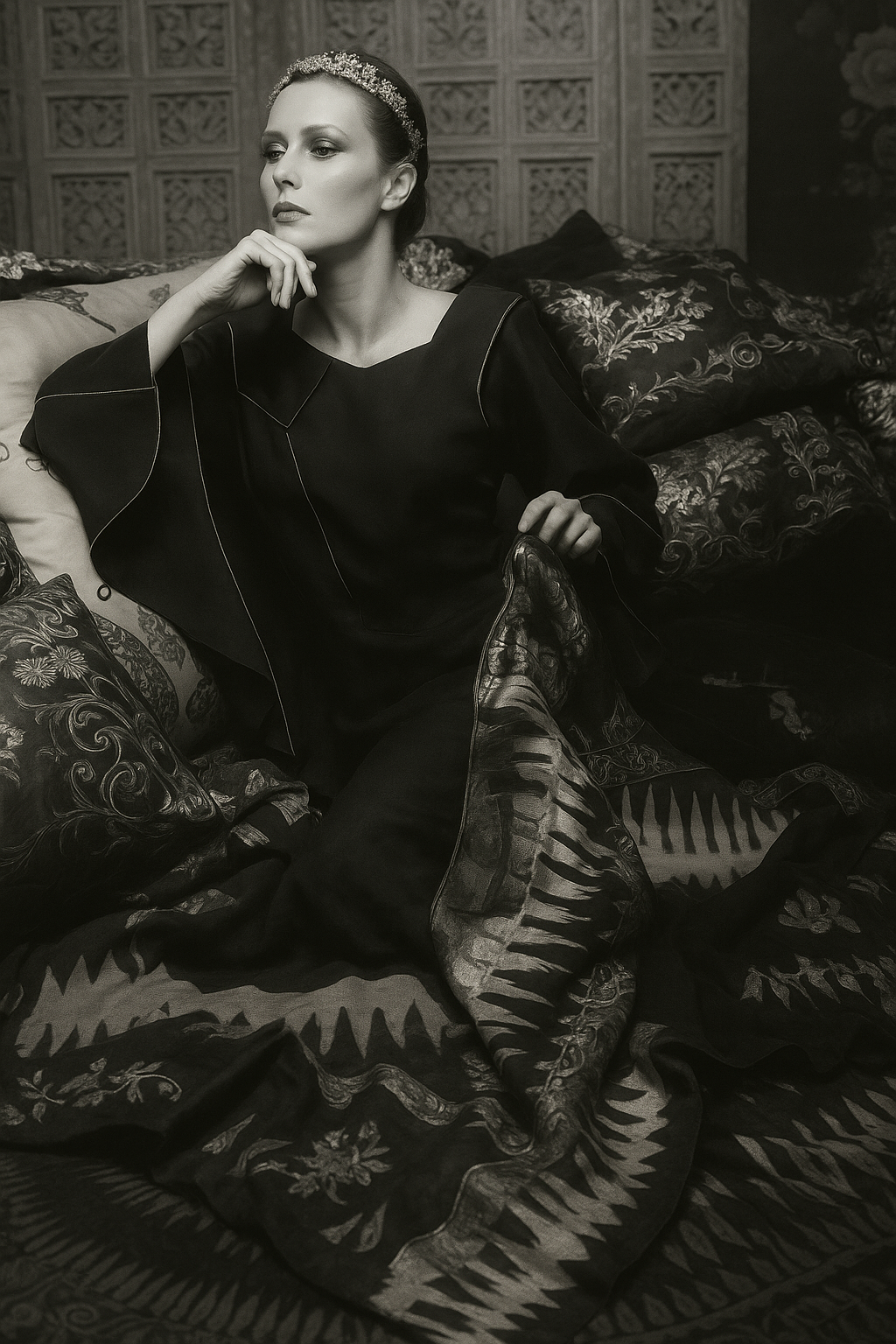
Jane Forth appeared in a black chiffon ayaba embroidered with scarlet silk and Oriental patterns—a garment that read less like a dress and more like wearable theater. Forth, already a fixture in underground fashion and film, embodied the collision of avant-garde and high glamour that Porter represented.
Elsa Peretti modeled two pieces: a bias-cut panne velvet gown with a mink collar, and a floor-length chiffon gown punctuated with satin insets. Peretti's presence was prescient—within a few years, she'd revolutionize jewelry design at Tiffany & Co. with the same sculptural romanticism visible in Porter's silhouettes.
Jane Holzer, Warhol's former superstar and a fixture of New York's art-world elite, wore red satin and chiffon trousers. Her inclusion made clear that Porter's clientele wasn't limited to society matrons. This was fashion for women who moved between galleries, salons, and social rebellion with equal fluidity.
The photography leaned into decadence. Models reclined on embroidered pillows. Interiors were dim, textures lavish, poses languid. This wasn't the brisk modernity of 1960s editorial work. This was fashion as mise-en-scène—an invitation to inhabit a world where clothing functioned as art, identity, and historical reverie all at once.
What the Spread Reveals: Nine Points of Significance
The Lineage This Issue Established
Today's fashion landscape—where Dior shows Moroccan embroidery, where Indian textiles appear in contemporary streetwear, where cross-cultural reference is industry standard—descends directly from the aesthetics Thea Porter championed in 1971. She anticipated the modern obsession with global influence by decades.
Her boutique in New York wasn't just a shop. It was a proof of concept: that clothing could function as curated cultural heritage, worn with both glamour and intellectual intention. For Vogue's 1971 readers, the spread offered permission to experiment, to see fashion as narrative rather than obligation. For readers now, it stands as evidence of how singular voices like Porter's redefined what eclecticism could mean.
Why This Issue Matters to Collectors
Owning this issue means possessing a primary document: the moment East met West in American couture, the moment bohemian luxury became mainstream aspiration, the moment Vogue decided what American women would covet next.
For Collectors: Where to Find the Archive
Original Vogue magazines are more than style guides. They're time capsules—complete with the photography, editorial voice, advertising, and cultural assumptions that shaped modern identity. The August 15, 1971 issue is especially vital for anyone studying the intersection of fashion, global aesthetics, and 1970s cultural transformation.
Browse Vogue Magazine CollectionConclusion: A Document of Vision
The August 15, 1971 Vogue remains a landmark not because it covered fashion, but because it recognized a cultural shift before it fully materialized. "Thea's in America" wasn't a boutique profile—it was Vogue betting on a worldview.
Thea Porter brought Orientalist chic to New York at the exact moment American culture was hungry for it. Vogue provided the platform, the photography, and the editorial benediction. Together, they created a document that still resonates: proof that glamour doesn't require simplicity, that luxury can be intellectual, and that the most enduring fashion comes from designers who refuse to separate beauty from history.
In a decade of transformation, Vogue made sure opulence kept its seat at the table—and Thea Porter gave it an entirely new vocabulary.