
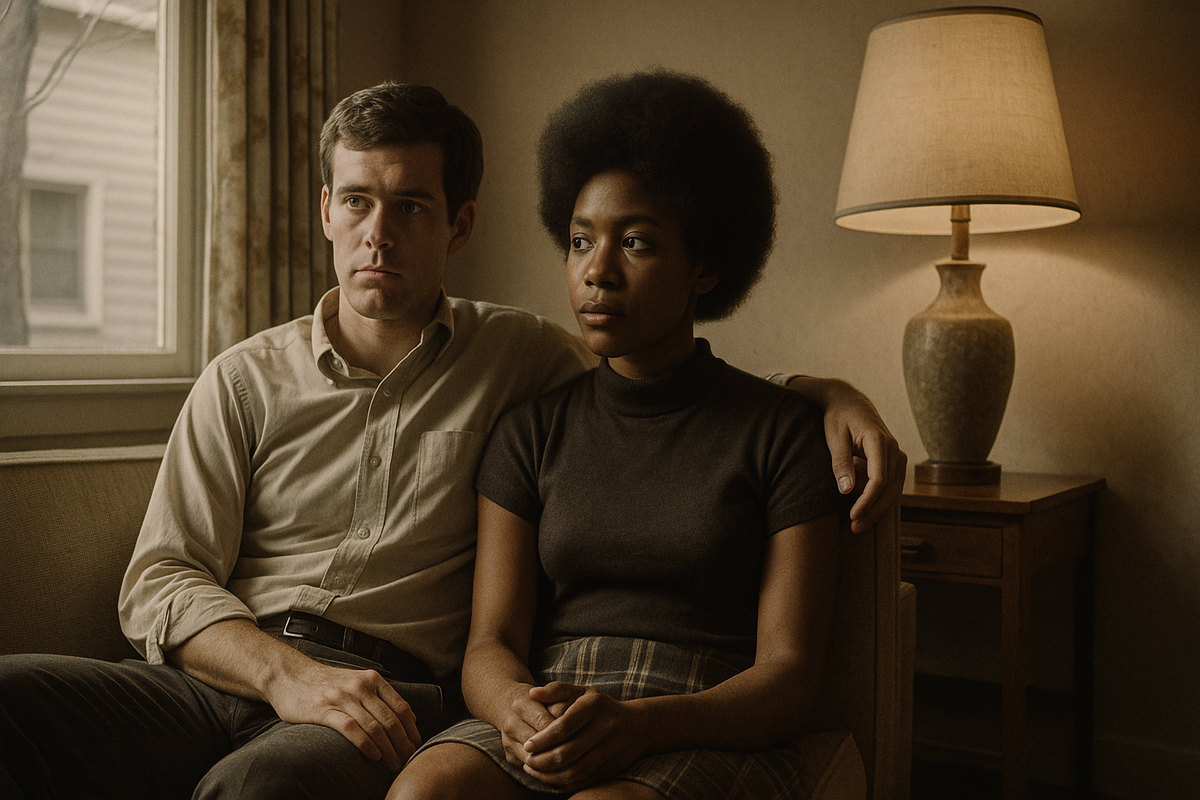
The Magazine That Dared White America to Answer: "Why Should My Child Marry Yours?"
How Ladies' Home Journal brought the civil rights movement into eight million living rooms—and forced mothers to confront the question they feared most
April 1968. Martin Luther King Jr. had three weeks to live.
Across America, women opened their mailboxes to find the latest Ladies' Home Journal—the same magazine that had taught them how to bake a proper casserole and organize their linen closets. But tucked between the fashion spreads and beauty columns was an essay that would force millions of white, middle-class readers to confront a question most had never allowed themselves to ask.
"Why Should My Child Marry Yours?"
The author: Myrlie Evers, widow of assassinated civil rights leader Medgar Evers.
The challenge: Tell me why I should trust you with my children's future after what your ancestors did to mine.
This wasn't a think piece. It was a reckoning delivered directly into America's living rooms.
Archive Details
Historical Figure: Myrlie Evers (widow of Medgar Evers)
Issue Date: April 1968
Publication: Ladies' Home Journal
Essay Title: "Why Should My Child Marry Yours?"
Context: Published 10 months after Loving v. Virginia, weeks before MLK's assassination
When the Supreme Court Legalized Love—But Not Acceptance
Just ten months earlier, the Supreme Court had struck down the last laws banning interracial marriage in Loving v. Virginia. The decision made headlines. But it didn't change hearts.
In 1968, interracial couples still faced violence, ostracism, and the cold shoulders of their own families. The law said these marriages were legal. Society said they were unthinkable.
Myrlie Evers understood both sides of that divide better than most.
She had fled Mississippi for Claremont, California, after her husband's murder in 1963—leaving behind the segregated South for an integrated neighborhood where white and Black children played together on the same sidewalks. The change should have felt like progress. Instead, she wrote, she felt like she was "in the midst of the enemy."
Her essay didn't offer easy answers. It offered raw honesty.
She admitted her suspicion of white people, even the kind neighbors who had brought flowers after Medgar's death. She described her husband's fierce opposition to interracial dating, rooted in his rage over centuries of white men exploiting Black women during slavery. She confessed her own conflicted feelings: the desire to judge people as individuals warring against the weight of generational trauma.
And she asked white mothers the question that terrified them: What if your child fell in love with mine?
The Magazine That Brought the Movement Home
Ladies' Home Journal wasn't The Atlantic or Harper's. It wasn't trying to be.
Founded in 1883, it had built its reputation on practical advice, serialized fiction, and the assumption that women's primary concerns revolved around home and family. For decades, that formula worked. By the 1960s, it reached eight million subscribers—more readers than most newspapers.
But under editor John Mack Carter, the magazine began weaving social and political commentary into its traditional content. The April 1968 issue is a masterclass in that strategy.
On one page: Myrlie Evers confronting readers with the psychological toll of racism and the fragility of trust across the color line.
On the next: advertisements for window treatments and a "Time-and-Motion Study in Beauty."
The juxtaposition wasn't accidental. It was the point.
Ladies' Home Journal understood that its readers weren't living in separate worlds—one domestic, one political. They were navigating both simultaneously, balancing casseroles and civil rights, lipstick and legislation. The magazine met them where they were: in their kitchens, grappling with what kind of country their children would inherit.
By publishing Evers's essay alongside recipes and fashion columns, the magazine validated a truth that women already knew: the personal was political, even if Betty Friedan hadn't yet made that phrase famous.
What the Essay Revealed—and What It Asked
Evers didn't write propaganda. She wrote testimony.
She described her husband's deep mistrust of white people, born from witnessing the systemic exploitation of Black women and the violence that maintained segregation. She recounted moving to California and feeling disoriented by white neighbors' gestures of sympathy—kindness that complicated her anger but didn't erase it.
One moment stands out: her grandmother visiting from Mississippi, stunned to see white and Black children playing together without incident. For the older woman, raised under Jim Crow, the scene was incomprehensible. For Myrlie, it represented the generational shift happening in real time.
But the essay's power came from what it didn't do. It didn't reassure white readers that everything would be fine. It didn't promise that forgiveness was inevitable or that integration would solve centuries of violence overnight.
Instead, it asked white mothers to sit with discomfort. To imagine their own daughters or sons falling in love across the color line. To consider whether they were ready to extend the same trust they expected Black families to offer them.
It was an invitation to examine their own prejudices—delivered not by a distant activist, but by a grieving mother who had every reason to reject reconciliation entirely.
Key Themes from the Essay
Medgar Evers's Opposition
He despised the exploitation of Black women by white men during slavery and carried that mistrust into fierce opposition to interracial marriage.
Suspicion in California
Moving from Mississippi to an integrated neighborhood, Evers felt like she was "in the midst of the enemy" despite the surface friendliness.
Unexpected Kindness
White neighbors offered genuine sympathy after Medgar's assassination, complicating her feelings and forcing her to reconsider blanket judgments.
Generational Shifts
Her grandmother, visiting from Mississippi, was astonished to see white and Black children playing together without incident—a scene unimaginable in the Jim Crow South.
Personal Growth
Evers admitted her own hesitation but also her determination to judge individuals on their character, not on racial categories.
Emotional Honesty
The essay was not propaganda but a candid exploration of fear, mistrust, and the fragile hope for eventual reconciliation.
Why This Issue Matters to Collectors Today
The April 1968 Ladies' Home Journal isn't just a vintage magazine. It's a historical artifact that captures a nation at a crossroads.
Historical Timing
Published weeks before Martin Luther King Jr.'s assassination, it documents the fragile moment between legal victory (Loving v. Virginia) and social transformation—a gap that still hasn't fully closed.
Rare Voice
Myrlie Evers speaking directly to a mainstream, predominantly white female audience was extraordinary in 1968. Civil rights leaders rarely had access to publications with this reach and demographic.
Cultural Snapshot
The photographs of Evers with her children, paired with ads for home décor and beauty products, create a vivid portrait of how ordinary life and national crisis coexisted on the same pages.
Visual Documentation
The clean serif typeface and uncluttered layout gave the essay weight, distinguishing it from lighter features while still integrating it into the magazine's flow. The design choices themselves tell a story about how editors navigated controversial content.
For collectors, historians, or anyone preserving the unvarnished record of America's racial reckoning, this issue is irreplaceable. It's not a retrospective or a sanitized textbook summary. It's the conversation as it happened—uncomfortable, unresolved, and undeniably real.
The Legacy: When Magazines Were Mirrors
Women's magazines have often been dismissed as frivolous—all recipes and fashion tips, nothing of substance.
The April 1968 Ladies' Home Journal destroys that myth.
By publishing Myrlie Evers's essay, the magazine acknowledged what its readers already knew: that deciding what to serve for dinner and deciding how to raise children in a racist society weren't separate concerns. They were braided together in the daily work of being a mother, a neighbor, a citizen.
The issue didn't solve America's racial divisions. But it refused to ignore them. And it trusted its readers to engage with hard truths, not just comforting illusions.
That's why this magazine matters. Not because it was radical, but because it brought radical questions into ordinary homes—and demanded that ordinary people answer them.
Explore the Archive
If you want to hold this piece of history in your hands, we've preserved it.
Browse Ladies' Home Journal Magazine CollectionEvery issue is more than paper and ink. It's a record of the conversations that shaped us—the ones we're still having today.