
The Silent Genius: When Esquire Opened the Door to Thelonious Monk's Private World
Inside the April 1960 issue that transformed a jazz enigma into an American icon
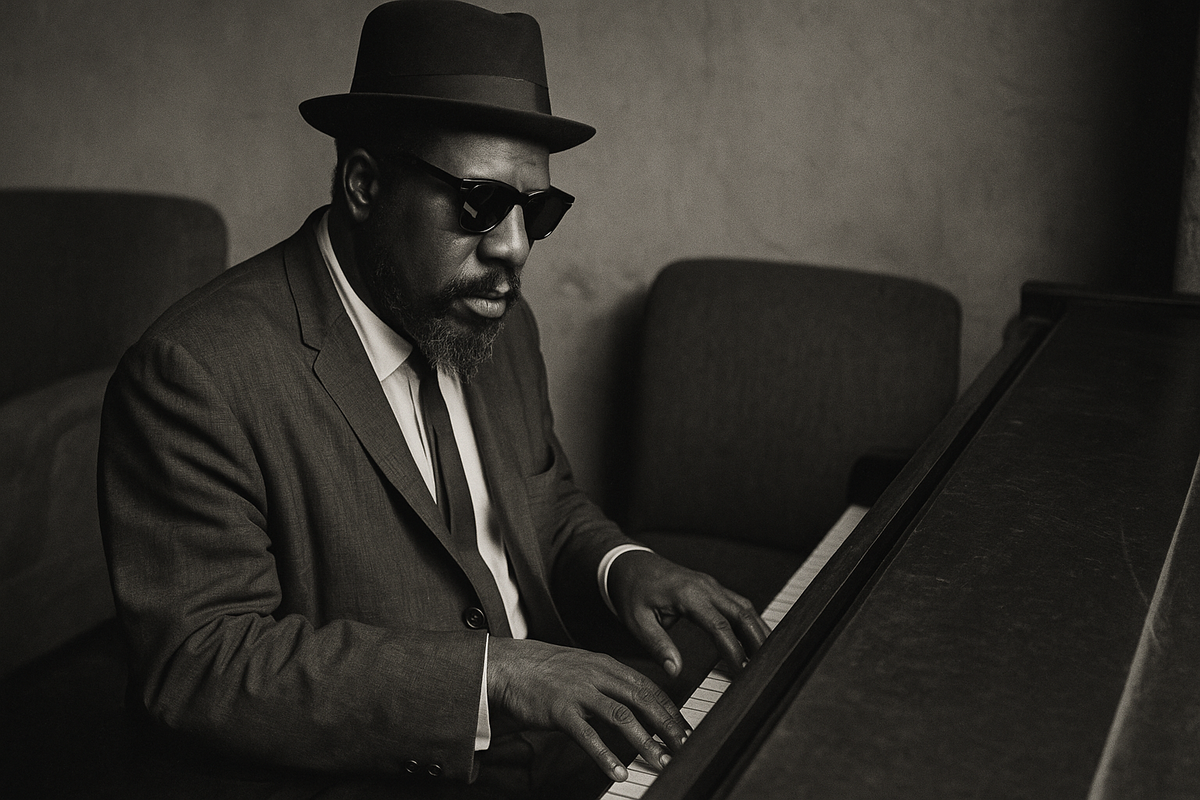
April 1960. A reader slides their copy of Esquire from the newsstand, expecting the usual—sharp tailoring, sharper wit, maybe a scotch recommendation. Instead, they find themselves face-to-face with one of the most enigmatic minds in American music: Thelonious Monk, seated at his piano in dark glasses and a hat, unreachable as a sphinx.
Nat Hentoff's profile, "The Private World of Thelonious Monk," wasn't just another celebrity feature. It was an act of cultural translation—an attempt to explain a man who spoke most clearly when he said nothing at all, whose silences at the keyboard could swing harder than most musicians' notes. For mainstream America in 1960, this was radical stuff: jazz as high art, a Black artist as tortured genius, and Esquire positioning itself not as a guide to what's fashionable, but to what matters.
The magazine wasn't just covering Monk. It was making a statement about what an educated, sophisticated man should care about in 1960s America.
Archive Details
Historical Figure: Thelonious Monk
Issue Date: April 1960
Archive Source: Esquire Magazine
Article: "The Private World of Thelonious Monk" by Nat Hentoff
The Cusp of Everything
The timing couldn't have been more charged. Sit-ins were erupting across Southern lunch counters. The Cold War hummed in the background like a nervous bassline. John F. Kennedy would win the presidency by November. America was reinventing itself, and so was its music.
Bebop had already blown apart the big band era, turning jazz from dancehall entertainment into something more cerebral, more uncompromising. Charlie Parker had burned bright and died young. Miles Davis was beginning his modal experiments. John Coltrane was stretching the boundaries of what a saxophone could say.
And then there was Monk—angular, cryptic, making music that felt like watching someone rearrange furniture in the dark until suddenly, impossibly, everything clicked into place.
By 1960, he'd finally broken through commercially, pulling in $1,700 to $2,000 a week at New York clubs. But success hadn't made him easier to understand. If anything, it sharpened the contradiction: a man whose genius was obvious to anyone who heard him play, yet who remained fundamentally unknowable the moment he stepped away from the piano.
Esquire's Gambit
By the late 1950s, Esquire had evolved beyond its origins as a men's style guide. It had become something more ambitious: a cultural authority that insisted its readers engage not just with fashion, but with ideas—cinema, politics, literature, and increasingly, the avant-garde.
The April 1960 issue exemplified this vision. Alongside commentary on Ingmar Bergman's films and political essays, the magazine devoted substantial space to a jazz pianist whose music baffled as many listeners as it electrified.
This was a calculated move. Profiling Monk signaled to readers that cultural sophistication now required fluency in modern jazz. Esquire wasn't just reflecting taste—it was shaping it, asking its audience to stretch beyond comfort into something stranger, more challenging, more real.
"Outside His Music There Is Little But Trouble"
Hentoff's thesis cut straight to the paradox. In conversation, Monk was scattered, distracted, prone to long silences or remarks that seemed to come from another conversation entirely. Friends and fellow musicians described him as brilliant but maddening, a man you couldn't quite reach.
At the piano, everything reversed. There, Monk spoke with crystalline clarity. His use of space—the deliberate pauses, the angular rhythms that lurched and then resolved—created a musical language entirely his own. Hentoff observed that Monk could "make silence swing," a phrase that captured something essential about his approach: sound defined by its relationship to absence.
The profile refused to romanticize. Hentoff documented Monk's frequent hospitalizations, his struggles with mental illness, his near-total dependence on his wife Nellie for managing the practicalities of life. Success had come late, and it hadn't made things easier. The article presented genius not as a gift but as a weight, carried at considerable cost.
Musicians like John Coltrane and critics like Gunther Schuller testified to Monk's radical originality. His seemingly eccentric choices at the keyboard reflected deep structural thinking—he wasn't being weird for its own sake. He was rebuilding jazz from the foundation up, note by note, silence by silence.
The photographs reinforced this duality. One image: Monk at the piano, shadowed by his hat and sunglasses, untouchable. Another: Monk at home, withdrawn, looking inward. Together they told the story Hentoff's words traced—brilliance and isolation, two sides of the same coin.
Key Themes from Hentoff's Portrait
The Paradox of Genius
Hentoff framed Monk's life as one of stark contradiction: chaos in everyday existence, but crystalline clarity in his music. The article captured how genius and vulnerability coexisted in one man.
Financial Success, Personal Struggle
Despite earning steady income by 1960, Monk's private world remained fragile, marked by hospitalizations and dependence on his wife Nellie for stability.
The Power of Silence
Hentoff emphasized Monk's revolutionary use of space and silence as musical tools—not absence of sound, but sound's essential counterpart.
Recognition Among Peers
Fellow musicians saw Monk not as eccentric, but as revolutionary—a figure who fundamentally reshaped modern jazz through radical structural innovation.
The Magazine as Time Capsule
Like Life's wartime issues or early Rolling Stone covers, vintage Esquire endures because it preserved more than information. It preserved a moment's anxieties, ambitions, and values.
The April 1960 issue reminds us that American masculinity was being redefined in real time. Being sophisticated no longer meant just following sports and politics—it meant engaging with art, understanding style as substance, recognizing genius even when it arrived in unconventional forms.
In an era when most journalism evaporates within days of publication, these physical magazines stand as reminders that history was once something you held in your hands, studied at leisure, kept on shelves, passed down. They're artifacts of a slower, more deliberate form of cultural engagement.
Why This Issue Endures
Cultural Timing
Published at the threshold of the 1960s, it captures America in flux—civil rights activism gathering force, artistic modernism pushing into the mainstream, traditional definitions shifting.
Rare Access
One of the first substantial profiles of Monk in a mainstream publication, capturing the transitional moment when recognition was arriving but understanding still lagged behind.
Esquire's Evolution
The issue demonstrates how the magazine was redefining itself—no longer just about what to wear or drink, but about how to think and what to value.
Visual Power
The stark photographs of Monk give the issue lasting impact—portraits that capture the mystery, distance, and presence of an enigmatic genius.
A Final Note
To hold the April 1960 issue of Esquire today is to hold a contradiction: a mass-market magazine that insisted on treating difficult art seriously, a profile of an unreachable man that somehow made him more human, a historical document that feels urgently relevant.
Thelonious Monk's silence still swings. Nat Hentoff's words still resonate. And Esquire's gambit—that its readers were ready for something more challenging, more real, more true—turned out to be right.
The magazine captured not just a musician, but a moment when America was learning to see its own genius, even when that genius arrived wrapped in mystery, silence, and uncommon grace.
For Collectors and Enthusiasts
Whether you're honoring Monk's legacy, collecting mid-century design, or tracing the evolution of American cultural journalism, the April 1960 Esquire offers something rare: a window into the private world of a public genius.
Browse Esquire Magazine Collection