
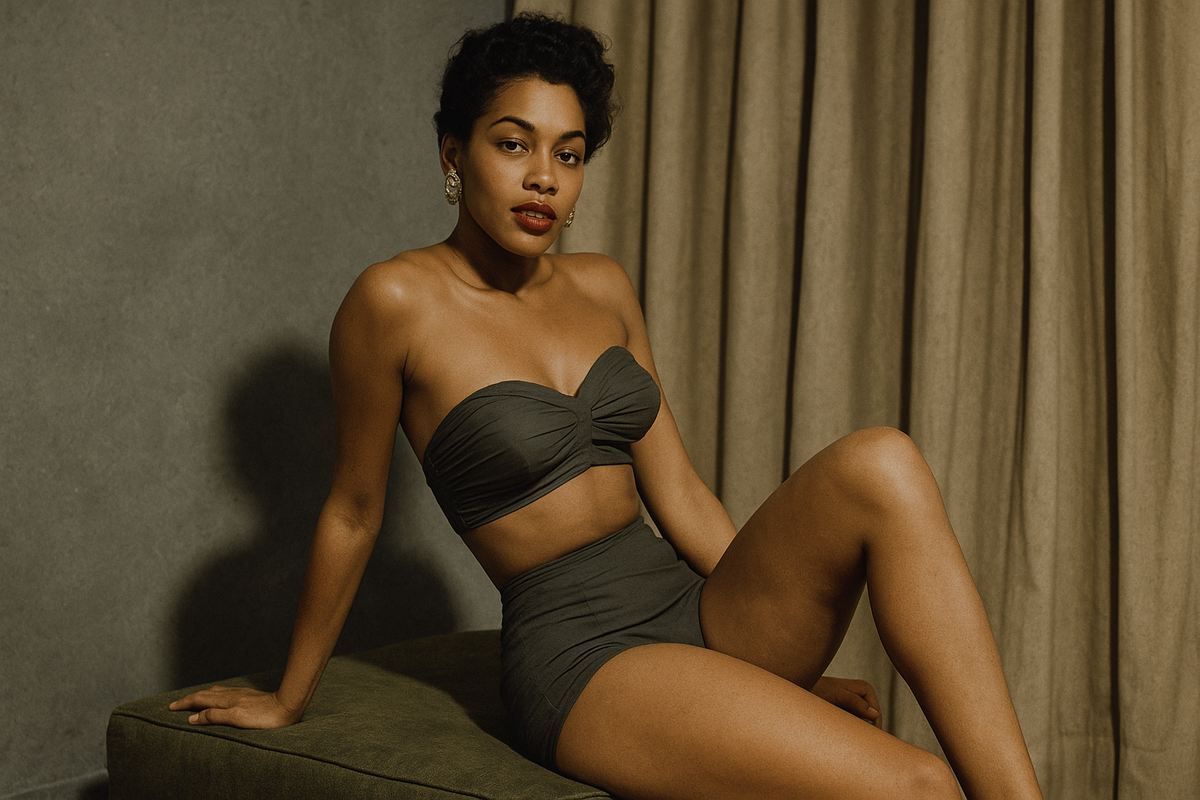
The Price of Glamour: Rosalind Hayes and the Pin-Up Girl Nobody Saw
Inside the March 27, 1952 Jet Magazine confession that exposed Hollywood's segregated beauty machine
When Rosalind Hayes stared out from the cover of Jet Magazine on March 27, 1952, she wasn't smiling. Her gaze was direct, unflinching—challenging readers to look past the yellow background and the swimsuit poses inside and confront a question the entertainment industry refused to answer: What does it cost a Black woman to be beautiful for a living?
Inside that pocket-sized issue, beneath the cover line "Confessions of a Pin-Up Girl," Hayes delivered testimony that shattered the fantasy. While white America swooned over Marilyn Monroe and Rita Hayworth, Hayes was working twice as hard for half the visibility, navigating an industry that wanted her body in photographs but not her name on marquees. Her confessions weren't celebrity gossip. They were evidence.
For Jet's readers in 1952, this was more than entertainment coverage. It was documentation of a specific kind of erasure—one that wrapped itself in sequins and called itself opportunity.
Historical Archive
Featured Subject: Rosalind Hayes, actress and model
Publication Date: March 27, 1952
Archive Source: Jet Magazine
Cover Story: "Confessions of a Pin-Up Girl"
Film Credits: Lydia Bailey, Caribbean Gold
Hollywood's Segregated Glamour Machine
The early 1950s should have been Hayes's moment. Postwar America was drunk on pin-up culture. Soldiers had returned home with images of Hollywood starlets tucked into their duffel bags. Magazines sold millions of copies on the promise of access to these women—their beauty routines, their measurements, their secrets.
But the machine only had room for certain faces.
Hayes had the portfolio: film roles in Lydia Bailey and Caribbean Gold, modeling contracts, the kind of bone structure that photographs called "camera-ready." What she didn't have was an industry willing to build her career the way it built white actresses' careers. Movie contracts remained scarce. Television roles were stereotyped when they existed at all. The modeling work that sustained her came with a different tax—constant suspicion that her beauty was somehow suspect, that pin-up work made her less respectable, less serious, less worthy of protection.
She told Jet about the long hours, the emotional exhaustion, the other women's jealousy. She talked about refusing shortcuts—a pointed reference to an industry where Black women's bodies were always assumed to be available, always up for negotiation. Hayes had been working since her teenage years, balancing acting and modeling while white pin-ups were being packaged as overnight discoveries. Her persistence wasn't just admirable. It was structural necessity.
What Jet Understood That Nobody Else Did
Mainstream magazines in 1952 weren't interested in Rosalind Hayes's reality. They wanted the fantasy—the idea that glamour was democratically accessible, that hard work and good looks were enough, that Hollywood was a meritocracy in heels.
Jet knew better.
Since its 1951 launch, Jet had positioned itself as the publication that refused to sanitize Black life for white comfort. Its pocket-sized format wasn't just practical—it was intimate, designed to be carried, passed around, discussed in living rooms and barbershops. The bold covers demanded attention on newsstands. The reporting inside delivered what mainstream outlets buried: unvarnished truth about what it meant to be Black in America.
The March 27, 1952 issue was classic Jet architecture. On the cover, Hayes posed against that striking yellow backdrop, her image paired with another cover line: "Do White Singers Imitate Negroes?" The magazine understood something fundamental—Hayes's story about Hollywood exclusion and the question of white appropriation of Black culture were the same story. Both were about extraction. Both were about who gets credit, who gets paid, who gets remembered.
Inside, Jet gave Hayes space to speak plainly. The layout mixed glamorous photography—Hayes in swimsuits, Hayes in modeling poses—with her unfiltered reflections on the grind behind those images. This wasn't exploitation. It was contextualization. Readers could admire the photographs while understanding exactly what they cost to produce.
This editorial approach made Jet indispensable. It offered cultural commentary, political coverage, and celebrity profiles that didn't pretend Black Americans lived in a post-racial fantasy world. No other publication was doing this work in 1952. Nobody else trusted their readers this much.
What Hayes Said (And What She Couldn't Say)
Hayes's confessions revealed the specific mechanics of exclusion:
From the outside, Hayes admitted, her life looked enviable: good money, stylish clothes, camera attention, film roles. But she described what the photographs didn't show—the long days, the relentless competition, the emotional toll of being evaluated primarily as a body rather than an artist.
Hayes emphasized that she refused to take shortcuts, a careful way of saying she wouldn't sleep her way into roles. In an industry where Black women were presumed sexually available, this refusal meant fewer opportunities. Her pride in maintaining her integrity was also an admission of professional cost.
Despite her film work, Hayes acknowledged that movie contracts remained elusive. Television and modeling provided steadier income, but Hollywood's doors stayed mostly closed. She was good enough to be photographed, not good enough to be invested in.
Hayes spoke about being judged by other women, about constantly defending her profession against assumptions that pin-up work was inherently scandalous. The cultural policing of Black female beauty was relentless—too sexual for respectability, not sexual enough on Hollywood's terms.
Above all, Hayes's testimony revealed the exhaustion of surviving in an industry designed to exclude her. She'd been working since adolescence. She was still fighting for recognition. Her story wasn't exceptional—it was typical for Black women in entertainment who refused to disappear.
Why This Issue Still Matters
For collectors of vintage Jet magazines, the March 27, 1952 issue represents something specific: documentary evidence of a conversation that mainstream culture refused to have.
Historical Timing – Published when Hollywood pin-up culture was at its commercial peak, this issue preserved a Black woman's firsthand account of that world's hidden mechanics. Hayes's testimony exists nowhere else in this form.
Intersectional Documentation – While Jet is rightfully celebrated for its civil rights coverage, this issue captured something equally important: how gender, race, sexuality, and representation collided in entertainment. It's a layered cultural document that speaks to multiple histories simultaneously.
Visual-Editorial Tension – The contrast between Hayes's glamorous photographs and her candid words creates a productive friction. The issue simultaneously validates Black beauty and exposes the industry that profited from it while refusing to honor it. For collectors, this duality makes it invaluable.
Contemporary Resonance – Seventy years later, conversations about representation, exploitation, colorism, and beauty standards continue. Hayes's 1952 confessions aren't historical curiosities—they're early chapters in an unfinished story. This issue allows readers to trace that story's roots.
These elements combine to make the March 27, 1952 Jet not just collectible, but essential—a primary source document for understanding how Black women navigated entertainment's machinery before anyone was paying attention.
The Archival Imperative
Vintage Jet magazines hold their value because they refused to lie. While mainstream media outlets sanitized Black life or ignored it entirely, Jet documented the full spectrum—political battles, cultural milestones, personal testimonies like Hayes's confessions.
These magazines are time capsules, yes, but they're also evidence. They prove that Black Americans were having sophisticated conversations about representation, dignity, and structural inequality decades before those conversations entered mainstream discourse. Collectors treasure them because they offer unmediated access to those voices.
Collector Significance
Rare firsthand testimony from a Black actress-model about Hollywood's exclusionary practices during the pin-up era's commercial peak.
Classic Jet architecture combining glamorous photography with unvarnished social commentary—a dual perspective found nowhere else in 1952.
Primary source material for understanding intersections of race, gender, and representation in mid-century American entertainment.
Hayes's 1952 confessions remain powerfully resonant in ongoing conversations about exploitation, beauty standards, and structural inequality.
For the Collector, the Historian, the Truth-Seeker
If you understand that cultural artifacts carry weight beyond their physical form, the March 27, 1952 Jet belongs in your collection. This isn't just vintage paper—it's testimony from a woman who looked directly at Hollywood's exclusion and refused to pretend it was opportunity.
Browse Jet Magazine CollectionFrom the early 1950s through the civil rights movement and beyond, Jet chronicled decades of change without flinching. Whether you're a serious collector, a cultural historian, or someone preserving family memory, these magazines offer something mainstream archives can't: Black history as it unfolded, told by the people who lived it.
What Rosalind Hayes Left Behind
Hayes's confessions in the March 27, 1952 Jet transcended individual career struggles. Her testimony illuminated the dreams and limitations of an entire generation of Black entertainers—the scrutiny they endured, the determination they required, the recognition they were denied.
By publishing her story, Jet gave readers more than Hollywood gossip. It gave them documentation of a specific historical injustice: an industry that sold Black women's beauty while refusing to value Black women's humanity.
For anyone serious about Black history, media history, or the cultural politics of representation, this issue is foundational. And because Jet had the courage to publish Hayes's truth, her voice still carries—a reminder that glamour always has a price, and Black women have been paying it for far longer than America wants to admit.
1 comment
Keith Schneider
Ms HAYES WAS A FAR BETTER TALENT THEN SHE WAS CREDITED FOR. SHE WAS BEAUTIFUL, TALENTED, AND DESIREABLE BUT NEVER GOT THE REAL BREAK THAT SHE WAS ENTITLED TO.