
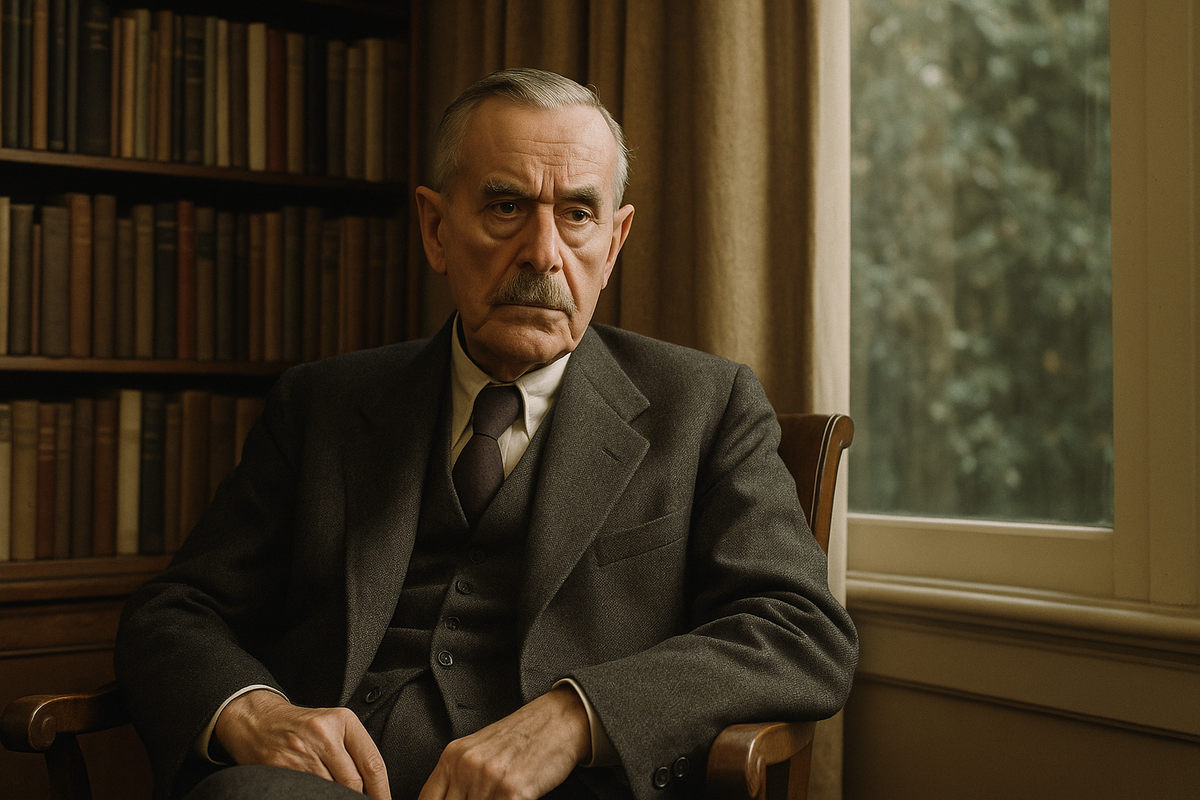
Thomas Mann in Exile, Conscience of a World at War
When America entered World War II, The New Yorker responded not with battlefield maps, but with the voice of a German intellectual in exile
Six days after Pearl Harbor, Americans opened their mailboxes to find Thomas Mann staring back at them from the pages of The New Yorker. Not literally—this was a magazine of words, not photographs—but his presence dominated the December 13, 1941 issue with an urgency that transcended literature. The Nobel laureate had fled Hitler's Germany eight years earlier. Now, with America finally in the war, his profile wasn't just cultural commentary. It was a declaration: the fight against fascism would be won with ideas as much as infantry.
The timing was everything.
Archive Context
Historical Figure: Thomas Mann, Nobel Prize-winning German novelist in exile
Issue Date: December 13, 1941
Archive Source: The New Yorker magazine, original print edition
Featured Article: "Goethe in Hollywood" (Profiles section)
Cover Artist: Ilonka Karasz
A Magazine Lands in Wartime America
When The New Yorker went to press in early December 1941, Operation Barbarossa was hemorrhaging Nazi forces in the Soviet winter. Japan and the United States stood on the knife's edge of conflict. By the time subscribers received their copies, Pearl Harbor had burned, Congress had declared war, and the nation had crossed a threshold from which there was no return.
Into this moment of national shock, the magazine placed "Goethe in Hollywood"—a Profiles piece on Thomas Mann, the German writer who had become democracy's most eloquent exile. The editorial choice was bold: frame Hitler's war as not merely a military campaign but an assault on civilization itself, and position Mann as the keeper of that civilization's flame.
For readers processing the chaos of December 1941, the profile offered something more valuable than news. It offered meaning.
The Paradox of Exile
Mann's displacement contained its own irony, which the profile mined for depth. Here was one of Europe's towering intellects—successor to Goethe in the German literary pantheon—living in Los Angeles, surrounded by Hollywood's artifice while Europe collapsed into barbarism. He was geographically removed from the catastrophe yet intellectually consumed by it, broadcasting radio addresses into Germany and writing essays that dissected the fascist pathology with surgical precision.
The article captured this tension without sentimentality. Mann appeared as both aloof and urgent, a man who refused the trappings of celebrity while wielding his moral authority like a weapon. He had not fled to save himself; he had fled to speak freely. From California, he became what the Nazis could never tolerate: a German voice that rejected everything they stood for.
By invoking Goethe—the embodiment of German humanism—the profile did more than flatter Mann. It reminded American readers that the war was also a battle for cultural inheritance, a question of which Germany would survive: the Germany of Goethe and Mann, or the Germany of Hitler and Goebbels.
Why The New Yorker Mattered
By 1941, The New Yorker had established itself as the thinking reader's magazine—sophisticated without being academic, witty without trivializing serious subjects. It spoke to urban professionals, cultural consumers, intellectuals who wanted their world news filtered through intelligence rather than hysteria.
The December 13 issue exemplified this balance. Ilonka Karasz's cover depicted a snow-dusted village scene: families gathering evergreens, children playing, the rituals of an American winter. It radiated warmth and continuity—a vision of what the nation was fighting to preserve. That this cheerful tableau appeared one week after Pearl Harbor gave it elegiac weight. Normalcy was now something to defend.
Inside, the Mann profile served a different function. While other publications ran battlefield maps and casualty reports, The New Yorker asked: What are we fighting for? The answer, embodied in Mann, was the survival of rational discourse, artistic freedom, and moral clarity—values that fascism sought to extinguish.
This wasn't escapism. It was cultural fortification.
The Arsenal of Ideas
The profile's core argument was radical in its simplicity: conscience matters in wartime. Mann's refusal to remain silent, his insistence on speaking truth to totalitarian power, represented a form of resistance as vital as military strategy. Ideas could be weapons. Literature could be ammunition.
The piece emphasized Mann's detachment from Hollywood's frivolity, his gravitas as a public intellectual, his role as moral counterweight to Nazi propaganda. He was presented not as a refugee seeking safety but as a combatant who had chosen a different battlefield—one where the pen genuinely rivaled the sword.
This framing elevated the stakes of the war beyond territorial conquest. If Mann embodied the democratic values America now fought to defend, then his exile proved how thoroughly fascism threatened human culture. To defeat Hitler was to ensure that voices like Mann's could exist at all.
Collector Significance
For collectors of 20th-century media and World War II ephemera, the December 13, 1941 New Yorker occupies singular territory.
Historical Inflection Point
Published in the immediate aftermath of Pearl Harbor, it captures American intellectual life at the precise moment of entry into global conflict—not the preparation, not the aftermath, but the rupture itself.
Mann in the American Consciousness
Early wartime profiles of Mann are rare primary sources for understanding how Americans processed European intellectual exile and the cultural dimensions of anti-fascism.
Karasz's Visual Elegance
Ilonka Karasz's winter covers remain among the most sought-after New Yorker illustrations, admired for their deceptive simplicity and emotional resonance.
Cultural Artifact of Resistance
This issue demonstrates how American media framed the war not only as military necessity but as defense of Enlightenment values—a narrative that shaped public morale and postwar identity.
This isn't simply a collectible magazine. It's a document of how a nation chose to understand its purpose in wartime, preserved in ink and paper.
The Permanence of Print
Like Life with its battlefield photography or Time with its war coverage, The New Yorker created a permanent record of American thought during the 1940s. But where other magazines documented what happened, The New Yorker documented what it meant—the cultural, intellectual, and moral dimensions that statistics and maps couldn't capture.
That permanence is why these issues endure. Each one is a time capsule, yes, but also a mirror: reading them now reveals not just the past but how profoundly different—and yet how strikingly similar—wartime consciousness remains across generations.
Acquisition
If you are searching for "New Yorker magazine December 13, 1941," this issue delivers everything serious collectors value: historical weight, cultural significance, and visual artistry. It belongs in collections focused on World War II, intellectual history, American journalism, or the evolution of literary culture.
Browse The New Yorker CollectionFrom the Jazz Age through the war years and beyond, each issue preserves a distinct moment in American cultural and political life.
Conclusion
The December 13, 1941 New Yorker stands as a landmark not because it reported the war, but because it illuminated what the war meant. Its profile of Thomas Mann—framed as "Goethe in Hollywood"—insisted that fascism threatened not just nations but the possibility of civilized thought itself.
Holding this issue today is holding the moment when America entered the Second World War, when intellectuals in exile lent gravity to the Allied cause, and when a magazine of cartoons and fiction reminded readers that culture was worth defending as fiercely as territory.
For collectors, historians, and lovers of literature, this issue transcends its format. It is a living artifact—proof that in humanity's darkest hours, words still matter.