
Four Freshmen Walk Into Woolworth's—And a College President Walks Into History
How the June 1961 Ebony captured North Carolina A&T at the center of American transformation
On February 1, 1960, four North Carolina A&T freshmen sat down at a Greensboro lunch counter and refused to leave. Within sixteen months, their college had a new president who refused to let their institution be anything less than extraordinary.
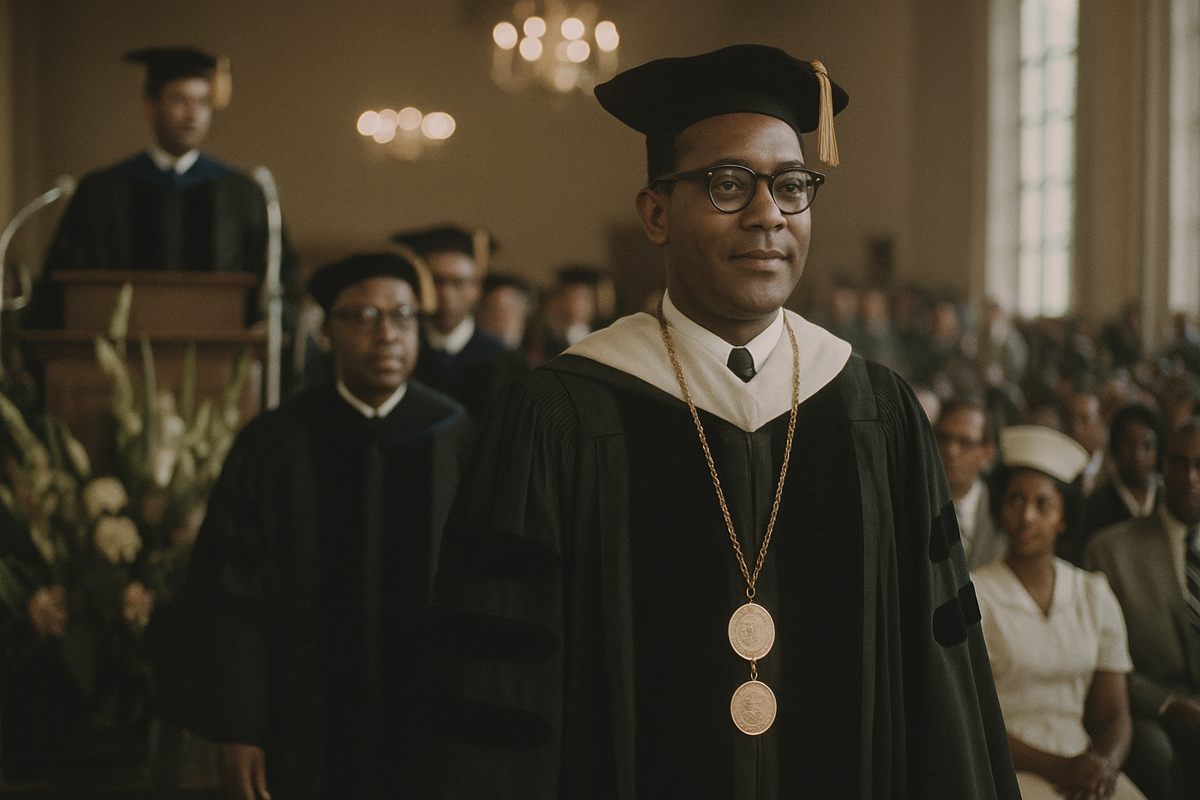
When readers opened the June 1961 issue of Ebony Magazine, they found Ann Porter—Miss Harlem Transit of 1958—gracing the cover in high-gloss glamour. But inside, past the fashion spreads and summer recipes, waited something far more urgent: a multi-page photo-essay titled "Changing College in a Changing South," profiling the inauguration of Dr. Samuel D. Proctor as the fifth president of North Carolina A&T College.
At 39, Proctor was the youngest college president in North Carolina. But age wasn't the story. The story was ambition—his refusal to accept what he called "the limited objectives traditionally relegated to Negro state colleges in the South." A&T, he declared, would be a center of intellectual and social transformation. Not tomorrow. Now.
For Ebony's readers—Black families navigating Jim Crow, watching freedom rides on television, debating the pace of integration—this wasn't just education news. It was a progress report from the front lines.
Archive Metadata
Historical Figure: Dr. Samuel D. Proctor, Fifth President of North Carolina A&T College
Issue Date: Ebony Magazine, June 1961
Archive Source: Original Magazines Collection
Historical Context: Published 16 months after the Greensboro sit-ins launched the national student sit-in movement
The Greensboro Earthquake Was Still Shaking
Sixteen months earlier, Franklin McCain, Joseph McNeil, Ezell Blair Jr. (Jibreel Khazan), and David Richmond had triggered a national movement from the Woolworth's lunch counter three blocks from campus. By June 1961, sit-ins had spread to dozens of southern cities. The Supreme Court was dismantling segregation case by case. Martin Luther King Jr. was becoming a household name.
A&T wasn't watching history—it was making it. And Ebony understood that Proctor's inauguration was part of that same seismic shift. The magazine's photographers captured McCain and McNeil in the crowd, visual anchors connecting the new president to the students who'd already changed America.
The timing mattered. This wasn't a retrospective. This was as it happened—the nation's premier Black magazine documenting an HBCU rising in real time, with the moral authority of the sit-ins still reverberating through its campus.
Ebony Knew How to Tell This Story
Since John H. Johnson launched Ebony in 1945, the magazine had perfected a particular alchemy: the visual sophistication of Life, the cultural pride of the Chicago Defender, and an editorial voice that spoke to Black America, not about it. By 1961, Ebony wasn't just chronicling Black life—it was shaping how that life was remembered.
The A&T feature exemplified this. Ebony's photographers captured:
The Pageantry
Robed delegates from more than 100 colleges and universities, filling Greensboro with academic regalia and institutional weight.
The Politics
North Carolina Governor Terry Sanford addressing the crowd—a southern white governor publicly affirming Black educational ambition.
The Intimacy
Dr. Proctor's wife Bessie and their sons Timothy and Herbert seated beside him, humanizing the moment even as it made history.
The Infrastructure
New construction, machine shops, dairy farms, engineering labs—visual proof that A&T was expanding physically and intellectually.
The Culture
ROTC drill teams. The Aggie Victory Bell. Faculty couples holding doctorates. The cafeteria buzzing with student life.
This wasn't reportage. This was curation—each photograph arguing that HBCUs were engines of progress, not symbols of segregation's leftovers.
And Ebony did something traditional news magazines couldn't: it embedded this story inside a broader portrait of Black life. Proctor's inauguration appeared alongside features on summer fashion, home entertaining, and Black entertainers. The message was clear—civil rights, education, family, and style weren't separate categories. They were the same lived experience.
What the Photos Captured—And Why It Mattered
Over 2,000 people attended Proctor's inauguration. Ebony made sure readers saw who was there and what they represented:
Leadership under pressure: At 39, Proctor became the youngest college president in North Carolina—a state where Black educators were expected to manage, not transform.
Institutional validation: Representatives from over 100 U.S. colleges and universities attended, signaling that A&T wasn't just respected locally—it was nationally recognized.
Faculty firepower: Ebony highlighted married couples on faculty—both spouses holding doctorates. This wasn't accidental. It was proof that A&T attracted serious scholars, not second-tier talent.
The sit-in legacy: McCain and McNeil weren't just attendees—they were proof. A&T wasn't producing compliant graduates. It was producing activists.
Applied excellence: Photos of labs, technical institutes, and agricultural operations showed A&T training engineers, scientists, and agricultural specialists—disciplines that built economic power, not just intellectual prestige.
Southern progress—with asterisks: Governor Sanford's presence was significant, but Ebony didn't oversell it. His rhetoric supported Black education; his state still enforced segregation. The photo-essay let readers draw their own conclusions.
Every image reinforced a single thesis: A&T was moving faster than the South could contain it.
Why This Issue Belongs in a Collection
For collectors of 20th-century media, the June 1961 Ebony occupies rare historical territory. It's not a retrospective or anniversary issue—it's a primary source documenting institutional transformation at the height of the Civil Rights Movement.
Collector Significance
The Timing Is Irreplaceable
Published sixteen months after the Greensboro sit-ins, while the movement was still accelerating. This isn't memory—it's reportage from the center of the storm.
The Sit-In Connection Is Direct
McCain and McNeil appear in the photo-essay, anchoring A&T's academic story to one of the 20th century's most famous protests.
The Leadership Profile Endures
Dr. Proctor went on to a storied career—president of Virginia Union University, advisor to the Peace Corps, associate director of the National Council of Churches. This issue captured him at the beginning.
The Photojournalism Is Museum-Grade
Ebony's photographers humanized their subjects without diminishing their gravity. These aren't snapshots—they're composed historical documents.
The Cultural Artifact Is Intact
From the Ann Porter cover to the advertisements for Cadillac and Murray's Pomade, this issue is a complete portrait of Black American life in 1961—aspirational, proud, forward-looking.
For descendants of A&T graduates, for families whose elders participated in the sit-ins, for anyone tracing the arc of HBCUs through the Civil Rights era—this magazine isn't just collectible. It's connective tissue between generations.
Why Vintage Ebony Outlasts the News Cycle
Like Life Magazine's World War II coverage, Ebony's Civil Rights–era issues endure because they captured history with both immediacy and care. These weren't hot takes or wire service dispatches. They were photographed, edited, printed, and mailed to homes where they were saved.
Digital media disappears into algorithmic noise. Vintage magazines are objects—held, shelved, passed down. They carry the weight of their moment because they were physically present during it.
The June 1961 Ebony sat in living rooms where families debated integration. It was read by students deciding whether to join protests. It was kept by parents who wanted their children to see what was possible.
Decades later, those pages still carry that urgency. Not as nostalgia—as testimony.
For Collectors Who Understand What They're Holding
If you collect Civil Rights history, African American cultural artifacts, or the rise of HBCUs, the June 1961 Ebony deserves space in your archive. It's part of a larger continuum—Harlem Renaissance manifestos, Negro League scorecards, Motown liner notes, Muhammad Ali fight programs—physical objects that trace Black excellence across the 20th century.
Browse Original Ebony MagazinesWhether you're building a research library, honoring family memory, or simply preserving history before it scatters—these magazines offer something the internet never will: unmediated access to how the past saw itself.
The Artifact Speaks for Itself
The June 1961 Ebony doesn't need embellishment. Dr. Samuel D. Proctor's inauguration, the Greensboro sit-ins' aftershocks, the photographic record of an HBCU refusing to be confined—it's all here, preserved in ink and paper.
Holding this issue is holding a moment when education, activism, and institutional ambition converged. When a 39-year-old president told a southern state college it would be world-class. When Ebony photographers made sure the world was watching.
That's not history in the past tense. That's history still insisting on being heard.
For anyone who believes primary sources matter—that seeing the original beats reading the summary—vintage Ebony magazines aren't just collectibles.
They're evidence. And they're irreplaceable.