
The Cottage, The Smokestacks, and the Unraveling
Traffic in Rolling Stone, May 1969
On May 3, 1969, readers who cracked open their copy of Rolling Stone found something rarer than another glowing album review or backstage access piece. They found a band coming apart at the seams—and a magazine willing to document it.
Traffic, one of Britain's most inventive psychedelic outfits, was living in a Berkshire cottage, supposedly rehearsing, supposedly writing, supposedly holding it together. Steve Winwood, Dave Mason, Chris Wood, and Jim Capaldi had retreated to the countryside to chase the late-'60s dream of communal creativity. What Rolling Stone captured instead was the gap between utopian ideals and messy reality: uneven rehearsals, clashing songwriting visions, and Dave Mason's restless departures that kept the band in perpetual flux.
This wasn't promotional fluff. It was journalism that treated musicians as cultural figures navigating impossible contradictions—fame versus authenticity, collective vision versus individual ambition, the Summer of Love versus the fractured end of the decade.
More than fifty years later, this issue remains one of the most revealing contemporary portraits of Traffic ever published. And it arrived at exactly the right moment to matter.
Archive Details
Band Featured: Traffic (Steve Winwood, Dave Mason, Chris Wood, Jim Capaldi)
Publication: Rolling Stone Magazine
Issue Date: May 3, 1969
Archive Source: Original Magazines Collection
Spring 1969: When Psychedelia Gave Way to Something Harder
By the time this issue hit newsstands, the counterculture had already peaked. The optimism of 1967's "Summer of Love" was curdling into something more uncertain. The Beatles were splintering. Cream had dissolved. The Rolling Stones were about to give the world Let It Bleed. Psychedelic rock was morphing into heavier, more experimental forms—progressive rock, blues revival, roots music hybrids.
Traffic had been at the center of Britain's psychedelic wave since 1967, with Paper Sun and Hole in My Shoe establishing them as pioneers of the underground scene. But by 1969, the group's trajectory was shifting under the weight of Steve Winwood's growing reputation. His work with the Spencer Davis Group and his collaborations with Eric Clapton had made him one of rock's most respected young musicians. His leadership anchored Traffic—but it also exposed the lack of cohesion around him.
Dave Mason's on-again, off-again membership became the band's defining tension. His songwriting contrasted sharply with Winwood's, creating both richness and conflict. Chris Wood's woodwinds and Jim Capaldi's percussion shaped Traffic's experimental textures, but the question lingered: Could a band this fragmented sustain itself?
Rolling Stone didn't answer that question. It simply showed readers what it looked like when a band tried.
What the Article Revealed
Unlike the superficial music press of the era, Rolling Stone practiced long-form journalism with sharp cultural commentary. The Traffic feature embodied this approach, diving into:
The Visual Language: Industrial Britain Meets Rural Escape
The photography accompanying the piece reinforced the contradictions. Dave Mason appeared against an industrial background, smokestacks looming behind him—a stark juxtaposition of the band's rural escapism with the realities of late-'60s Britain. The image's grainy, high-contrast style fit Rolling Stone's aesthetic of gritty realism over polished publicity.
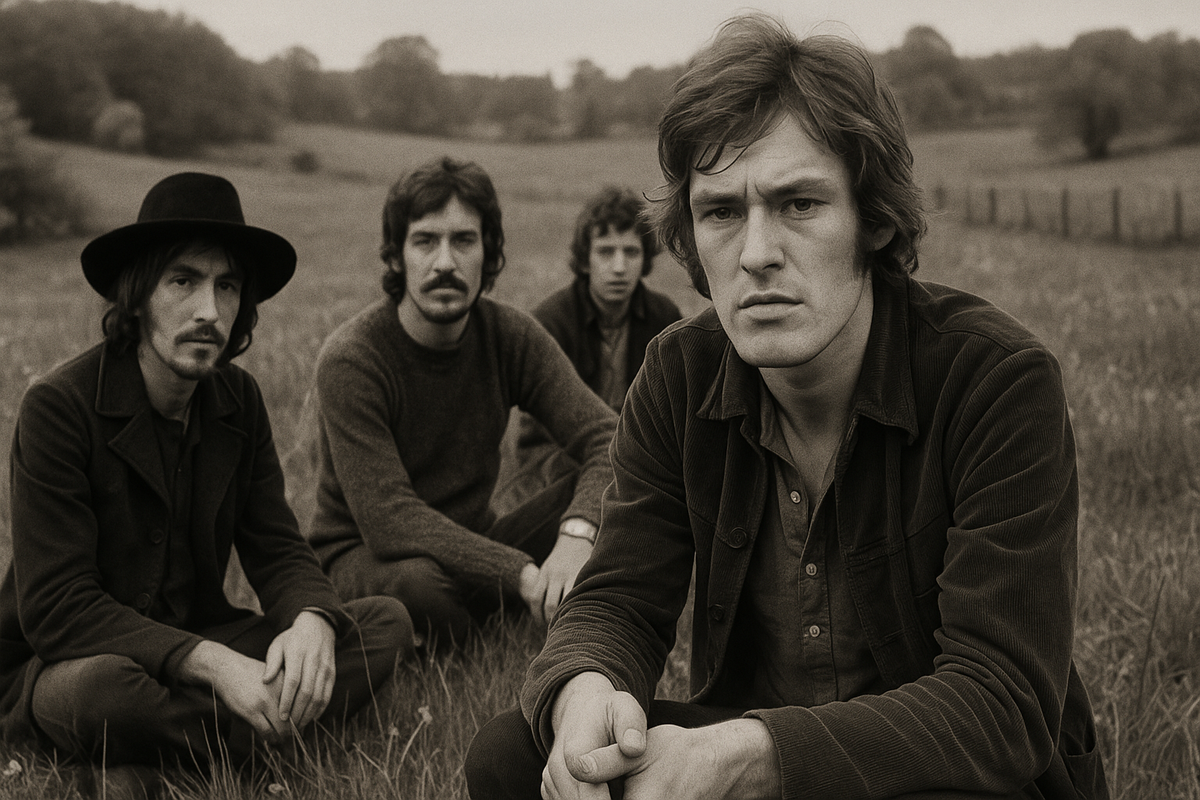
Inside, candid black-and-white portraits of Mason, Wood, and Capaldi, alongside group shots in rural fields, conveyed raw honesty. These weren't posed. They were a band caught between youthful experimentation and looming adulthood.
The magazine's design emphasized substance over style: dense, long-column journalism running alongside the photos, encouraging readers to immerse themselves in extended narratives. This was the editorial approach that separated Rolling Stone from fan magazines—it treated music as culture, not entertainment.
A Living Artifact
The May 3, 1969 issue of Rolling Stone featuring Traffic remains one of the most compelling portraits of a band at a crossroads. Its documentation of communal living, artistic struggle, and the search for meaning mirrors the broader countercultural challenges of the late '60s.
For anyone who values music history, Rolling Stone magazines like this are living artifacts of a transformative era. They're not just reading material—they're primary sources.
Why This Issue Still Matters
Explore the Archive
Thousands of original Rolling Stone magazines are available in our collection. From the 1960s through the 1980s, trace the evolution of rock, politics, and cultural change as they were documented in real time.
Browse Rolling Stone Magazines Collection