
The Issue That Changed American Parenting
Dr. Spock's Revolution in the August 1954 Ladies' Home Journal
In August 1954, a seismic shift in American family life arrived not through legislation or protest, but through a magazine column. When mothers across the country opened their copies of Ladies' Home Journal that month, they encountered something radical disguised as reassurance: permission to trust themselves.
Dr. Benjamin Spock's article, "Dr. Spock Talks with Mothers," didn't just offer advice. It dismantled decades of cold, clinical child-rearing doctrine and replaced it with something revolutionary—the idea that warmth, instinct, and common sense belonged in the nursery alongside expert guidance.
For a generation of young mothers navigating the chaos of the postwar baby boom, this wasn't just helpful. It was liberating.
Archive Details
Historical Figure: Dr. Benjamin Spock
Issue Date: August 1954
Archive Source: Ladies' Home Journal
Article Title: "Dr. Spock Talks with Mothers"
The World Before Spock
The early 1950s were a crucible of contradictions. World War II had ended less than a decade earlier. The baby boom was cresting. Suburbs were sprawling. Millions of young couples were raising children in a nation that looked nothing like the one their parents had known.
But the parenting manuals they inherited belonged to another era entirely.
Pre-Spock advice literature was unforgiving: rigid feeding schedules, emotional restraint, warnings against "spoiling" children with affection. The dominant philosophy treated child-rearing as a mechanical process—input discipline, output obedience. Deviation was weakness.
Then came the postwar pivot. Psychology entered mainstream consciousness. Freudian ideas filtered into popular culture. Women, newly defined by domestic roles yet shaped by wartime agency, wanted guidance that acknowledged their complexity. They needed a voice that balanced science with humanity.
Dr. Spock became that voice.
His Ladies' Home Journal column spoke directly to the anxieties and aspirations of millions. He told mothers that responding to their babies' cries, showing affection freely, and trusting their own judgment weren't signs of permissiveness—they were marks of good parenting. In a nation hungry for both stability and progress, this was nothing short of groundbreaking.
Why Ladies' Home Journal Mattered
Ladies' Home Journal wasn't just another women's magazine. It was cultural infrastructure.
With millions of subscribers, the magazine blended domestic instruction, social commentary, fiction, and practical advice into a monthly ritual for American women. It was where the nation's mothers learned to cook, decorate, dress, think, and—increasingly—parent.
By giving Dr. Spock a regular platform, Ladies' Home Journal transformed parenting advice from clinical pamphlet to national conversation. His prose was warm, accessible, and refreshingly conversational—worlds apart from the austere medical manuals that preceded him.
Readers weren't lectured. They were respected.
The magazine's reach ensured that Spock's ideas didn't remain confined to progressive circles or university psychology departments. They landed in living rooms from Maine to California, shaping the intimate daily decisions of ordinary families.
Inside the August 1954 Issue
The cover radiated postwar optimism: polished design, stylish women, the gleaming promise of domestic prosperity. It was aspirational, reassuring, and deeply middle-class—the visual language of a nation trying to convince itself it had arrived.
Inside, "Dr. Spock Talks with Mothers" stood apart.
The article was structured around direct, practical concerns—sleep struggles, feeding anxieties, the constant worry of doing it wrong. But Spock's tone was disarming. He acknowledged doubt. He normalized imperfection. And he distilled complex psychological concepts into memorable truths.
Two pull quotes captured his philosophy perfectly:
These weren't platitudes. They were permission slips—permission to prioritize need over schedule, to choose warmth over rigidity, to remember that joy was part of the job.
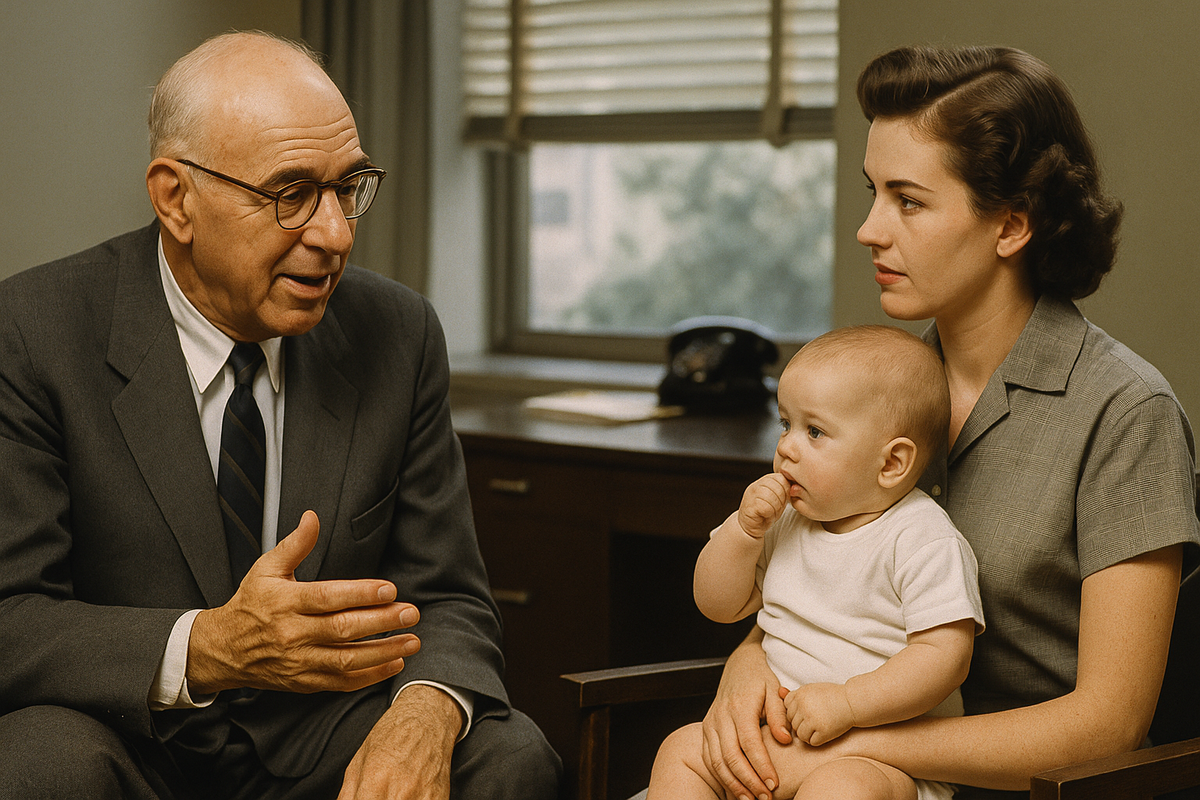
The accompanying photographs reinforced this. Dr. Spock appeared not as a distant authority in a white coat, but as a seated conversationalist—approachable, engaged, human. The visual storytelling mattered. He looked like someone you could trust, not someone you had to fear disappointing.
The Core Philosophy
Spock's advice in the August 1954 column can be distilled into several interlocking principles:
These ideas may seem obvious now. In 1954, they were revolutionary.
The Enduring Legacy
Dr. Spock's advice endures because he understood something fundamental: parenting is both science and art, both expertise and instinct.
He didn't tell mothers to ignore doctors or dismiss research. He told them they were part of the equation—that their observations, their affection, their instincts mattered as much as any textbook's prescription.
In doing so, he gave women something the culture often denied them: intellectual authority over their own domain.
The August 1954 Ladies' Home Journal captured this transformation in progress. The magazine's pages bridged the clinical and the personal, the expert and the everyday, the rigid past and the flexible future. Seventy years later, that bridge still stands.
Why This Issue Matters to Collectors
For historians, this is evidence. For collectors, it's provenance. For anyone interested in how ideas move from theory to practice to cultural norm, it's essential.
Experience It Yourself
If you want to understand how magazines shaped American family life—or if you're building a collection that documents women's history and domestic culture—original issues of Ladies' Home Journal are indispensable.
These aren't reprints or summaries. They're the real thing: the paper stock, the advertisements, the editorial voice, the visual design that greeted readers in their own moment.
Browse Ladies' Home Journal Magazines CollectionThe August 1954 Ladies' Home Journal remains a landmark in American cultural history. With "Dr. Spock Talks with Mothers," it documented a turning point—the moment when parents were invited to balance expert knowledge with human warmth, when affection and confidence became as important as discipline and structure.
To hold this issue today is to hold a piece of that transformation. It's history you can touch, ideas you can trace, a conversation that still echoes in every parenting book, blog, and debate that followed.
For collectors, historians, and anyone fascinated by how America learned to raise its children, this issue isn't just paper and ink.
It's the moment the rules changed.