
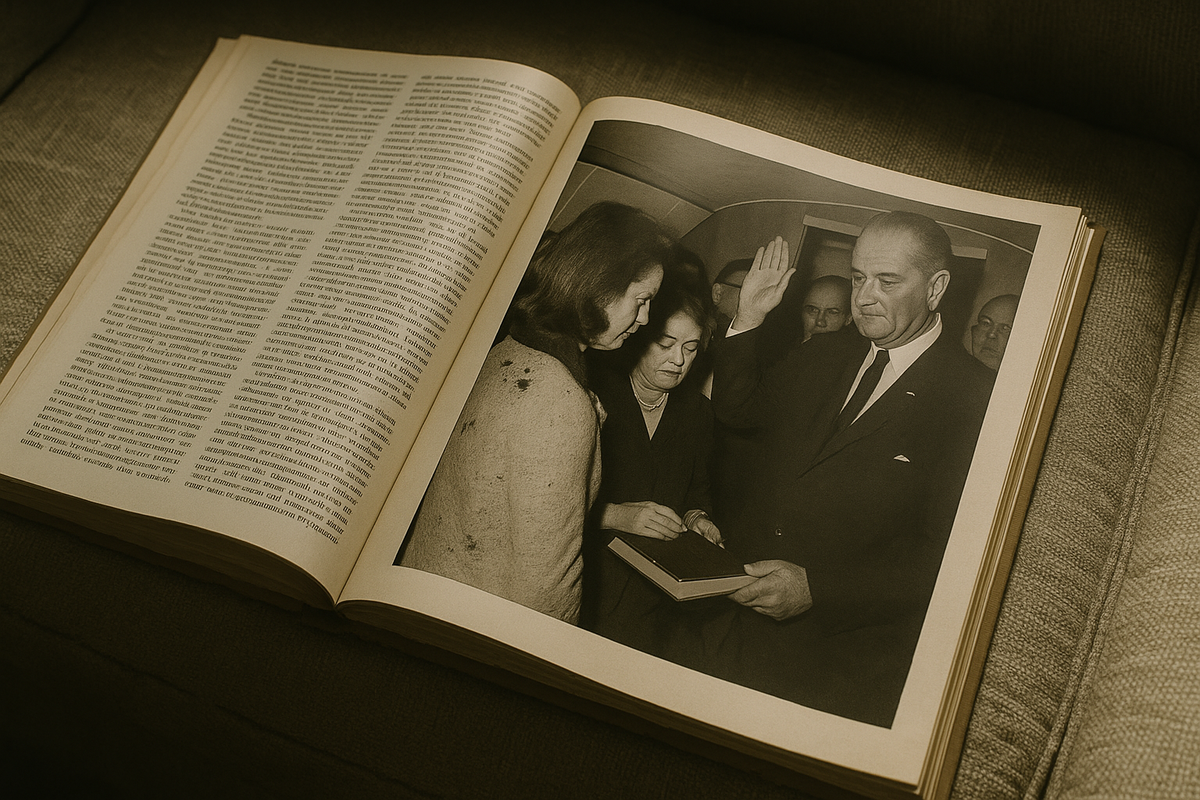
The Magazine That Made Women Witnesses to History
Ladies' Home Journal, November 1968, and the assassination narrative that redefined women's media
On a newsstand in November 1968, tucked between Life and Look, sat an issue of Ladies' Home Journal that had no business existing.
Between the Jell-O ads and beauty columns was Jim Bishop's "The Day J.F.K. Died"—a 40-page reconstruction of the assassination so visceral that readers could hear Jackie Kennedy's stockings tearing as she climbed onto the trunk of the Lincoln Continental. Five years after Dallas, the magazine handed millions of American women the one thing television couldn't: the interior monologue of Air Force One on November 22, 1963.
This wasn't grief tourism. It was editorial audacity. Ladies' Home Journal, a magazine born to sell cake recipes and sewing patterns, had become the keeper of national trauma—and in doing so, redefined what women's media could hold.
Why a Women's Magazine Owned the Kennedy Story
By 1968, America was hemorrhaging. The Tet Offensive. King's assassination in April. Bobby Kennedy shot in June. The Democratic Convention riots in August. Readers didn't need another news recap—they needed excavation. Bishop's piece didn't report the assassination; it autopsied the 90 minutes that followed, when constitutional order hung by the thread of a confused Secret Service agent and a bloodstained pink Chanel suit.
Ladies' Home Journal understood something the newsweeklies didn't: women weren't passive consumers of history. They were its archivists. The magazine's 6.5 million subscribers had spent five years absorbing Kennedy's death through their children's nightmares, their husbands' silences, their own kitchen radios replaying Walter Cronkite's cracked voice. Bishop's narrative gave them the missing footage—the claustrophobic chaos inside Air Force One, the moment Judge Sarah Hughes (the first woman to administer the Presidential Oath) placed her hand on Kennedy's Catholic missal, the nuclear "football" carrier wandering the Dallas tarmac with the fate of the Cold War in his briefcase.
This was reporting as séance. And Ladies' Home Journal was the medium.
Archive Data
Historical Subject: President John F. Kennedy assassination, November 22, 1963
Featured Article: "The Day J.F.K. Died" by Jim Bishop (40-page book bonus)
Issue Date: November 1968 (Fifth anniversary commemoration)
Circulation: 6.5 million subscribers
Archive Source: Original Ladies' Home Journal Collection
The Details That Made History Human
Bishop wrote like a court stenographer on Benzedrine. His account strips presidential death of mythology and replaces it with sweat, miscommunication, and the surreal banality of crisis:
The Nuclear Codes in Limbo
In the confusion, the officer carrying America's nuclear launch codes was separated from the chain of command. For critical minutes, no one knew if retaliatory strikes could be authorized. The Cold War's entire architecture of deterrence depended on a man standing in the right room.
Jackie's Calculated Defiance
"Let them see what they have done." She refused to change out of the pink suit caked with her husband's blood, understanding instinctively that her appearance would be the photograph that froze history. Johnson's swearing-in, with Jackie beside him in that ruined wool, became the image of American continuity built on carnage.
The Catholic Paradox
A priest administered Last Rites to Kennedy in Trauma Room One at Parkland Hospital, though Catholic doctrine rendered the sacrament invalid—Kennedy was already dead. Bishop noted this with clinical precision, then pivoted to its emotional truth: ritual mattered more than theology when the world was ending.
Robert Kennedy's Arrival
Boarding Air Force One at Andrews, RFK moved through the plane like a ghost, avoiding Johnson, heading straight for the casket. The two men—one new president, one former Attorney General and grieving brother—occupied the same aircraft but existed in separate realities of power and loss.
Each detail landed with the weight of primary evidence. Bishop had interviewed Secret Service agents, White House aides, and Kennedy loyalists who spoke on the record for the first time. Ladies' Home Journal wasn't summarizing history—it was sourcing it.
When Women's Magazines Stopped Being "Women's Magazines"
The November 1968 issue is a Rosetta Stone for understanding the mutation of women's media in the late 1960s. Flip through its pages and you see the collision:
A 12-page spread on Thanksgiving centerpieces. Beauty advice from Helena Rubinstein. Bishop's blood-spattered reconstruction of presidential succession. Fiction by Joyce Carol Oates.
This wasn't tonal whiplash—it was editorial philosophy. Ladies' Home Journal operated on the premise that women contained multitudes. The same reader clipping pot roast recipes was also parsing Vietnam casualty lists and debating Great Society legislation. The magazine refused to condescend.
By 1968, "women's issues" had exploded beyond the kitchen. Second-wave feminism was rising. The sexual revolution was fragmenting traditional roles. Ladies' Home Journal didn't lecture its readers about these shifts—it documented them, layering domestic content with political reportage, making both equally serious.
Bishop's piece crystallized this transformation. Here was a male journalist (whose book The Day Kennedy Was Shot had been a bestseller) using a "women's magazine" as his platform to reach millions. The implication was clear: if you wanted to shape how Americans remembered their most traumatic national event, you published where women read.
The Collector's Lens: Why This Issue Endures
Vintage magazine collectors operate on a simple metric: does the issue change when you know what came next?
The November 1968 Ladies' Home Journal does.
Collector Significance
Historical Proximity
Published exactly five years after the assassination, it captures American memory at the moment of crystallization—before conspiracy theories calcified, before Oliver Stone, before the Kennedy death industry became self-parodic. It's grief still processing itself in real time.
Format Rarity
Long-form assassination narratives appeared in books and newsweeklies, but Bishop's version—40 uninterrupted pages in a glossy monthly aimed at homemakers—has no peer. The juxtaposition of subject and venue makes it culturally strange and therefore valuable.
Visual Archive
The photographs are spare but devastating: Jackie on the plane, Johnson's grim oath, the flag-draped casket. Unlike TV footage, these are curated images, chosen to work in sequence with Bishop's prose. The issue functions as a bound photo essay.
Market Demand
Presidential assassination artifacts occupy the top tier of political memorabilia. Issues tied to Kennedy's death—especially those published during the turbulent Johnson years—command premiums. Condition matters, but even reading copies hold value as primary sources.
In today's market, this issue sits at the intersection of three collector categories: political history, women's media, and mid-century print culture. That overlap creates scarcity.
The Time Capsule Test
Every artifact from the past has to answer one question: what does it preserve that nothing else can?
For the November 1968 Ladies' Home Journal, the answer is this: it preserves the moment when American women became the designated mourners of national history.
Men wrote the policy briefs. Men commanded the military response. Men investigated the crime. But women were given the job of remembering—of keeping the emotional ledger, of teaching children what the day meant, of deciding which details mattered and which could be forgotten.
Ladies' Home Journal didn't assign this role. It recognized it. By publishing Bishop's piece alongside recipes and fashion, the magazine made an implicit argument: remembering Dallas is domestic work. It happens in living rooms and at dinner tables, in the conversations mothers have with daughters about what kind of country this is.
That's why this issue isn't just collectible—it's documentary evidence of how grief becomes culture.
Where to Find History in Your Hands
The November 1968 Ladies' Home Journal is not simply a magazine. It's a primary source, a narrative artifact, and a reminder that the most important stories don't always live where you expect them.
For collectors, historians, and anyone who believes that understanding the past requires holding its physical remnants, this is an essential acquisition.
Browse Ladies' Home Journal Magazine CollectionFinal Reflection
The November 1968 Ladies' Home Journal endures because it refused to treat women as bystanders. It published difficult history for an audience capable of processing it. It trusted its readers to sit with ambiguity, sorrow, and the jagged fragments of constitutional crisis.
Decades later, the issue remains a testament to what women's media could be when it stopped apologizing for its audience's intelligence—when it recognized that the people reading about casserole techniques were also the people who would decide what their country should remember.
That's not just magazine history. That's American history, archived one issue at a time.