
The Beef Heart on America's Dinner Table
How Life Magazine Sold Organ Meats to a Nation at War
Picture this: January 1943. A housewife in Cleveland opens her copy of Life Magazine and finds herself staring at a photograph of a beef heart—raw, glistening, and being stitched shut with heavy thread like a surgical patient. By the next page, that same heart appears golden-brown and garlanded with vegetables, plated as elegantly as any crown roast.
This wasn't shock value. It was survival propaganda, dressed in full color.
The January 11, 1943 issue of Life arrived at a pivotal moment in American history. The country was one year into World War II, and the home front had become a theater of its own. Gasoline was rationed. Rubber was scarce. Cooking fats were collected for munitions. And now, with official meat rationing looming in March, families faced a stark choice: adapt their palates or go without.
Life's response was the "Variety Meats" feature—a masterclass in visual persuasion that transformed organ meats from Depression-era desperation food into patriotic cuisine. Through anatomical diagrams, step-by-step butchery instructions, and jewel-toned photographs, the magazine recast hearts, kidneys, livers, and tongues as both nutritional powerhouses and civic duty.
It worked because Life understood something essential: Americans don't just change what they eat because they're told to. They change when they're shown why it matters—and how to do it beautifully.
Archive Details
Publication: Life Magazine
Issue Date: January 11, 1943
Feature: "Variety Meats" Photographic Essay
Historical Context: Second year of U.S. involvement in World War II, pre-official meat rationing
Archive Significance: Rare wartime home-front documentation with full-color food photography
When Prime Cuts Went to War
By early 1943, the U.S. Office of Price Administration had already curtailed access to sugar, coffee, rubber, and gasoline. Meat rationing wouldn't become official until March, but the shortages had already begun. Prime beef and pork were being diverted to military supply lines at a staggering rate. What remained for civilian consumption were the cuts most Americans had spent decades learning to ignore.
Enter the offal.
Life didn't apologize for this shift. Instead, the magazine repositioned variety meats as a form of domestic valor. Housewives weren't settling for scraps—they were freeing up sirloin for soldiers overseas. Children weren't suffering through liver and onions—they were learning resourcefulness. The message was clear: the war would be won not just on battlefields in Europe and the Pacific, but in American kitchens, one braised oxtail at a time.
This wasn't mere rhetoric. It was a calculated editorial intervention, designed to make the unpalatable not just acceptable, but aspirational.
The Anatomy of Persuasion
Life Magazine built its reputation on the marriage of documentary photography and narrative journalism. By 1943, it had perfected a visual language that could make any subject feel urgent and important. The "Variety Meats" spread deployed every tool in that arsenal.
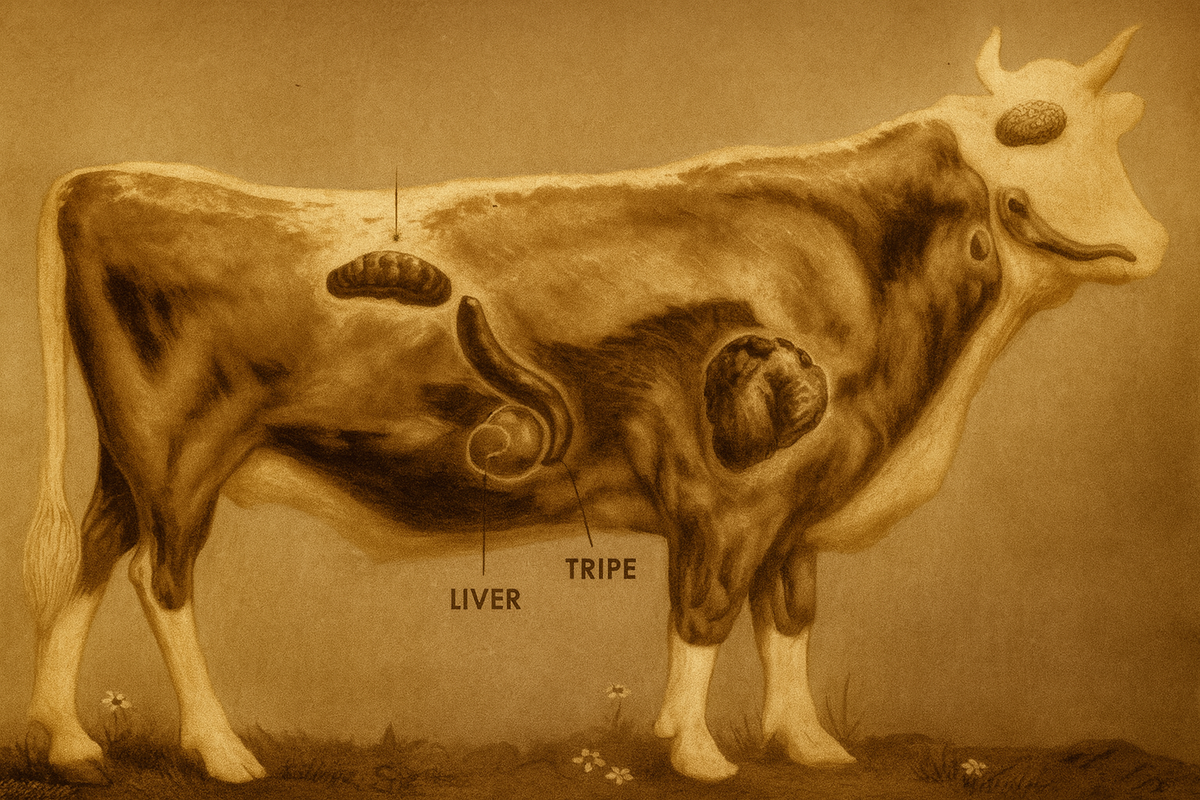
The Anatomical Diagram: The feature opened with a bold illustration of a cow, its body mapped like a butcher's chart. Each organ was labeled—liver, tripe, tongue, heart—with lines connecting them to their location in the animal. This wasn't just informative; it was a visual argument. These weren't mysterious scraps. They were identifiable, locatable, and therefore legitimate cuts of meat.
The Nutritional Chart: Beside the diagram sat a comparison table measuring protein, iron, calcium, and vitamin B₁ content. The data was damning for traditional cuts. Liver outperformed steak. Kidneys rivaled chops. The subtext was unmistakable: if you were still clinging to familiar cuts, you were choosing taste over health—an almost unpatriotic stance in wartime.
Black-and-White Process Photography: One sequence documented the preparation of a beef heart with forensic precision. First, the raw organ under running water. Then, the removal of valves and connective tissue. Next, the cavity stuffed with bread dressing, sewn shut with needle and thread, browned in a skillet, and finally braised until tender. These weren't glamour shots. They were instructional, almost clinical—proof that any competent home cook could master this.
Full-Color Presentation: And then came the payoff. After all the butchery and labor, Life presented the finished dishes in saturated color photography—still a relative luxury in 1943. Oxtails arranged in a perfect circle. Kidney stew spooned into a ring of white rice. Lamb hearts garnished with buttered noodles. Even pigs' ears and tails appeared vibrant and appetizing. The message: organ meats weren't just nutritious and affordable—they could be beautiful.
Cultural Elevation: Throughout the spread, captions invoked European culinary traditions. Tripe, readers learned, was considered a delicacy in France, Spain, and Italy. By linking these cuts to continental sophistication, Life lent them a cosmopolitan glamour that transcended their Depression-era associations.
The strategy was sophisticated: combine scientific authority, visual demystification, and aspirational presentation. Make readers feel informed, capable, and even a little worldly for embracing what they'd previously dismissed.
The Cover That Wasn't About Food
The January 11, 1943 cover of Life featured no roasts, no stews, no patriotic food displays. Instead, it carried a stark black-and-white portrait—serious, immediate, unflinching. This was Life's signature approach during wartime: documentary realism over illustration, gravity over charm. It was a visual promise that everything inside, including a feature about beef hearts and pigs' feet, would be treated with the same journalistic seriousness as battlefield dispatches.
That tonal consistency gave the "Variety Meats" spread an authority no other magazine could match. When Life showed you a beef heart being sewn shut, you believed it was important. When it plated that heart in full color on the next page, you believed it was worth trying.
This wasn't advertising. It was journalism with a national mission.
What the Spread Contained
The feature methodically covered every category of variety meat Americans might encounter:
The Enduring Power of Documentary Journalism
What made Life essential—then and now—was its commitment to showing rather than telling. The magazine didn't just report that Americans were adapting to rationing. It documented how they adapted, what they cooked, what their kitchens looked like, what their tables held.
Vintage Life magazines remain collectible precisely because they are both artifacts and evidence. They trace the cultural evolution of the 20th century in real time, page by page, photograph by photograph. Issues like January 11, 1943 reveal that the war was fought not only with bombers and battleships, but with cast-iron skillets and resourcefulness.
Why This Issue Endures
Wartime Timing
Published at the peak of home-front mobilization, it documents how deeply the war penetrated daily American life.
Unique Subject Matter
While most wartime Life issues focused on battles, strategy, and military portraits, this one turned its lens on the domestic front—making it a rarer artifact among World War II issues.
Color Food Photography
Full-color spreads were still expensive and uncommon in 1943. The decision to lavish them on organ meats signals how seriously Life took this editorial mission.
Cultural Inflection Point
This issue captures the exact moment Americans were asked to fundamentally change not just how they fought, but how they ate—and it shows them how to do it.
For culinary historians, the feature is a goldmine. For students of visual rhetoric, it's a case study in persuasive design. For families tracing the experiences of grandparents who lived through the war, it's a tangible connection to the sacrifices and adaptations that defined the era.
This isn't just a magazine. It's a window into a moment when survival required creativity, and when a photograph of a stuffed beef heart could be an act of patriotism.
Acquire a Piece of Wartime History
Original copies of the January 11, 1943 Life Magazine issue—along with thousands of other milestone editions—remain available to collectors. Each one is a fragment of lived history: the advertisements, the editorial voice, the photographic choices, all preserved exactly as readers first encountered them.
Browse Life Magazine CollectionWhether you're building a collection focused on World War II home-front history, studying the evolution of American food culture, or preserving family stories from the 1940s, these magazines offer something increasingly rare: the ability to experience history precisely as it was first presented—no retrospective analysis, no modern interpretation. Just the primary source.