
The First Lady Who Refused to Wait Her Turn
March 1, 1999. Americans tore open their mailboxes to find Hillary Rodham Clinton staring back from the pages of Time Magazine—not as a political spouse, not as a scandal survivor, but as a candidate.
The issue's title said it all: "A Race of Her Own."
What readers held in their hands that morning wasn't just another profile of a First Lady. It was the opening bell of a campaign that would shatter every expectation of what a president's wife could become. While Washington was still processing the wreckage of impeachment, Hillary Clinton was already plotting her exit—not from public life, but into it, on her own terms.
For collectors and historians today, this issue captures the exact moment when speculation became inevitability. Before the listening tours. Before the carpetbagger accusations. Before "Senator Clinton" became a household phrase. This was the spark.
Archive Details
Historical Figure: Hillary Rodham Clinton
Issue Date: March 1, 1999
Archive Source: Time Magazine
Feature Title: "A Race of Her Own"
Photography: Diana Walker
The Wreckage and the Runway
The timing could not have been more brutal—or more perfect.
Just weeks earlier, the Senate had acquitted President Bill Clinton in his impeachment trial. The Monica Lewinsky scandal had turned the White House into a tabloid spectacle, and Hillary Clinton had endured it all under the cruelest spotlight imaginable. Lesser politicians would have retreated. She leaned forward.
Time framed her prospective Senate run not as opportunism but as transformation: Could personal resilience become political power? Could a woman who had spent eight years as the most scrutinized First Lady in history step out from behind the presidential seal and claim her own mandate?
The answer, according to Time's polling, was cautiously yes. A Time/CNN survey showed Hillary leading New York City Mayor Rudy Giuliani 52% to 43% in a hypothetical matchup. The numbers weren't dominant, but they were real. She could win this.
But New York wasn't going to make it easy. Giuliani was the mayor who "cleaned up" Times Square, a Republican star in a blue state. Hillary, meanwhile, had never lived in New York, never held elected office, and carried baggage heavy enough to sink most campaigns. The state's mix of liberal urban cores and conservative suburbs would test whether her celebrity could translate into credibility.
Time didn't shy away from the risk. One spread, headlined "If She Can Make It There…"—a nod to Sinatra—captured the audacity of the moment. New York was the toughest stage in American politics. It was also the biggest.
The Magazine That Knew How to Build a Candidate
By 1999, Time had mastered the art of making news feel cinematic.
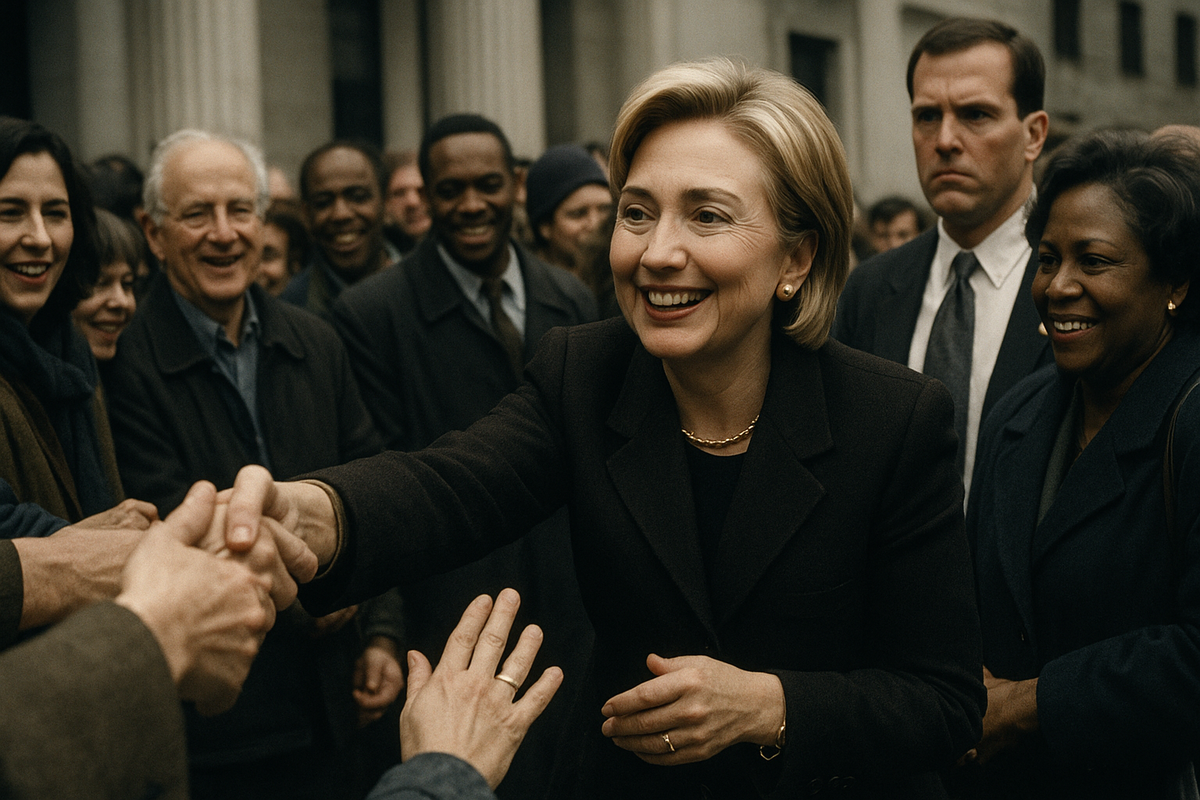
The Hillary Clinton feature didn't just report—it staged. Diana Walker's black-and-white photography filled the spreads: Hillary on rope lines, leaning into crowds, shaking hands with voters who looked both skeptical and curious. One image showed her laughing backstage before a TV appearance, a rare glimpse of ease in a woman the public had come to see as perpetually guarded.
The layout was deliberate. Bold typography against the New York skyline at dusk. Sidebar commentary from political heavyweights like Mario Cuomo, Ed Koch, and Geraldine Ferraro—figures who lent the story weight and legitimacy. Another section, titled "Do It, Hillary! Here's Why," laid out the case for her candidacy: national profile, independence from Bill's shadow, and the unique platform New York offered for someone with global ambitions.
This wasn't neutral journalism. Time was presenting the race as suspenseful, consequential, and—crucially—winnable. For families reading over breakfast tables that March morning, the issue offered both drama and prophecy.
The magazine understood something important: Hillary Clinton's candidacy wasn't just political news. It was cultural disruption. First Ladies had influenced policy from the East Wing—Eleanor Roosevelt, Lady Bird Johnson, Nancy Reagan—but none had walked out the front door and run for office while still holding the title. Hillary was crossing a line no one had drawn yet.
What the Issue Got Right (and What It Couldn't See)
The March 1, 1999 issue captured four truths that would define the race:
The Polling Advantage Was Real, But Fragile
Hillary's 52-43 lead over Giuliani gave her campaign oxygen, but the numbers masked deeper skepticism. New Yorkers weren't sure she was one of them. The "carpetbagger" label would haunt her for months.
Cultural Symbolism Mattered More Than Policy
Time understood that Hillary's run wasn't about healthcare proposals or committee assignments. It was about whether a woman—especially this woman—could claim power in her own name after years of being defined by her husband's career and failures.
New York Was a Proving Ground, Not a Safe Bet
The state's political landscape was brutal. Tabloids like the New York Post would dissect every misstep. Suburban swing voters in Westchester and Long Island would demand more than celebrity. Hillary would have to earn it.
The Media Would Feast
Hillary Clinton running for Senate was the biggest story in American politics that wasn't about Bill. Cable news, newspapers, and magazines would obsess over every poll, every gaffe, every comparison to her husband's charisma (or lack thereof in her case, critics would say). The coverage would be relentless.
What Time couldn't predict: Giuliani would drop out due to health issues and personal scandal, replaced by a little-known congressman named Rick Lazio. Hillary would win with 55% of the vote. And the seat she claimed in 2001 would become the launchpad for two presidential campaigns, a term as Secretary of State, and a permanent place in American political history.
But in March 1999, none of that was written yet. The magazine captured the moment when possibility was still bigger than outcome.
The Artifact Economy
Vintage newsweeklies endure because they offer what digital archives cannot: the weight of a moment. You can read about Hillary's Senate campaign on Wikipedia. You can watch old footage on YouTube. But holding the March 1, 1999 issue of Time in your hands is different. It's how Americans first encountered the story. It's how history was reported before it became history.
These magazines are time capsules. The ads for Nokia phones and AOL. The font choices. The editorial confidence of a media industry that still believed print mattered. All of it matters now, in ways the publishers couldn't have imagined.
Why Collectors Treasure This Issue
It's a "Before" Document
This issue predates Hillary's official announcement, giving it the rare quality of captured speculation. Historians can trace the exact moment when the idea became inevitable.
It's Visually Iconic
Diana Walker's photography and Time's bold layout make this issue a display piece, not just an archive document. The images humanized Hillary in ways that would become harder as the campaign intensified.
It's Generational Memory
For those who lived through the 1990s, this issue is a tactile reminder of how politics felt during the Clinton era—messy, magnetic, and exhausting. For younger readers, it's a primary source that no digital article can replicate.
It Appreciates in Relevance
Hillary Clinton's career didn't end with the Senate. Every chapter she added—Secretary of State, 2016 and 2020 presidential runs—made this issue more valuable. Owning it means holding the origin story of one of the most polarizing and influential politicians of the modern era.
Political milestone issues of Time consistently outperform other collectibles because they freeze moments that keep echoing. This one captured the transformation of a First Lady into a senator, and eventually, into something larger than either role.
Explore the Full Archive
If this deep dive into Hillary Clinton's political origin story has sparked your curiosity, there's more to discover. Thousands of original Time magazines spanning decades of American life—politics, war, culture, science, and art—are available to collectors and enthusiasts.
Browse Time Magazine CollectionWhether you're preserving family memory, studying political history, or simply chasing the thrill of holding the past in your hands, these issues offer something rare: journalism as it was first written, before hindsight rewrote the story.
Final Word
The March 1, 1999 issue of Time Magazine is more than a collectible. It's a hinge point in American political history—the moment when a First Lady stopped waiting for permission and claimed a race of her own.
Twenty-five years later, we know how the story unfolded. But this issue captured something more valuable than outcomes. It captured the uncertainty, the ambition, and the audacity of a woman who bet her legacy on New York and won.
For collectors, historians, and anyone who believes that the past is never really past, this isn't just a magazine.
It's the starting gun.