
War Brides, Postwar America, and the Everyday Struggles of Building a New Life
How Ladies' Home Journal documented the intimate realities of women who crossed oceans to marry American soldiers
When Noriko "Nori" Scheuer sat down with a writer from Ladies' Home Journal in 1955, she had been married to her American husband for nearly a decade. Their 1946 wedding in Tokyo had taken place barely a year after Hiroshima—when the idea of a Japanese woman marrying an American serviceman still carried the sharp edge of recent war. Now, in a modest suburban home in Rego Park, Long Island, she spoke candidly about the differences in hospitality, traditions, and food culture that marked her daily life. Her story wasn't just personal memoir. It was postwar reconciliation playing out in American kitchens, one meal at a time.
Nori was one of five women profiled in the July 1955 feature "War Brides: Ten Years Later," and her presence in those pages represented something quietly revolutionary. This wasn't the usual fare for Ladies' Home Journal—no recipes, no fashion spreads, no lighthearted fiction. Instead, readers found themselves confronted with the intimate realities of women who had crossed oceans to marry American soldiers, and who were now navigating the complex terrain of love, identity, and assimilation in a nation still reshaping itself after global war.
The article arrived at a precise cultural moment: exactly one decade after victory, when America was ready to reflect on the war's long-term human costs and transformations. More than 100,000 women from Europe and Asia had entered the United States under the War Brides Act of 1945, and by the mid-1950s, their children were speaking English in suburban schools, their husbands were commuting to white-collar jobs, and their own voices—accented, critical, grateful, conflicted—were beginning to be heard.
Archive Details
Five Women, Five Countries, One Magazine
The genius of the Ladies' Home Journal feature lay in its selection. By profiling brides from Belgium, France, Italy, England, and Japan, the magazine captured the full spectrum of postwar international marriage—from the relatively seamless Anglo transitions to the far more complicated Japanese-American unions that still carried wartime suspicion.
Monique Munson had met her husband, a U.S. officer, at a wartime dance in Belgium. By 1955, they had four children and lived in a spacious home in Cragsmoor, New York. Her reflections revealed the friction between European frugality and America's roaring consumer culture. She embraced modern conveniences—the dishwasher, the vacuum cleaner—but kept her Belgian identity alive through embroidery and traditional meals. Her tension was America's tension: how much to adopt, how much to preserve.
Micheline Glover, a Parisian who had married Lieutenant Garlan Glover, was raising bilingual children in White Plains. She didn't soften her critique. American boys, she argued, should be more rigorously schooled. Girls received less encouragement than they deserved. Her life embodied a duality: admiration for American opportunity paired with sharp-eyed criticism of its cultural blind spots. She was grateful, but she wasn't going to pretend the suburban dream was flawless.
Noriko "Nori" Scheuer carried the heaviest symbolic weight. Married in Tokyo in 1946, she represented one of the earliest Japanese-American marriages in the postwar era—a relationship that required both personal courage and public diplomacy. Her story illustrated how reconciliation between former enemies wasn't merely a matter of treaties and trade agreements. It happened in living rooms, at dinner tables, in the small daily negotiations of married life.
Lullina Burck, a Roman beauty, had met her husband Arthur after the liberation of Rome. Transplanted to Staten Island, she found herself overwhelmed by America's consumer orientation—the supermarkets, the appliances, the material abundance that stood in stark contrast to Italy's closer-knit family traditions. Her adjustment wasn't just linguistic or geographic. It was philosophical: learning to live in a culture that measured progress in refrigerators and washing machines.
Elizabeth Locke, a Devonshire native, faced her own recalibration in rural Cornwall, Connecticut. Even within the so-called "Anglo" world, the differences were profound. Household help, domestic responsibilities, rural American independence—all of it required adaptation. Her story was a reminder that cultural distance couldn't be measured by language alone.
The Magazine as Mirror and Guide
Ladies' Home Journal in 1955 was one of the most powerful editorial forces in American life, shaping how millions of women understood marriage, motherhood, and their place in a rapidly changing world. The magazine's influence came not from dictating behavior but from reflecting it back—offering both aspiration and validation.
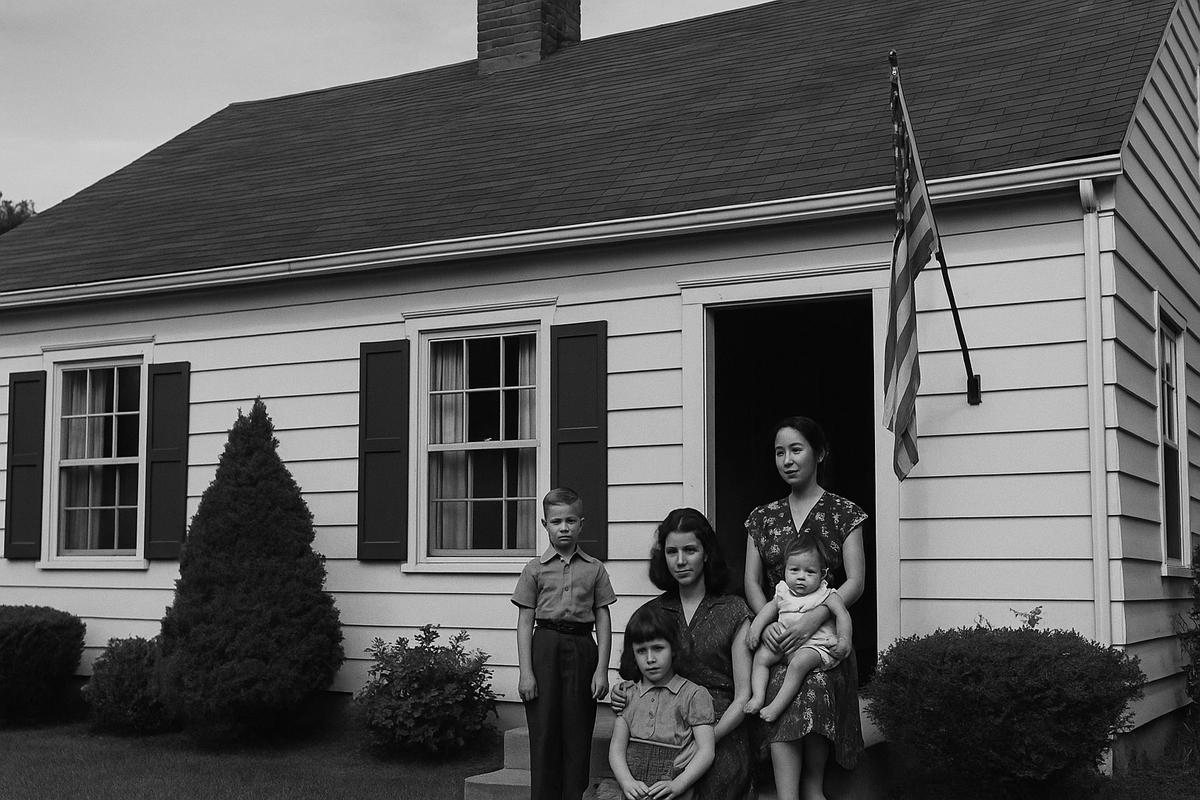
The presentation of "War Brides: Ten Years Later" was as carefully constructed as its content. Each woman's story featured "then and now" photography: wedding pictures taken in Europe or Asia, where brides in white gowns stood beside uniformed soldiers, juxtaposed with contemporary portraits in American living rooms. The visual narrative was clear—transformation, assimilation, the suburban dream realized.
But the article refused easy triumphalism. These women spoke with complexity. They praised America's opportunities while questioning its education system. They appreciated material comfort while mourning the loss of extended family structures. They had built new lives without erasing their old ones.
This editorial strategy—balancing personal narrative with broader social commentary—gave the feature its lasting power. Readers weren't just voyeurs. They were invited to compare their own marriages, parenting styles, and household adjustments against these international benchmarks.
Why It Mattered Then, Why It Matters Now
The war brides story resonated in 1955 because it crystallized several urgent cultural questions.
Marriage Across Borders
These unions symbolized America's new role as a global superpower. Every cross-cultural marriage was a small-scale experiment in international cooperation—intimate, domestic, and real.
Women's Roles
The war brides—many of whom had survived occupation, bombing, and deprivation—weren't easily contained by suburban expectations. Their voices reveal the complexity beneath the era's glossy surface.
Assimilation & Identity
A French bride faced different social pressures than a Japanese bride. The article acknowledged that postwar America was still navigating its relationship with former enemies on a deeply personal level.
Suburban Life
These women were unlikely pioneers of America's grand postwar experiment. They adapted, criticized, and ultimately helped shape what suburban America would become.
What the Archive Preserves
Unlike newspapers or ephemeral media, magazines like Ladies' Home Journal were designed to be kept, reread, and passed down. The July 1955 issue preserves multiple layers of history simultaneously.
It captures voices of negotiation—women working out their identities in real time, neither fully American nor entirely anchored to their countries of origin.
It documents mid-century aesthetics—the photography, typography, and design sensibility that defined the era's visual culture.
It records how ordinary families experienced extraordinary change—global conflict, international migration, and cultural transformation filtered through the daily routines of cooking, child-rearing, and suburban life.
Vintage women's magazines offer a direct window into history that academic texts can't replicate. They show us not only what people wore and cooked, but how they understood themselves, their marriages, and their futures. They reveal the gap between official narratives and private realities.
The Collector's Perspective
Why the July 1955 issue of Ladies' Home Journal holds exceptional value
Historical Timing
Published exactly ten years after the war's end, this issue captures the first wave of sustained reflection on the conflict's cultural impact. It's early enough to feel raw, late enough to offer perspective.
Documentary Significance
This feature offers rare sociological evidence of how international marriages functioned in practice—not theory, not propaganda, but lived experience.
Visual Record
The full-page spreads of multicultural families in American homes document mid-century domestic life with authenticity. The details—furniture, clothing, children's toys—are invaluable to historians and designers alike.
Cultural Heritage
Families preserving their own migration stories often seek original magazines like this as tangible links to the past. These aren't just collectibles. They're family artifacts.
Preserving the Story
If you're drawn to World War II history, postwar domestic life, or women's experiences of migration and assimilation, the July 1955 issue of Ladies' Home Journal isn't just a magazine. It's an artifact of cultural memory—a record of how love, war, and identity converged in the everyday lives of women who chose to build new worlds.
"War Brides: Ten Years Later" remains one of the most historically significant features ever published in Ladies' Home Journal. Through the voices of Monique, Micheline, Nori, Lullina, and Elizabeth, readers witnessed cultural blending, struggle, and triumph on a human scale. These weren't abstract political victories. They were personal ones—hard-won, imperfect, and real.
Holding this issue today means holding a piece of history. It's a record of how ordinary women navigated extraordinary circumstances, and how their choices rippled outward to shape American culture in ways that still resonate.
That's why vintage Ladies' Home Journal magazines deserve a place not only on collectors' shelves but in our ongoing conversation about women's history, migration, and what it means to build a life in a new land.
Explore the Archive
Browse our complete collection of original Ladies' Home Journal magazines and discover more stories from America's postwar transformation.
Browse Ladies' Home Journal Magazine Collection