
The Last Summer Before Everything Changed
Inside Seventeen's April 1963 Spanish Fantasy
In April 1963, American teenage girls opened their mailboxes to find something that would never exist again: a fashion magazine that still believed in innocence.
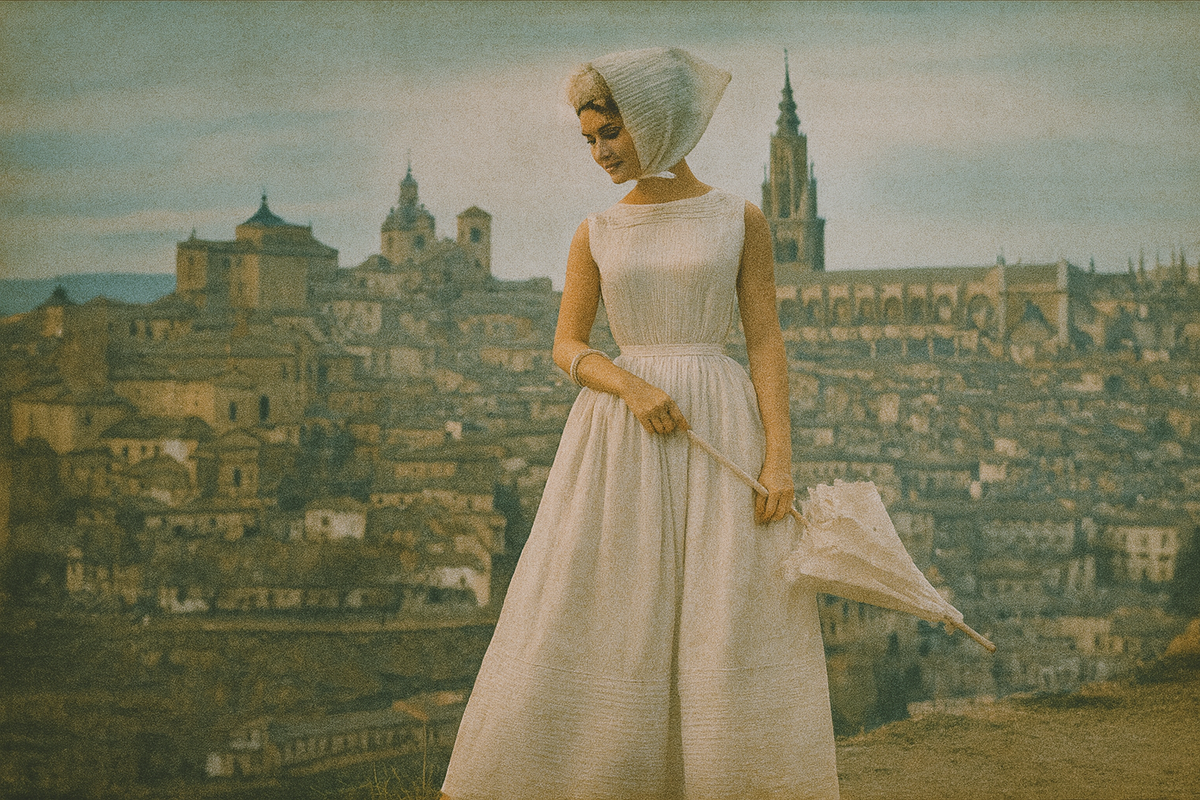
The issue of Seventeen that month contained a feature called "Fashion Speaks with a Spanish Accent"—eight pages of white cotton dresses photographed against the stone streets of Toledo and the Moorish arches of Granada's Alhambra. The models looked seventeen. The dresses cost what a babysitter could afford. And the whole spread read like a fever dream of European romance designed for girls who had never left their hometowns.
Five months later, Kennedy would be dead. A year after that, the Beatles would arrive and the whole careful architecture of American teenage girlhood would fracture. But in April 1963, Seventeen was still selling a version of youth that was wholesome, aspirational, and utterly confident in its own vision. This issue captures that world at its apex—and its unknowing edge.
Archive Details
Publication: Seventeen Magazine
Issue Date: April 1963
Featured Spread: "Fashion Speaks with a Spanish Accent"
Primary Theme: White cotton and lace summer fashion in Spanish settings
Historical Context: Final season before the British Invasion and cultural transformation of American youth
The Magazine That Taught America How to Be a Teenager
Seventeen didn't just cover teen culture. It invented it.
Founded in 1944 as the war was ending, the magazine established itself as the first publication to treat adolescence as a distinct life stage worth celebrating. While adult women's magazines focused on homemaking and Hollywood glamour, Seventeen spoke directly to girls navigating the strange territory between childhood and marriage. It offered fashion advice, beauty tutorials, college guidance, and fiction—all calibrated to the emotional reality of being fifteen, sixteen, seventeen.
By 1963, the magazine had perfected an editorial formula that blended practical guidance with aspirational storytelling. It didn't just show dresses. It showed scenes. Every fashion spread became a narrative, complete with setting, mood, and an implied storyline readers could step into. The Spanish feature was this technique at its most potent.
White Cotton and European Dreams: Anatomy of the Spread
The "Fashion Speaks with a Spanish Accent" feature opened with illustrated sketches—perforated playsuits and playdresses described as "new shapes for suntime fun." These were clothes for movement, for teenage bodies that climbed, swam, and sprawled on beach blankets.
Then came the photographs, and the shift from American practicality to European fantasy:
Toledo's Medieval Streets
Models in backless, sleeveless cotton whites posed against weathered stone and wrought-iron balconies. The caption called white "temptingly textured and beautifully bare"—copy that read more like poetry than advertising.
The Alhambra's Palatial Arches
Lace gowns photographed in Granada's most romantic setting, described as "lavish and luxurious, romantic as a kiss." These were prom dresses masquerading as travel costumes, formal wear given narrative weight by centuries-old architecture.
Granada University's Courtyard
The final scene placed a model in sparkling white cotton among troubadour students in traditional black capes. It was Seventeen's synthesis—modern American style meeting Old World tradition, youth culture validated by ancient institutions.
The Power of White
The through-line was white: white as youth, white as summer, white as a blank page waiting to be written on. For 1963, the symbolism was almost too perfect.
The Cultural Moment: Spring 1963
Teen culture in early 1963 existed in a strange pause.
Elvis was still a fixture, but his cultural dominance was fading. The Beatles were climbing British charts but hadn't yet invaded America. Movies like Rome Adventure (1962) had romanticized European travel for American audiences, creating a hunger for Continental sophistication that most teenagers could only satisfy through magazines.
Fashion itself was shifting. The structured, conservative silhouettes of the 1950s were giving way to simpler shapes—shift dresses, sheaths, A-lines. Fabrics became easier to care for. Hemlines rose slightly. The clothes anticipated the youth revolution without yet embodying it.
Seventeen captured this in-between moment perfectly. The April 1963 issue presented fashion that was modern but not rebellious, sophisticated but not inaccessible, romantic but not sexual. It was the last vision of teenage girlhood before the culture splintered into something faster, stranger, and impossible to control from a magazine editor's desk.
What Survives
Most digital media vanishes. A blog post gets deleted. A social media platform shuts down. Even websites decay.
But printed magazines endure. They sit in attics and estate sales. They get cataloged by collectors. They become primary sources for historians trying to understand how people actually lived, not just what they accomplished.
When you hold an original issue of Seventeen from April 1963, you're not just looking at fashion. You're looking at a moment when American culture still believed it could package teenage girlhood into something coherent and beautiful. When summer still meant white cotton dresses. When Spain was exotic. When growing up followed a script everyone understood.
That world ended. But the magazine remains.
Why This Issue Matters to Collectors
Historical Positioning
It sits at a cultural inflection point—the final season before the British Invasion, the last full year of Kennedy's America, the end of consensus youth culture.
Fashion Documentation
Costume designers and fashion historians use these issues as primary sources. The silhouettes, fabrics, and styling details are references for period accuracy in film, theater, and television production.
Advertising Archaeology
The original advertisements—for Noxzema, Aqua Net, department store junior sections—reveal how corporations spoke to teenage girls before youth marketing became a science.
Nostalgic Value
Women who came of age in the 1960s remember these exact pages. Owning a copy is possessing a physical artifact of their adolescence.
Scarcity
Unlike Life or Look, which were saved for their photojournalism, teen magazines were disposable. They were marked up, torn apart for bedroom collages, thrown away. Survival rate is low. Condition matters.
Editorial Excellence
The Spanish feature specifically represents Seventeen at peak editorial ambition—when the magazine still had the budget and vision to shoot fashion internationally, when it still believed that eight pages of white dresses could transport a reader somewhere she'd never been.
The Archive
Original issues of Seventeen spanning the 1940s through the 1970s are available for collectors, researchers, and anyone curious about the material culture of American youth.
Each issue is a document of its moment—not a reproduction, not a scan, but the physical artifact that teenage girls held in their hands, marked up, dreamed over, and sometimes saved for sixty years.
Browse Seventeen Magazine CollectionThe April 1963 issue of Seventeen captured American teenage girlhood at a precise moment—confident, romantic, and entirely unaware that within months, the culture would transform beyond recognition. Its Spanish fashion feature remains one of the most visually striking examples of how magazines once taught young women to dream. And for collectors, it's something rarer: proof that innocence, however manufactured, once had a magazine that believed in it completely.