
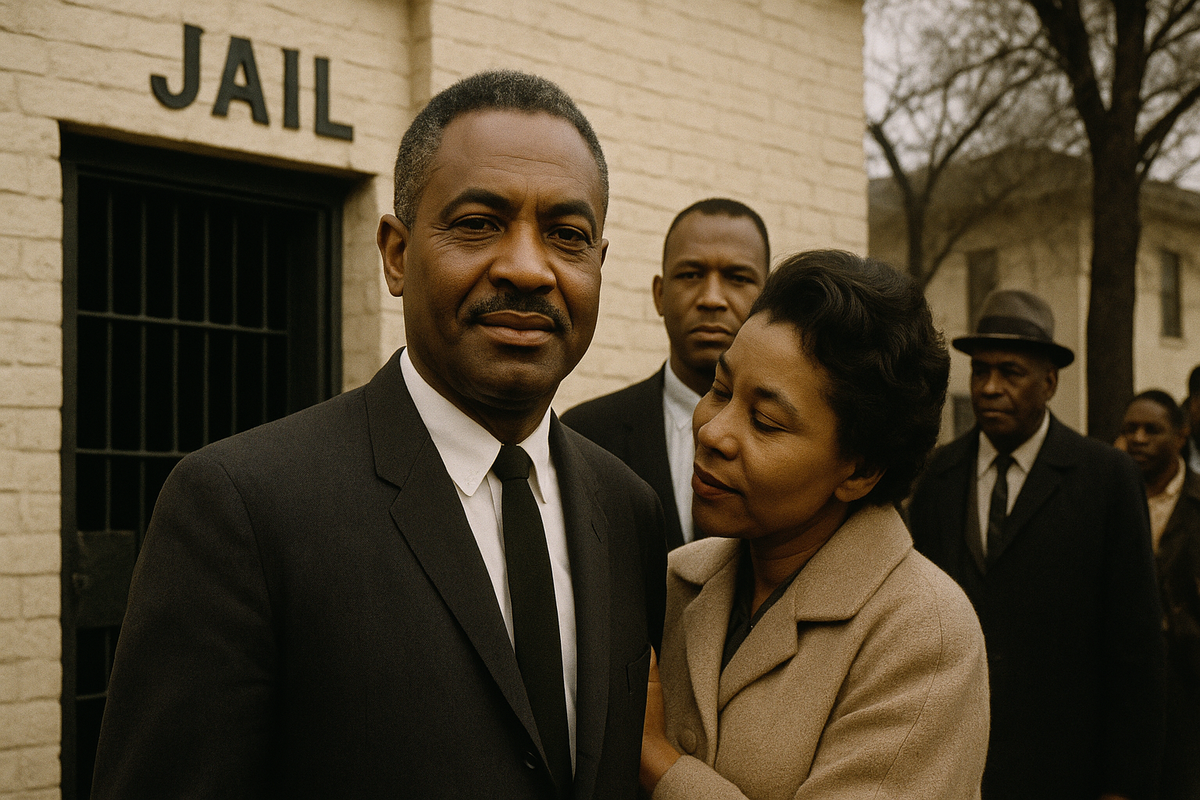
"Whites Can't Stop Us Now": When Fred Shuttlesworth Walked Out of Birmingham Jail and Into History
Inside the March 22, 1962 issue of Jet Magazine that documented resistance at its breaking point
Birmingham, Alabama, 1962. A minister emerges from 35 days of hard labor—hauling garbage cans before dawn, washing dishes until his hands crack, driving trucks through the city that tried to break him. His home has been bombed. His body has been beaten by mobs. He has lost count of his arrests.
He faces the cameras with a message that will echo across a nation on the brink: "Whites can't stop us now."
When African Americans picked up the March 22, 1962 issue of Jet Magazine that spring, they weren't just reading news. They were holding proof that the movement had found a new weapon—one the segregationists couldn't confiscate, couldn't burn, couldn't lock away. That weapon was the refusal to be broken.
This issue didn't just report on resistance. It documented what resistance costs, what it looks like in a man's eyes after five weeks of punishment designed to crush him, and why—against every brutal calculation of Jim Crow power—it was working.
Archive Details
Historical Figure: Rev. Fred L. Shuttlesworth
Issue Date: March 22, 1962
Archive Source: Jet Magazine
Historical Context: One year before the Birmingham Campaign of 1963
The City That Swore It Would Never Change
By 1962, Birmingham had earned its reputation as the most segregated city in America. Not quietly segregated—violently segregated. Schools, buses, restrooms, water fountains: all divided by law, all defended by force. The city's white power structure didn't just resist integration. It promised to destroy anyone who tried.
Rev. Fred L. Shuttlesworth, pastor and co-founder of the Southern Christian Leadership Conference, had already survived what most men wouldn't: a dynamite blast that leveled his parsonage, beatings that left him hospitalized, and a legal system that arrested him as routinely as it breathed. In late 1961, after yet another demonstration demanding basic human dignity, a judge sentenced him to 90 days of hard labor.
The punishment was designed to humiliate. The message was clear: This is what happens when you challenge us.
But Birmingham's segregationists had miscalculated. They had given Shuttlesworth time—time to plan lawsuits, time to strategize boycotts, time to sharpen the next phase of attack. And when he walked out after 35 days, he didn't emerge defeated. He emerged weaponized.
The Freedom Rides of 1961 had proven that young people were willing to bleed for change. The sit-ins had shown that students wouldn't be moved from lunch counters. But Shuttlesworth's defiance proved something the segregationists feared most: that jail itself—their ultimate tool of control—had become useless.
Why Jet Mattered in 1962
Jet Magazine wasn't performing journalism. It was performing documentation—the kind that survives courtrooms, archives, and the erosion of memory.
By 1962, Jet had become the visual record of Black America. While mainstream publications buried civil rights stories on back pages or ignored them entirely, Jet's editors understood something fundamental: people believe what they see. And what readers saw in the March 22 issue wasn't abstract. It was Fred Shuttlesworth in a dark suit, staring directly into the lens with the calm of a man who had survived hell and come back stronger.
Inside, the magazine delivered what no other publication could: intimacy. Shuttlesworth reunited with his wife. Shuttlesworth at home, surrounded by children and grandchildren after five weeks of state-sanctioned cruelty. Shuttlesworth describing 12-hour shifts that began at 5 a.m.—hauling 500 garbage cans, scrubbing dishes, driving trucks through the city that had tried to erase him.
These weren't symbols. They were receipts.
Jet gave its readers something more powerful than editorials: evidence. Evidence that the system could torture you, humiliate you, and lock you away—and still fail to stop you. For Black families debating whether to send their children to integrate schools, whether to march, whether to risk everything—this issue was fuel.
The Power of the Photograph
The cover alone was a statement. High-contrast. Unsmiling. Direct. Shuttlesworth wasn't asking for sympathy. He was announcing survival.
In an era when television was still catching up to the civil rights struggle, Jet's photography did what words couldn't: it made the movement present. The images didn't soften the story or abstract the violence. They showed exhaustion, reunion, resolve. A man who had every reason to quit—and didn't.
This wasn't magazine design. It was visual testimony. Every photograph in the March 22 issue served as evidence that would outlast any courtroom stenographer's notes. When historians later asked what the movement looked like from the inside, Jet's pages provided the answer.
What Jail Taught Shuttlesworth
The article's central revelation wasn't about suffering—it was about strategy.
Shuttlesworth described the labor in clinical detail: rising at 5 a.m., hauling hundreds of garbage cans, washing endless dishes, working until 9 p.m. But the real story was what he did with that time. He planned lawsuits against segregated hospitals. He mapped out boycotts of downtown Birmingham stores. He calculated pressure points in a system that believed itself invincible.
Jail hadn't silenced him. It had given him a laboratory.
By the time he walked out, Birmingham's white business owners were beginning to feel the sting of Black economic boycotts. Stores that had refused service to African Americans were watching their profits drain. The cracks were forming. And Shuttlesworth had spent 35 days designing the crowbar.
His declaration—"Whites can't stop us now"—wasn't bravado. It was tactical assessment. The segregationists had used their most powerful weapon. And it hadn't worked.
Shuttlesworth framed his imprisonment as proof of the movement's growing strength, declaring that white resistance had lost its power to intimidate.
Days beginning at 5 a.m., hauling 500 garbage cans, washing dishes, and working until 9 p.m.—yet he refused to be broken by the system's cruelty.
Jail gave him time to plan lawsuits against segregated hospitals, courthouses, and public facilities, turning punishment into preparation.
Boycotts of downtown Birmingham stores were beginning to succeed, showing cracks in the system of segregation that seemed unbreakable.
One Year Before Birmingham Exploded
History remembers the Birmingham Campaign of 1963: the children marching into fire hoses and police dogs, the images that shocked the world, the turning point that forced a nation to confront its sins.
But the March 22, 1962 Jet issue captures something more fragile and more crucial—the moment just before. The moment when the strategy was still forming, when the outcome was uncertain, when one man's refusal to break became the blueprint for a city-wide revolt.
This issue is a time capsule of the movement in formation. Not the triumphant history we read in textbooks, but the grinding, brutal, day-by-day work of people who didn't yet know they would win.
That uncertainty makes it more valuable, not less.
The Permanence of Print in a Disposable Age
We consume news now in bursts—scrolled past, forgotten by nightfall. But in 1962, Jet was read slowly. Studied at kitchen tables. Saved in family Bibles and dresser drawers. These magazines were treated as records because readers understood instinctively: Someone needs to remember this.
That's why original issues retain their power. They aren't reproductions or digital scans. They're physical witnesses—ink on paper, handled by people who lived through what we can only read about.
The March 22, 1962 issue still carries that charge. Open it, and you're not observing history. You're standing inside it.
Why This Issue Commands Collector Attention
Civil rights-era Jet issues were read, passed around, and worn to pieces. Surviving copies in good condition are genuinely scarce.
This issue captures Birmingham on the eve of its transformation into the epicenter of the movement. It's pre-iconography—history before it knew it was being made.
The Shuttlesworth cover ranks among Jet's most recognizable civil rights images, reproduced in museums, documentaries, and academic texts.
Unlike commemorative reprints or retrospective coverage, this was real-time journalism under threat. Jet's offices received bombs and death threats for this kind of reporting.
Beyond the cover story, the issue documents Black life in 1962—politics, entertainment, community news—making it a comprehensive snapshot of the era.
When you acquire an original copy, you're not purchasing nostalgia. You're acquiring primary-source material that belongs in the same conversation as protest signs and freedom songs.
Start Your Collection
For collectors building comprehensive civil rights archives—or families preserving the memory of those who lived this history—original Jet magazines offer unmatched authenticity.
From the 1950s through the 1970s, Jet documented every major shift in African American life: the legal battles, the cultural breakthroughs, the leaders who changed the country. Each issue is a time capsule. Each one is irreplaceable.
Browse Jet Magazine CollectionFinal Word
The March 22, 1962 issue of Jet Magazine endures because it captured a truth that couldn't be legislated away or beaten into silence: that resistance, once it reaches a certain pitch, becomes unstoppable.
Fred Shuttlesworth walked out of Birmingham City Jail and declared that the old order was finished. One year later, the world would watch Birmingham burn on television and realize he was right.
But this issue shows us something more valuable than hindsight. It shows us the moment when one man—exhausted, brutalized, unbroken—looked at the machinery of oppression and saw not power, but weakness.
That's the artifact you hold when you own this issue. Not just a magazine. A turning point in American history, preserved in ink and paper, waiting for someone to remember what it cost.