
Who Will Get the Negro Vote?
Kennedy, Nixon, and the Power of Black Ballots in 1960
The question wasn't if African Americans would vote in November 1960. The question was: which candidate understood that their votes could decide the presidency?
When Ebony Magazine published "Who Will Get the Negro Vote?" in its November 1960 issue, it wasn't making a prediction. It was issuing a challenge. To Kennedy. To Nixon. And to every Black voter who held the outcome of the closest presidential race in modern history in their hands.
This wasn't abstract political theater. In cities like Chicago, Detroit, and Philadelphia, where margins ran thin and Black populations ran deep, the outcome hung on a single demographic that both parties had historically courted with caution and taken for granted with impunity. Ebony refused to let that happen again.
The magazine's editors did something radical: they treated Black voters not as a footnote to national politics but as its pivot point.
Archive Details
Publication: Ebony Magazine
Issue Date: November 1960
Feature Article: "Who Will Get the Negro Vote?"
Historical Context: Published weeks before Kennedy defeated Nixon in one of the closest presidential elections in U.S. history
The Election That Turned on Dignity
By 1960, the Civil Rights Movement had moved from the margins to the mainstream. The Montgomery Bus Boycott had ended five years earlier, proving that organized resistance could break Jim Crow's back. Student sit-ins were spreading across the South like brushfire. Dr. Martin Luther King Jr. was no longer a regional minister—he was a national voice. And television was doing what decades of newspaper editorials couldn't: broadcasting the violence of segregation into living rooms across America.
The presidential race reflected this shift. John F. Kennedy, a Massachusetts senator barely in his forties, represented youth, change, and—despite his own cautious civil rights record—a willingness to speak directly to Black concerns. Richard Nixon, the sitting vice president, carried the weight of Eisenhower's legacy and a reputation for political calculation that left civil rights leaders wary.
The contrast wasn't just ideological. It was generational. And Ebony knew that its readers—people who had watched their parents navigate disenfranchisement and were now registering voters by the thousands—needed more than campaign slogans. They needed a reckoning.
Why Ebony's Coverage Was Different
Most national magazines in 1960 treated Black voters as a curiosity—a demographic to be analyzed from a distance, never addressed directly. Ebony flipped that script. It didn't write about African Americans. It wrote to them, and it did so with the authority of a publication that had spent fifteen years covering Black life with sophistication, pride, and editorial rigor.
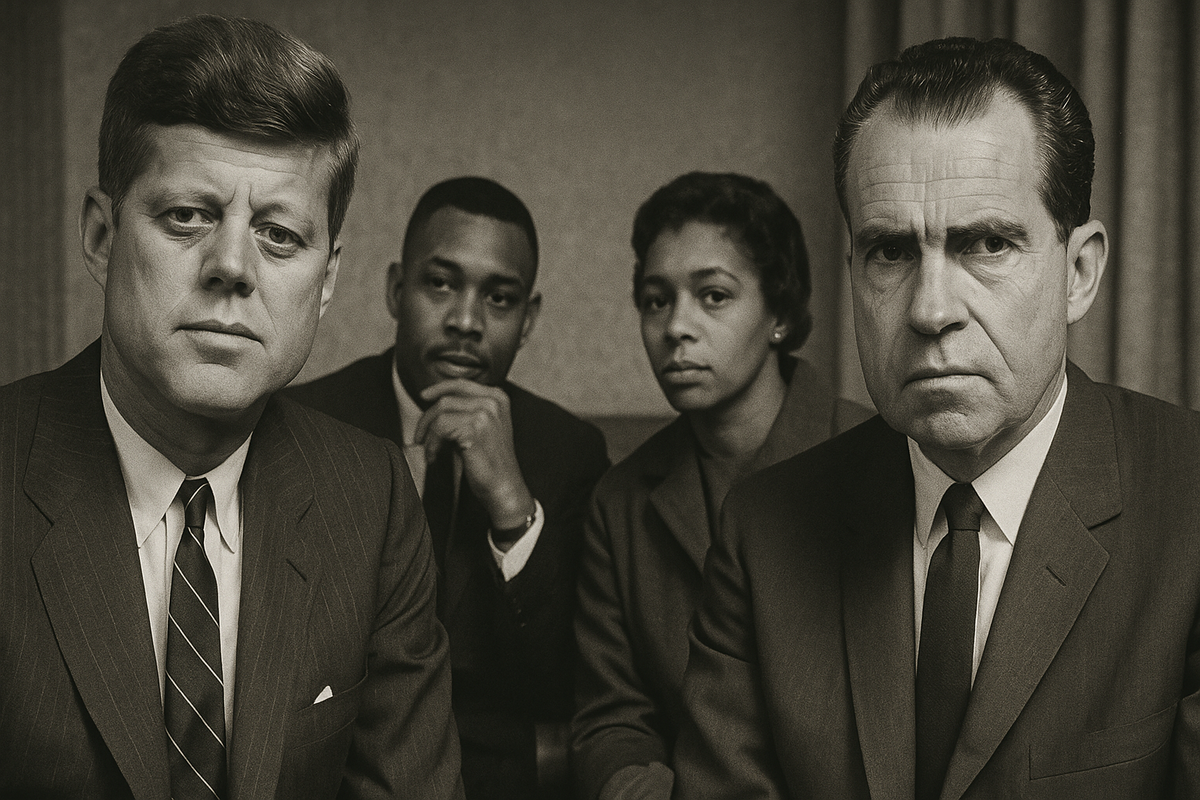
"Who Will Get the Negro Vote?" was a masterclass in political journalism. The article featured side-by-side portraits of Kennedy and Nixon—not as distant figures on a debate stage, but as men whose policies would determine whether Black families could buy homes, whether their children could attend integrated schools, whether justice would arrive in their lifetimes.
Ebony's editors dissected each candidate's record with surgical precision. Kennedy's outreach to civil rights leaders, including his now-famous phone call to Coretta Scott King after Dr. King's arrest in Georgia, was presented not as political theater but as a gesture that Black voters could—and should—measure against Nixon's more cautious approach to desegregation.
This wasn't stenography. It was guidance. Ebony was telling its readers: You are not spectators. You are the game.
The Anatomy of a Political Earthquake
The article's structure revealed its purpose. Kennedy's record was laid bare—his Senate votes, his promises, his alliances with Southern Democrats who opposed civil rights. Nixon's history as vice president was examined with equal scrutiny, noting his support for some civil rights legislation alongside his reluctance to challenge segregationists head-on.
But Ebony did something more important than fact-checking. It amplified community voices. Everyday Black voters appeared throughout the piece, weighing promises against lived realities, debating whether Kennedy's Catholicism mattered less than his willingness to listen, whether Nixon's experience could overcome his party's resistance to meaningful change.
The photography reinforced the stakes. The side-by-side images of Kennedy and Nixon weren't just visual aids—they were a call to judgment. Readers could see the men as they made their decision, could study their faces as they considered which one understood that civil rights weren't a side issue but the defining moral question of the era.
And throughout the article, Ebony drove home a single point: the Black vote in northern swing states wasn't just significant. It was decisive.
They were right. Kennedy won the popular vote by roughly 100,000 ballots. In Illinois, he won by fewer than 9,000 votes. In Michigan, the margin was 67,000. African American voters in cities like Chicago and Detroit didn't just participate in the election. They delivered it.
Key Elements of the Coverage
Kennedy's Outreach
The article detailed Kennedy's attempts to court Black voters, including his supportive phone call to Coretta Scott King after Dr. King's arrest in Georgia.
Nixon's Record
Ebony examined Nixon's track record as Vice President, noting his mixed history on civil rights legislation and cautious approach to desegregation.
Power of the Black Vote
The feature made clear that the African American vote, especially in northern swing states, could decide the election outcome.
Civil Rights as Core Issue
Ebony emphasized that for Black voters, civil rights were not a side issue but the center of their political concerns.
Side-by-Side Photography
The contrasting images of Kennedy and Nixon gave readers a visual choice, underscoring that this decision was personal and historic.
Community Voices
The article included perspectives from everyday Black voters, showcasing how citizens weighed promises against lived realities.
Why This Issue Remains Essential
Sixty-four years later, the November 1960 issue of Ebony Magazine stands as one of the most important political artifacts of the twentieth century.
It captured the moment when African American voters moved from the periphery of presidential politics to its center. It documented the strategies, the promises, and the skepticism that defined Black political engagement at the height of the Civil Rights Movement. And it did so with editorial confidence that most mainstream outlets couldn't match.
Historical Timing
Published weeks before an election that would reshape American politics, capturing the decisive role of Black voters in Kennedy's eventual victory.
Civil Rights Context
One of the first national magazines to put the African American vote at the center of presidential politics.
Photography & Design
The bold side-by-side visuals of Kennedy and Nixon remain iconic for historians of American media and political journalism.
Cultural Significance
Owning this issue means holding the same pages that African American families studied before casting votes in a landmark election.
Collector Demand
Civil Rights–era Ebony magazines are among the most sought-after for historians, educators, and families preserving heritage.
Living Archive
Represents the intersection of journalism, activism, and democracy—proof that media could be both a mirror and a lever.
Ebony's legacy extends far beyond a single election. For decades, it documented African American life with a combination of cultural pride and journalistic integrity that few publications could rival. Politics, music, sports, literature, civil rights—all of it captured in real time, with the clarity that comes from speaking to a community rather than about it.
Today, as debates over voting rights and political representation continue, these vintage issues remind us that the fight for inclusion is neither new nor finished. The November 1960 issue doesn't just tell us what happened. It shows us how democracy works when citizens refuse to be taken for granted.
The Verdict
The November 1960 issue of Ebony Magazine did what great journalism should: it informed, it challenged, and it empowered. "Who Will Get the Negro Vote?" wasn't just a headline. It was a declaration that Black voters would no longer wait for permission to shape American politics.
Kennedy won that election. But Ebony's readers won something more important: recognition that their votes—and their voices—were powerful enough to decide the future.
That lesson hasn't expired. And neither has this magazine.
Explore the Archive
Whether you're a collector building an archive, a historian researching the Civil Rights era, or someone honoring your family's legacy, these magazines are more than reading material. They are artifacts of a movement.
Browse Ebony Magazine Collection